In this article, you’ll learn how to use the Call to Action element in Thrive Architect. This element lets you insert professionally designed, pre-built call-to-action sections from the cloud template library, complete with headlines, descriptions, buttons, images, and other sub-elements.
The Call to Action element is a pure template element—it has no hardcoded options of its own. Instead, you select a complete design from the template library, and then edit each sub-element (text, buttons, images, backgrounds) individually using standard Thrive Architect controls.
What Is the Call to Action Element?
The Call to Action (CTA) element provides ready-made sections designed to drive a specific visitor action—such as signing up, purchasing, or clicking through to another page. Rather than building a CTA from scratch with individual elements, you choose a professionally designed template and customize the content.
Key characteristics of the Call to Action element:
- It is a cloud template element, meaning its designs are hosted in the Thrive Themes template library
- It has no hardcoded main options of its own—all controls come from the individual sub-elements within the selected template
- After inserting a template, the CTA becomes a container of standard elements (text, buttons, images, icons, and more) that you can edit individually
- Templates include a variety of layouts optimized for different conversion goals
Adding the Call to Action Element to a Page
Follow these steps to add a Call to Action section to your page:
- Open your page or post in the Thrive Architect editor.
- Click the green plus (+) icon in the right sidebar to open the element panel.
- Type Call to Action in the search field at the top of the panel.
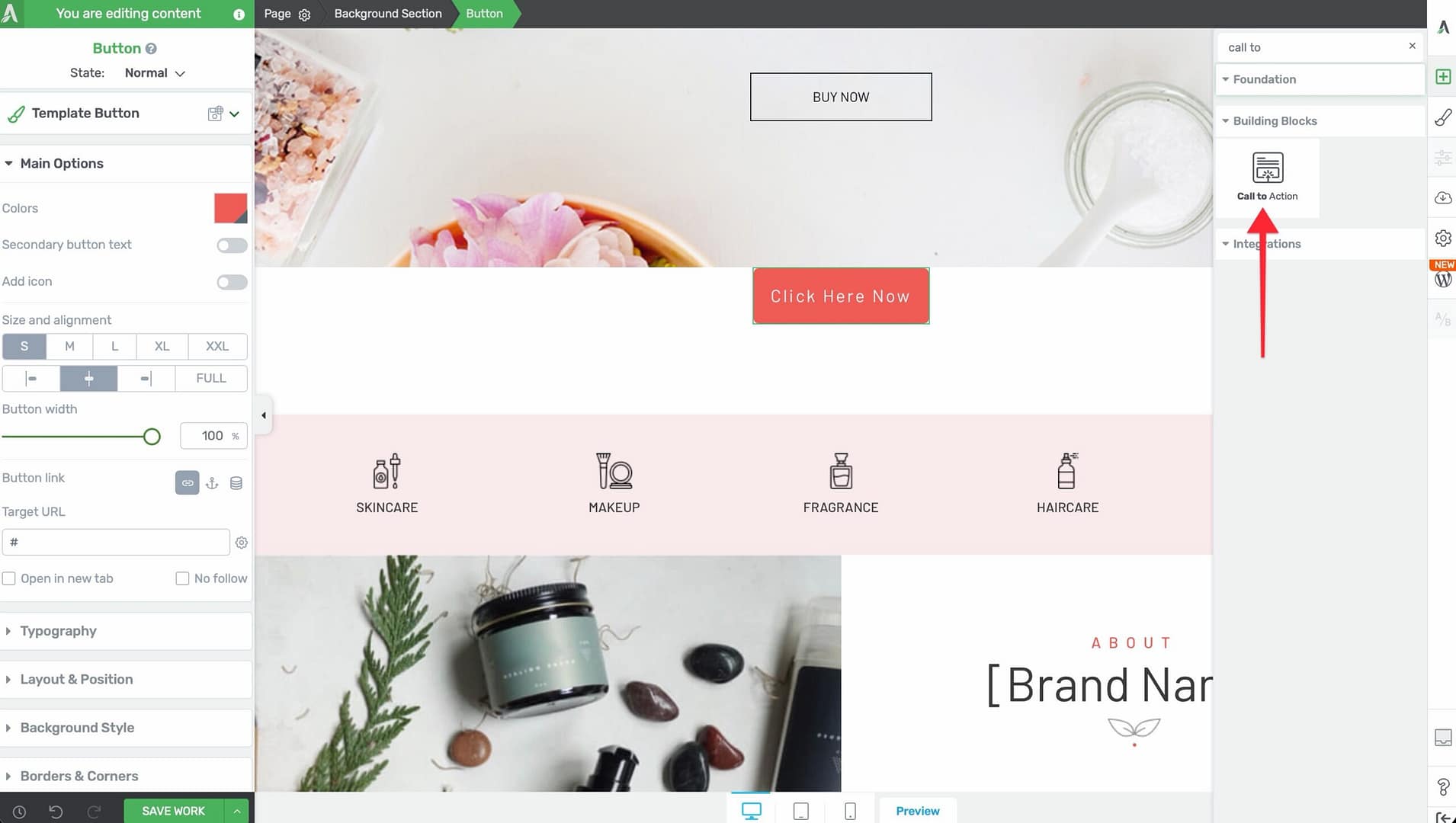
- Alternatively, scroll down to the Building Blocks section in the element list to find the Call to Action element.
- Drag the element from the panel and drop it onto your page canvas.
An Insert Call to Action placeholder will appear on the canvas. This placeholder indicates that you need to select a template before the element displays any content.
Selecting a Call to Action Template
After adding the placeholder to your page, you need to choose a template:

- Click on the Insert Call to Action placeholder on the canvas.
- The cloud template library will open, displaying a gallery of available CTA designs.
- Browse through the templates or use the search and category filters to narrow down your options.
- Click on a template to preview it.
- Click Insert (or double-click the template) to add it to your page.
The selected template will replace the placeholder on your canvas, and you’ll see the fully designed CTA section with all its elements in place.
Editing the Contents of a Call to Action
Once you’ve inserted a CTA template, you can customize every element inside it using standard Thrive Architect controls.
Editing Headlines and Text
- Click on any text or headline element within the CTA.
- The text formatting toolbar will appear, allowing you to change fonts, sizes, colors, and alignment.
- Type directly to replace the placeholder text with your own message.
Replacing Images
- Click on an image element within the CTA.
- In the left sidebar, click Replace Image or use the image options to upload a new image or select one from your media library.
- Adjust the image size, alignment, and alt text as needed.
Customizing Buttons
- Click on any button element within the CTA.
- Use the left sidebar options to change the button text, link destination, colors, size, and icon.
- Configure the button link to point to your desired destination (sales page, signup form, product page, and so on).
Adjusting the Layout and Background
- Click on the background section or column structure within the CTA.
- Use the standard layout controls to adjust padding, margins, column widths, and background settings.
- Change background colors, gradients, or images to match your brand.
Using Call to Action Sections as Guarantee Boxes
One powerful use case for the Call to Action element is creating guarantee boxes—sections that reassure visitors about risk-free purchases, money-back guarantees, or satisfaction promises.
To create a guarantee box using the CTA element:
- Add a Call to Action element to your page and select a template with a clean, trust-focused layout.
- Replace the headline text with your guarantee statement (for example, “100% Money-Back Guarantee”).
- Replace the description text with the details of your guarantee policy.
- Optionally replace the image with a guarantee badge, seal, or trust icon.
- If the template includes a button, either customize it as a link to your terms or remove it if your guarantee section is purely informational.
Displaying Call to Action Sections Based on Login Status
You can use Thrive Architect’s conditional display features to show different CTA sections to logged-in and logged-out visitors. This is useful for:
- Showing a “Sign Up” CTA to visitors who are not logged in
- Showing a “Go to Dashboard” or “Upgrade” CTA to logged-in users
- Hiding promotional sections from existing customers
To set up conditional display on a CTA:
- Select the CTA element (or its parent container) on the canvas.
- Look for the Conditional Display or Visibility options in the left sidebar or right-click context menu.
- Set the display condition to show the element only to Logged In or Not Logged In visitors.
- Create a second CTA with the alternate content and apply the opposite visibility condition.
Common Use Cases
Sales Page CTA
Place a CTA section at the top and bottom of a sales page with a compelling headline, benefit-focused description, and a prominent purchase button.
Email Opt-In CTA
Use a CTA template with a form-style layout to encourage visitors to subscribe to your email list. Pair it with a Lead Generation element inside the CTA for full form functionality.
Webinar Registration
Insert a CTA section that highlights the webinar topic, date, and time, with a registration button that links to your signup page.
Content Upgrade
Add a CTA within a blog post to offer a downloadable resource (checklist, template, or guide) in exchange for an email address.
Frequently Asked Questions
Can I Change the Template After Inserting a CTA?
No. Once you insert a CTA template, it becomes a collection of standard Thrive Architect elements on your canvas. To use a different template, delete the current CTA and add a new one.
Does the CTA Element Have Its Own Design Options?
No. The Call to Action element is a pure template element with no hardcoded options. All design controls come from the individual sub-elements (text, buttons, images, backgrounds) within the selected template.
Can I Save a Customized CTA as a Template?
Yes. After customizing a CTA section, you can save it as a content template for reuse. Right-click the CTA container element, select Save as Template, and give it a name. It will then be available in your saved templates for future use.
Are CTA Templates Responsive?
Yes. CTA templates from the cloud library are designed to be responsive. They will adapt to different screen sizes automatically. You can further fine-tune the responsive behavior using Thrive Architect’s device-specific editing controls.
Related Resources
- Buttons: How to Use the Button Element — Customize individual buttons within your CTA
- Lead Generation: How to Use the Lead Generation Element — Add opt-in forms inside CTA sections
- Background Sections: How to Use the Background Section Element — Full-width backgrounds for CTA sections
- Styled Box: How to Use the Styled Box Element — Another template-based building block element
That’s it! You’ve successfully learned how to use the Call to Action element in Thrive Architect. By selecting a pre-designed template and customizing the sub-elements, you can quickly add high-converting CTA sections, guarantee boxes, and conditional-display promotions to your pages.