


TL;DR: How to Get Membership Models Right
Most people treat a membership model like a pricing strategy. That's why they fail. A successful membership is a business architecture designed for retention, not just acquisition.
This guide moves you past the hype and gives you the strategic framework to build a predictable, durable revenue stream that aligns with your bandwidth and delivers continuous transformation for your members.
Key Takeaways for the Strategic Skimmer:
- A Membership is a Relationship, Not a Transaction: Design your model for connection and continuous transformation, or churn will silently kill your business.
- Match Your Model to Your Bandwidth: Use the Effort–Value Map to ensure your chosen structure doesn't make you the bottleneck. If you only have 5 hours a week, don't choose a high-touch Community model.
- The First 72 Hours Determine LTV: Focus obsessively on delivering a quick, tangible win within the first three days of a member signing up.
If you're serious about building a business that lasts, you'll want to read the full guide—especially the Decision Framework section.
When I talk to business owners about membership models, the immediate thought is usually predictable, recurring revenue. And who doesn't want that? The promise of a stable monthly income stream is incredibly attractive, whether you’re a solo creator or a growing enterprise.
But here is the messy reality I see every day:
Most people approach membership models like a pricing strategy, not a business architecture. They focus on the launch and the price tag, only to be blindsided by the churn reports six months later.
I wrote this guide because I believe a successful membership isn't about having the most content; it's about building a system that consistently delivers transformation and connection. If you're ready to move past the hype and architect a durable, profitable membership business, you’re in the right place.
We're going to clarify the confusion, identify the model that fits your operational reality, and give you a practical framework for building it—starting today.
If you're just starting out and need the full roadmap, we've got a comprehensive guide on How to Start a Membership Business that breaks down the essentials.
What Are the Pros and Cons of Membership Models in Business?
Before we dive into the specific structures, it helps to understand why we pursue membership models in the first place, and what the non-negotiable costs are. Running a membership is a strategic choice, and you need to go into it with eyes wide open.
Pros and Cons of Membership Models in Business
Strategic Advantages (Pros)
Operational Challenges (Cons)
What Are Key Benefits of Different Membership Models for My Business?
A well-designed membership model changes the fundamental economics of your business, shifting you from a transactional relationship to a long-term partnership with your customers.
Predictable Revenue and Stability
This is the obvious one, but it’s worth repeating. Knowing that a percentage of your revenue is guaranteed each month lets you plan, hire, and invest with confidence. It smooths out the peaks and valleys that plague businesses reliant on one-off launches. This stability is the core reason we build these systems.
Higher Customer Lifetime Value (CLV)
By design, a membership model maximizes the value of every customer you acquire. Instead of earning $99 once from a course sale, you earn $19/month for 18 months, dramatically increasing the return on your marketing investment.
Community-Driven Feedback Loop
When customers are paying you monthly, they are invested in your success. A membership community becomes the best focus group you could ever ask for. They tell you exactly what features to build, what content they need next, and where your product is falling short. This continuous feedback loop ensures your product stays relevant.
Built-in Market Defense
It’s easy for a competitor to copy a single product. It’s incredibly difficult for them to copy a thriving, high-retention membership community. The combination of your unique content, your specific community culture, and the network effect of your members creates a powerful competitive moat.
What Are the Major Challenges to Overcome?
If membership models were easy, everyone would have one. They introduce specific operational demands that often surprise business owners coming from a purely product-based background.
The Relentless Demand for Novelty
The biggest challenge is content fatigue—yours and the member’s. You must continuously justify the monthly fee. This requires a commitment to ongoing creation, updates, or facilitation. If you stop adding value, the member will stop paying. This is why choosing a model that aligns with your bandwidth is critical.
High Churn Risk
Churn is the silent killer of membership businesses. If you have a 5% monthly churn rate, you lose over 45% of your members in a year. You are constantly running just to stay in place. This requires an obsessive focus on retention strategies, especially during the first 90 days of a member's journey.
Technical and Operational Overhead
A membership requires more moving parts than a simple e-commerce store. You need a robust system for managing recurring payments, handling access permissions (who sees what content?), managing failed payments (dunning), and integrating a community platform. If your tech stack isn't solid and automated, you’ll spend all your time on admin instead of creation.
Shifting the Marketing Mindset
You can’t market a membership like a one-time product. You aren't selling a conclusion; you are selling a continuous process. This means your marketing needs to focus less on the initial "big win" and more on the long-term transformation, the community gravity, and the rhythm of ongoing value.
If you're still in the early stages of setup, our Ultimate Guide on How to Create a Membership Site on WordPress walks you through the technical steps.
The Big Picture: What Membership Models Really Are
A successful membership model is not just a recurring billing schedule. It is a business system designed to solve a specific, ongoing problem for a defined audience, creating predictable revenue for you and predictable transformation for your members.
The core mistake people make is confusing a subscription with a membership.
A subscription is a transaction. You pay for access to a thing (like streaming video or a monthly box). The value exchange is purely transactional.
A membership is a relationship. You pay for access to a community, a continuous process, or an ongoing identity. The value is rooted in the long-term journey, the community gravity, and the sense of belonging.
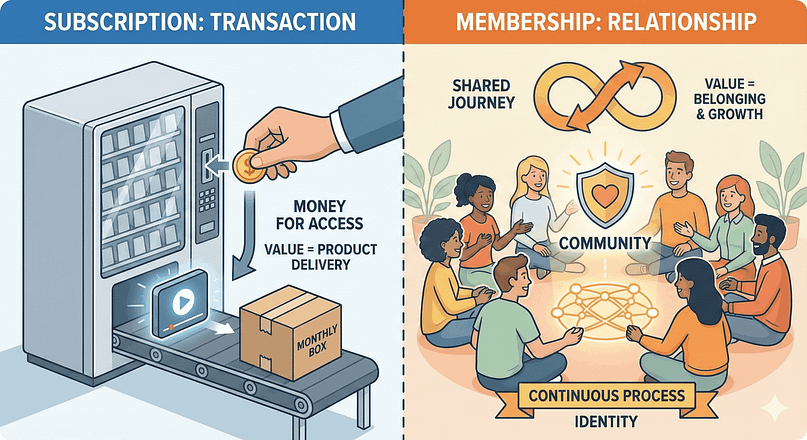
If you design for the transaction, you get high churn. If you design for the relationship, you build a durable business.
Why Most Membership Models Fail
I’ve analyzed hundreds of membership businesses, and the failures almost always boil down to three strategic missteps:
- They Copy Competitors: They look at what the biggest player in their niche is doing and assume that model will work for them, ignoring that competitor’s decade of brand equity, team size, and existing audience.
- They Design for Acquisition, Not Retention: The entire structure is optimized to get the initial sign-up (free trials, huge content dumps) but lacks the mechanisms to keep people engaged past the first 30 days.
- They Overestimate Their Bandwidth: They choose a high-touch model (like live coaching or a hyper-active community) that requires 40 hours a week, while they only have 5 hours to spare.
A membership model’s real purpose is to provide operational scalability and long-term transformation. If your model makes you the bottleneck, it will fail.
The 7 Core Membership Models (Explained Practically)
These are the fundamental structures you can use to build your membership. Remember, you don't have to pick just one—the most durable businesses use a hybrid approach.
1. Drip Model
This is where content is released on a schedule (e.g., one module a week or one lesson every three days).
2. All-In Access Model (The Library)
The member pays a recurring fee for immediate access to everything you’ve ever created.
- Great For: Large, established content libraries or audiences who value choice and speed.
- The Problem: Without a strong community or a clear path, members often feel overwhelmed and churn out quickly. Access alone isn't enough; you need guidance.
- The Fix: Use dynamic tools like Conditional Display in Thrive Architect to show personalized content paths or "What's Next" suggestions based on their behavior, cutting through the noise.
3. Course-Based Model (Evergreen or Cohort)
The membership is structured around a single, high-value course or a series of courses designed to achieve a clear transformation.
- Great For: High perceived value and clear marketing messaging. People buy transformation, not access.
- The Strategy: The retention lever here is the clear, measurable result. If they get the result, they stay for the next course or the advanced community.
4. Community Model
The primary value is the people, the connection, and the support, not the content library.
- Great For: Businesses where the members themselves are the product (in a good way). Think masterminds or peer-to-peer support groups.
- The Strategy: This is the hardest model to copy and the strongest for long-term retention, but it requires consistent moderation and facilitation to keep the energy high. You need to build "micro-engagement loops" (small, frequent interactions) using tools like private forums or dedicated discussion areas.
5. Fixed-Term Model
The membership has a clear start and end date (e.g., "The 90-Day Reset").
- Great For: Audiences who need structure and deadlines. It’s often easier to sell a 12-week commitment than an indefinite one.
- The Strategy: Use progress bars, milestones, and certification-style tagging to reinforce the member's journey and prove they completed the transformation.
6. Product Model
The recurring fee grants access to a digital product, software, templates, or resources that are continuously updated.
- Great For: Highly scalable businesses (like Thrive Suite itself). The value is utility and continuous improvement.
- The Strategy: Focus on feature velocity and customer support. The moment the product stops solving their problem, they leave.
7. Hybrid Model
This combines elements of two or more models—for example, a Drip Course + a Gated Community.
- The Strategy: My research shows the Hybrid Model is the most durable long-term structure. It allows you to mix the high perceived value of a course with the high retention of a community. You can use Thrive Suite to seamlessly blend course delivery, controlled drip release, and a private community experience all under one roof.
The 7 Core Membership Models
The 7 Core Membership Models Summary
Model | What Members Actually Get | Works Best When… | Why People Stay | Common Pitfall |
|---|---|---|---|---|
Drip Model | Lessons released gradually over time | Members need guidance and structure | They feel progress and momentum | Value feels slow if the payoff isn’t clear |
All-In Access (Library) | Everything at once | You have a big content library | Depth and choice feel valuable | Members feel overwhelmed and leave |
Course-Based Model | A clear start-to-finish transformation | You’re selling a specific outcome | They get real results | Churn after the result is reached |
Community Model | Access to people, discussion, support | The members learn from each other | Relationships create stickiness | Needs active moderation to stay alive |
Fixed-Term Model | A defined program with an end date | Members want deadlines and focus | Clear milestones keep them engaged | No built-in long-term retention |
Product Model | A tool, templates, or resources that evolve | The product solves an ongoing problem | Utility improves over time | Churn if updates slow down |
Hybrid Model | A mix (e.g. course + community) | You want long-term stability | Multiple reasons to stay | Can feel messy if not well-designed |
Applying the Models: Matching Your Model to Your Organizational Archetype
Before you even look at pricing or content structure, you need to identify your operational identity. The right model for a nonprofit is wildly different from the right model for a software company.
These four archetypes define your core mission and audience needs. Aligning your chosen membership model (from the 7 above) with your archetype is the secret to reducing friction and increasing retention.
Membership Archetypes and Best Models
Archetype | Core Value Proposition | Primary Retention Lever | Best Membership Models |
|---|---|---|---|
Clubs & Access | Exclusivity, physical access, habit | Proximity, habit, social connection | Community, All-In Access, Fixed-Term (for challenges) |
Associations | Status, accreditation, connection | Professional necessity, career advancement | Community, Course-Based (for certification), Fixed-Term (for cohorts) |
Nonprofits | Mission alignment, advocacy, impact | Emotional connection, shared values | Community, Fixed-Term (for campaigns), All-In Access (for resources) |
Commercial/Digital | Utility, speed, ongoing results | Continuous transformation, novelty, community | Hybrid (Drip + Community), Product, All-In Access (with strong guidance) |
If you are a commercial creator building a digital product, you need a model that maximizes utility and speed. Trying to run a digital course business like a professional association (heavy on accreditation, light on practical tools) is a recipe for member confusion.
The Decision Framework: How to Pick the Right Membership Model
Don't choose your model based on what sounds cool. Choose it based on your goals, your audience's needs, and your available energy.
1. The Effort–Value Map: Balancing Your Inputs and Their Outcomes
This map helps you balance what you have to give against what the member receives. It’s a crucial step in preventing founder burnout and member overwhelm.
Effort–Value Map for Membership Models
Model Type | Your Effort (Setup) | Your Effort (Ongoing) | Member Value (Perceived) | Member Value (Actual) |
|---|---|---|---|---|
All-In Library | High (Content Dump) | Low (Maintenance) | High | Low (Overwhelm) |
Drip Course | Medium | Medium (Support) | Medium | High (Pacing) |
Community | Low (Content) | High (Facilitation) | Medium | High (Connection) |
Hybrid | High | Medium/High | High | High (Best of both) |
If you have a small team or limited time, you should lean toward models that require lower ongoing effort from you, like a Drip or Product model. If your unique skill is facilitation and connection, lean into the Community model. The goal is to move your model toward the High Actual Value quadrant without pushing your Ongoing Effort into the unsustainable zone.
2. The Four Non-Negotiables for a Thrive-Powered Membership Model
Before you commit, run your proposed model through these four checks. If your model fails even one of these, you need to revise the structure.
The Retention Litmus Test
- Can this model deliver quick wins within the first 48 hours? If a member has to spend a week reading onboarding documents before getting value, you’ve failed the retention test. The first interaction must provide immediate, tangible benefit.
- Can your tech stack automate 80% of delivery? If you are manually adding people to forums or sending welcome emails, your model is not scalable. Your tools (like Thrive Automator and Apprentice) should handle the heavy lifting of access, tagging, and follow-up.
- Does it create repeatable transformation, not just one-off information? The value must renew every month. If they learn everything they need in month one, they will cancel in month two. The model must have a continuous learning or utility loop.
- Does it give you at least 2 opportunities for conversion upgrades? A good model is a ladder. It should naturally lead members to higher-tier coaching, events, or advanced products. Your entry point should be designed to build trust for the next sale.
3. Model-Selector Prompts
If you’re still torn, use these prompts to guide your decision:
- Choose Drip if your value depends on guiding the member through a specific sequence.
- Choose Community if your audience's biggest challenge is isolation or accountability.
- Choose Fixed-Term if your audience needs a clear deadline and structure to take action.
- Choose Hybrid if you want the highest long-term retention and lifetime value (LTV).
Pricing: The Most Misunderstood Part of Membership Models
Pricing is not about what you need to earn; it’s about the value you deliver and the psychology of your buyer.
Value-Based vs. Ability-to-Pay
Value-Based Pricing is the gold standard for most commercial memberships. You price the offer based on the economic or emotional value the member receives. Example: If my course helps you save $10,000 in taxes, a $1,000 annual fee is a steal.
Ability-to-Pay Pricing is often used by associations, nonprofits, or government organizations. The price is set based on the member's capacity (e.g., student rate, small business rate, enterprise rate). This promotes inclusivity and sustainability for mission-driven organizations.
Flat Rate vs. Tiered Pricing
Most successful membership models use tiered pricing because it lets power users self-select into higher value (and higher price) tiers, maximizing your revenue without alienating budget-conscious members.
Tiered Pricing Strategy
Tier | Focus | Key Value | Pricing Psychology |
|---|---|---|---|
Good (Entry) | Access | Content library, basic tools | Low barrier to entry, volume play. |
Better (Standard) | Transformation | Core course, limited community access | The target tier, balancing features and price. |
Best (Premium) | Connection | Live coaching, private community, 1:1 support | High LTV, high-touch, maximizes revenue. |
Part of designing that durable business means structuring your pricing smartly; we have a great article on Membership Tiers That Captivate & Convert if you need inspiration.
How to Avoid Undervaluing Your Offer
The biggest mistake I see is pricing too low. When you price low, you attract members who are less committed and more likely to churn.
A higher price point signals higher quality and attracts members who are serious about getting results. Don't be afraid to let power users self-select into your premium tiers—they are often your best customers and most active community members.
Retention: The Real Battle in Membership Models
Retention starts the moment they click "Buy." If you are conversion-obsessed (and you should be), you must be equally retention-obsessed.
First 72 Hours = Lifetime Value
The first three days of a membership are disproportionately important. This is where you prove the value and build momentum.
Your onboarding must focus on three things:
- Quick Wins: What is the fastest, easiest result they can get? (e.g., "Download this template," "Complete this 5-minute audit.")
- Personalized Path: Don't dump them into the library. Use an automated onboarding sequence to ask them what they need and direct them to the precise content.
- Instant Community Integration: Get them to introduce themselves or ask a question immediately. This moves them from being a consumer to a participant.
Engagement Loops
Retention is maintained through predictable, high-value engagement loops. You need a rhythm that keeps them coming back without overwhelming them.
Membership Engagement Loops
Loop Frequency | Purpose | Example |
|---|---|---|
Weekly | Habit Building | Weekly live Q&A, new template release, "What I'm Working On" thread. |
Monthly | Milestone Setting | Monthly challenge, guest expert workshop, progress check-in survey. |
Milestone | Transformation | Certification upon course completion, badge for 6 months of participation, upgrade path after 1 year. |
To keep that focus group active and happy, you need fresh ideas, which is why we gathered over 25+ Membership Engagement Ideas: How to Turn Members Into Superfans.
And If you want to keep your superfans, you absolutely need to nail your Membership Engagement Strategy from day one.
The Launch Blueprint: Validating and Scaling Your Founding Members
You don't launch a full-scale membership. You launch a minimum viable product (MVP) to a small group of founding members.
Step 1: Define Your MVP Value
What is the single, most valuable thing your membership delivers? For founding members, focus on one core course or one core community function.
Defining that and your specific audience is crucial, and our guide on Niche Marketing Strategies can help you stand out by serving them better than anyone else.
Step 2: Set the Founding Member Terms
Founding members get a lower price, but in exchange, they agree to provide detailed feedback, act as beta testers, and give testimonials. This is a value exchange, not a discount.
Step 3: Build the Core Offer
Use Thrive Apprentice to build out the first 2-3 modules of your course or the structure of your community forum. Focus on clarity and completion, not volume.
Step 4: Launch the Beta
Invite 10–50 people. Do not automate anything yet. Manually onboard them, check in frequently, and collect feedback daily. You are stress-testing the model, not the technology.
Step 5: Iterate and Automate
Once the founding members confirm the model delivers the promised transformation, then you automate the onboarding, build the full library, and scale the marketing.
Choosing Your Membership Tech Stack: Platforms and Tools
Before you start building, you need to decide where your membership will live. The platform you choose dictates your flexibility, your costs, and your long-term scalability. This decision is less about features and more about control.
Broadly, you have two main categories of membership platforms:
1. All-in-One SaaS Solutions (e.g., Kajabi, Teachable, Mighty Networks)
These platforms provide a fully hosted environment for your content, payments, and sometimes community.
- Pros: Extremely easy setup, minimal technical maintenance, everything works out of the box.
- Cons: High monthly fees (often scaling with your revenue), limited design control, you are locked into their feature set and their branding. You don't own the platform; you rent space on it.
2. CMS/Plugin Solutions (e.g., WordPress with Thrive Suite, MemberPress, Paid Memberships Pro)
These solutions use a Content Management System (like WordPress) that you host yourself and add specialized plugins to handle the membership functionality.
- Pros: Full ownership and control over your data, design, and branding. Infinite flexibility to integrate with any tool (CRM, email provider) using automation. Lower operating costs once set up.
- Cons: Requires slightly more technical setup, and you are responsible for hosting and maintenance.
This is often where people start wondering about platform choice, so we broke down the pros and cons of SaaS vs. WordPress for building your business.
Why Control Matters for Durable Membership Models
If your goal is to build a durable, high-LTV business, you need the flexibility to adapt your membership model as your audience evolves. A locked-down SaaS platform makes it difficult to implement sophisticated hybrid models, complex tiered access, or deep automation sequences.
This is why I recommend building on a platform you own, like WordPress. It allows you to use a powerful, integrated toolset like Thrive Suite, which gives you the course delivery and access restriction (Apprentice), marketing pages (Thrive Architect), lead generation and personalization (Leads and Quiz Builder), and so much more all under one roof, ensuring seamless member experience and maximum control over your business architecture.
Choosing the right tools is half the battle, so make sure you read our comparison of Membership Site Platforms Compared: How to Find Your Exact Match before committing.
Step-by-Step: How to Build Your Membership Model in WordPress
One of the greatest advantages of using a platform like WordPress with Thrive Suite is that you can test and pivot between membership models without migrating your entire site.
Here is a clean, beginner-friendly path to building your system:
Step 1: Clarify Your Model and Archetype
Decide on your core model (e.g., Hybrid: Drip Course + Community) and confirm it aligns with your organizational archetype (e.g., Commercial/Digital).
Step 2: Map Your Benefit–Effort Matrix
Use the table above to confirm you have the bandwidth for the ongoing effort required by your chosen model.
Step 3: Build Your Core Offer in Thrive Apprentice
Apprentice is designed for structured learning. Create your first course, mapping out the modules and lessons that deliver the quick wins. (If you're thinking about using that tool, you might want to check out my full Thrive Apprentice Review where I tested it like a first-time buyer.)
Step 4: Add Drip, Progress, or Community Features
Use the built-in features of Apprentice to set up your drip schedule or add progress tracking. Integrate a private forum solution (like a gated Slack channel or a dedicated forum plugin) and protect the access using Thrive's access restrictions.
Step 5: Create Tiered or Flat Pricing Pages Use Thrive Architect to design dedicated sales pages for your different tiers. Use Conditional Display to show different testimonials or feature lists based on the tier you are promoting.
Step 6: Build Retention Loops Set up automated welcome sequences using your email provider and use Thrive Automator to tag members based on their course progress, triggering personalized follow-up emails that encourage them to return.
Step 7: Launch a Founding Member Beta Start small, gather data, and prove the model works before you scale.
Conclusion: Membership Models Are Living Systems
A membership model isn’t something you launch, celebrate, and walk away from. It’s a living system — one that needs structure, feedback, and intentional design to actually work long term.
The real goal isn’t the signup. It’s creating a setup where members want to stay because they’re making progress, seeing results, and feeling like they’re part of something that keeps moving forward.
That’s why the most successful memberships don’t obsess over content volume. They obsess over:
- how new members are onboarded,
- how value is delivered in the first few days,
- and how everything connects into a clear, ongoing journey.
When your model aligns with your real bandwidth — and your tools support retention, not just access — you stop chasing the next launch just to keep revenue stable. You move into predictable, recurring growth instead.
And this is where the right platform makes all the difference.
The Integrated Solution for Durable Growth
Thrive Suite is built for membership businesses that want to last.
Not just courses. Not just communities. Complete, conversion-focused systems.
With Thrive Suite, you can:
- Structure and drip content intentionally with Thrive Apprentice
- Design guided member journeys and “what’s next” paths using Thrive Architect
- Reinforce progress, momentum, and engagement across your entire site
- Build everything inside WordPress — without duct-taping tools together
Instead of fighting your tech stack, you’re designing a membership that actually supports how people learn, engage, and stay.
You already have the framework.
You already know the models.
The next smart move is choosing your archetype — and building the first version of your membership with tools designed to grow with you, not hold you back.


