


TL;DR: How to Create a Membership Site in WordPress, Shown on a Real Demo Club
To create a membership site in WordPress, you need a membership plugin that can protect your content and take recurring payments. I'm using Thrive Apprentice here, on a demo membership I built for this guide, and the whole build comes down to twelve steps:
- Install Thrive Apprentice: through Thrive Product Manager
- Create your members-only content: a course, plus a post category that keeps growing
- Turn that content into products: one product per membership tier
- Drip the course out: so a new week opens every seven days
- Take payments: with Stripe, PayPal or Square, right inside Thrive Apprentice
- Brand your course pages: Thrive Apprentice has its own logo, colors and menus
- Build a header that knows who's logged in: different menu items for visitors and members
- Create the Members Area page: where members find everything they've paid for
- Set up the login page: and point its sign-up link at your sales page
- Decide what non-members see: with access restriction rules
- Build the sales page: and connect its buttons to your checkout
- Test it as a member: before anyone pays you
Most of the clicking happens in steps 2 to 5. Step 12 is the one I'd never skip, because it's where you find out whether everything works the way a member will see it.
If you're here, you probably want to get paid every month for what you know, instead of starting from zero with every new client or every new launch. A membership site does exactly that: people pay you monthly or yearly to keep getting your content, your structure and your support.
The first time I had to create a membership site was for one of my early fitness clients, mid-pandemic, and I was nervous.
It felt like a huge leap from designing a simple website. This was a full-blown subscription-based setup with members-only content, gated videos, recurring payments, a whole new level of digital strategy.
I got through it. It wasn't flawless, and looking back, I'd do a few things differently. But six years later, building online membership platforms is second nature, and I've seen how powerful they can be for coaches, creators, and small business owners looking to grow their audience and monetize their content more sustainably.
So for this guide, I built something close to that first site: a home workout membership called the Living Room Strength Club. It has two tiers, a four-week course that unlocks one week at a time, weekly workout posts for members, a replay library only the top tier can open, and a header that changes when you log in. Every screenshot below comes from that build, so you can see what each step looks like once it's done.
Memberships Still Pay, Even Now That AI Answers Questions for Free
It's fair to wonder whether anyone still pays for a membership when an AI chatbot will answer most questions for free. And plenty of people do ask the chatbots: about half of U.S. adults (49%) now use them, according to Pew Research Center's 2026 survey.
But answers were never the whole product. In a 2025 Pew study, 50% of Americans said AI will make people worse at forming meaningful relationships, and only 5% said it would make them better. What people pay a membership for is the part a chatbot doesn't give them: a person they trust, a plan that unfolds week by week, and other people working on the same thing.
People are still happy to pay for that kind of ongoing access, too. Zuora's 2025 Subscription Economy Index found that 68% of U.S. consumers subscribed to a new service for the first time in 2024.
And the community side is what keeps them. In Membership Geeks' 2022 survey of more than 2,300 membership site owners, memberships with a community area had a churn rate of 6.06%, compared with 10.46% for memberships without one.
So the opportunity is still there. It just rewards a membership that's planned before it's built, which is where I'll start.
Before You Build, Decide Three Things (Here's What I Picked for the Demo)
Almost every step below asks you about one of these, so make the calls on paper first:
What members get
For the demo, a starter course (the 4-Week Strength Starter) plus new workout posts every week, so there's a reason to come back after the course is done. Membership vs. Course and Membership Models cover the other ways to structure it.
How many tiers
Two. Club Member gets the course and the weekly workouts. Club Plus adds notes and replays from a monthly live Q&A. Stuck on names? Here's how to choose membership tier names.
What it costs
$19 a month for Club Member and $39 a month for Club Plus. These are demo prices, so work out yours with the membership pricing strategy guide.
Every product, page and rule in the steps below is built around those three answers.
How to Create a Membership Site in WordPress (Step by Step, on the Demo)
The demo runs on WordPress with three Thrive tools: Thrive Apprentice for the membership itself (the course, products, drip, payments and access rules), Thrive Architect for the pages, and Thrive Theme Builder for the rest of the site. Most of these steps happen in Thrive Apprentice.
Step 1: Install Thrive Apprentice (It Installs Through Thrive Product Manager)
Thrive Apprentice is a premium plugin, so you won't find it in the WordPress plugin directory. It installs through Thrive Product Manager, a small plugin that installs and licenses every Thrive tool you own:
- Buy Thrive Apprentice on its own, or as part of Thrive Suite if you want Thrive Architect and Thrive Theme Builder too (prices are in the FAQ below)
- In your Thrive Themes account, download the Thrive Product Manager plugin
- In WordPress, go to Plugins → Add Plugin → Upload Plugin, then upload and activate it
- Click Product Manager in your dashboard menu and log in with your Thrive Themes account
- Select Thrive Apprentice and click Install selected products
Step 2: Create Your Members-Only Content (A Course Plus a Category That Keeps Growing)
Your membership needs something to protect, and in Thrive Apprentice that's usually two kinds of content.
The first is a course. Go to Thrive Apprentice → Courses, click Add New, and give it a name, a summary and a cover image. Then open the Content tab and add modules and lessons. The demo course has four modules, one per week, and each week has one workout plus two short lessons that make it easier to stick with.
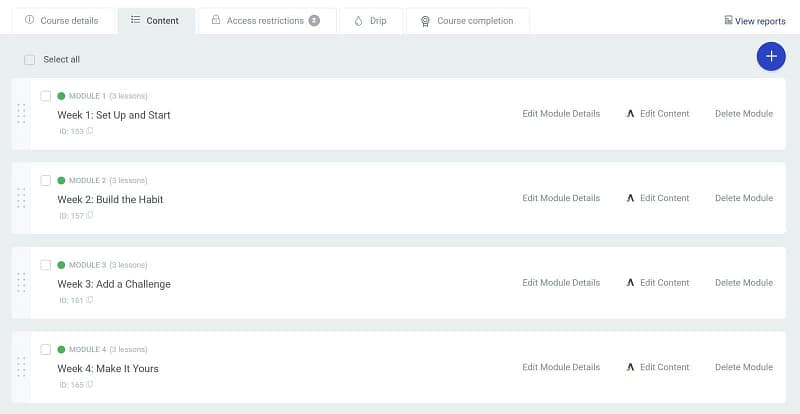
The demo course: four weekly modules with three lessons each. Add Lesson, Add Chapter and Add Module sit at the bottom of this tab.
The second is ongoing content, and a regular WordPress post category works well for it. Create a category for each kind of members-only post (the demo has Member Workouts and Live Q&A Replays), and write those posts the way you write any other post. You'll protect the whole category in the next step, so every new post you add to it is members-only the moment you publish it.
That's what keeps a membership going after the course ends. The course gives new members a clear place to start, and the category gives them a reason to still be there in month three.
Step 3: Turn That Content Into Products (One Product Per Tier)
In Thrive Apprentice, a product is what people buy, and it decides what they unlock. So you create one product for each tier.
Go to Thrive Apprentice → Products, click Add New, name it, and add what it unlocks:

The Club Plus product unlocks the course, both members-only post categories and the Members Area page.
For the demo, Club Member unlocks the course, the Member Workouts category and the Members Area page. Club Plus unlocks the same three, plus the Live Q&A Replays category. That one extra category is the whole difference between the tiers, and it's also how a Club Member who clicks on a replay ends up looking at an upgrade (more on that in step 10).
Step 4: Drip the Course Out Weekly (So Members Aren't Staring at Everything on Day One)
A drip schedule releases your content over time instead of all at once. For a membership, that keeps people from bingeing the course in a weekend and drifting off, and it gives them a reason to log in every week.
Open your course, go to the Drip tab and click Add new. Thrive Apprentice starts you off with templates, and the demo uses an evergreen schedule: a purchase starts it, and it unlocks one module every week after Week 1. So every member gets the same weekly rhythm from the day they join, whenever that is.
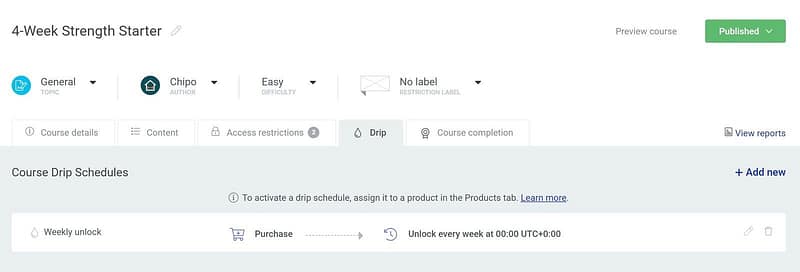
The demo's drip schedule: a purchase starts it, and it unlocks a new week every seven days.
Notice the line above the schedule: it doesn't do anything until you assign it to a product. So open each product in Thrive Apprentice → Products and pick the schedule on its Drip tab.
I'd also switch on Show locked content in lesson lists in the schedule's settings. Members then see the weeks that are coming, with the date each one opens, instead of a course that seems to end at Week 1.
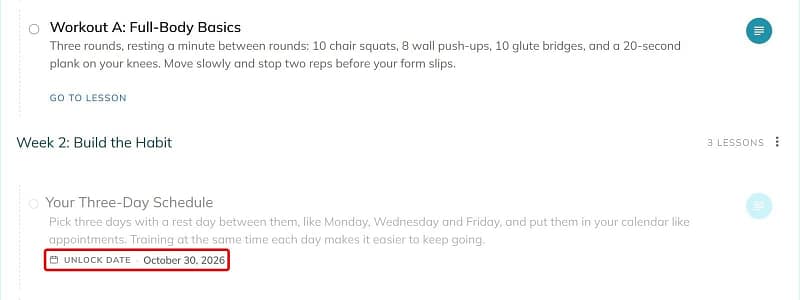
What a member sees: Week 1 is open, and Week 2 shows the date it unlocks.
Step 5: Take Payments Inside Thrive Apprentice (No ThriveCart Required)
This is the step that's changed the most. A few years ago, selling a membership meant a separate checkout tool and some embed code. Now Thrive Apprentice connects to Stripe, PayPal and Square directly. All three handle one-time payments and recurring subscriptions, and when someone pays, Thrive Apprentice unlocks their product for them.
First, connect the service you want to use. Go to Thrive Apprentice → Settings → Payments, pick Stripe, PayPal or Square, click Connect, then sign in to that service and approve the connection. All three let you connect in test (sandbox) mode first, so you can try a purchase before any real money moves.
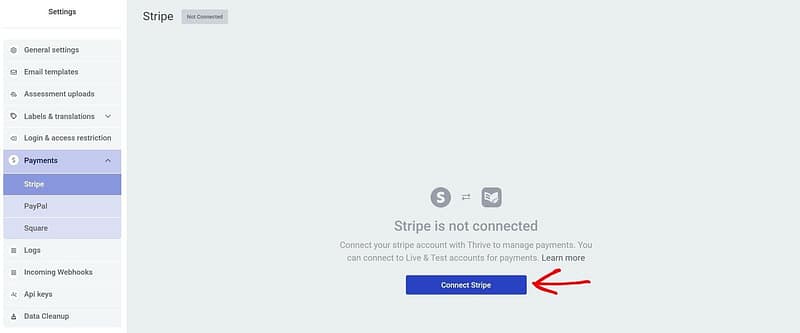
Stripe, PayPal and Square each have their own page under Settings → Payments.
Then give each product a price. Open the product, go to the Access requirements tab, expand the row for your payment service, and choose or create a price, like a monthly or yearly subscription. For the demo, that's $19 a month on Club Member and $39 a month on Club Plus. Then save the product, and if Thrive Apprentice reminds you to set the product's buy button, point it at the same service.

The Access requirements tab is where a product gets its price. Stripe, PayPal and Square sit at the top.
You pick the payment service per product, so one tier can sell through Stripe while another sells through PayPal, if that suits your buyers.
Already selling somewhere else? You don't have to move. Further down the same tab, you can unlock a product from a ThriveCart Product, a WooCommerce Product or a Custom payment link, and if you sell through SamCart or connect your checkout with Zapier, incoming webhooks in Thrive Apprentice can unlock the product as soon as that checkout records a sale.
Step 6: Make Your Course Pages Match Your Brand (Thrive Apprentice Has Its Own Colors)
This one caught me out on the demo. The rest of the site was already teal, with the club's logo and menus, but the course and lesson pages still showed Thrive Apprentice's default blue, a "Your Logo" placeholder, and a header menu that said "Nav #1, Nav #2, Nav #3". That's because Thrive Apprentice designs your course pages separately from your theme, so it keeps its own logo, colors and menus.
The quickest fix is the school wizard. Go to Thrive Apprentice → Design, open your design, and click Start wizard. These are the steps that matter:

One switch in the school wizard makes your course pages use your Thrive Theme Builder color.
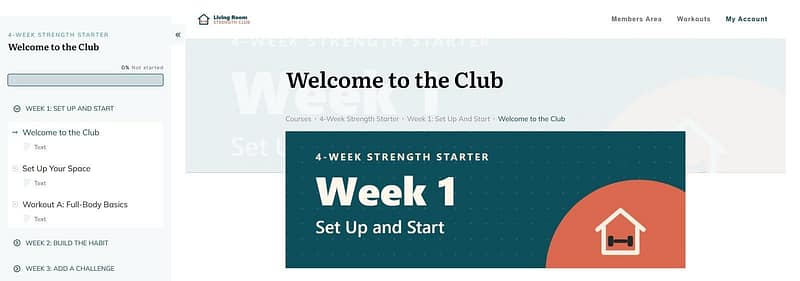
A lesson page after the wizard: the club's logo, menu and colors, with the course navigation on the left.
Step 7: Build a Header That Knows Who's Logged In
Your header has two jobs on a membership site. Visitors need a way to join and log in, and members need a way back to their content. If everyone sees every link, the menu gets cluttered for both.
So the demo's menu changes with who's looking. Go to Appearance → Menus and add every item either group needs. Then open each item: you'll see a Show when setting (it comes with Thrive Architect) that shows the item always, only to logged-in users, or only to logged-out users.
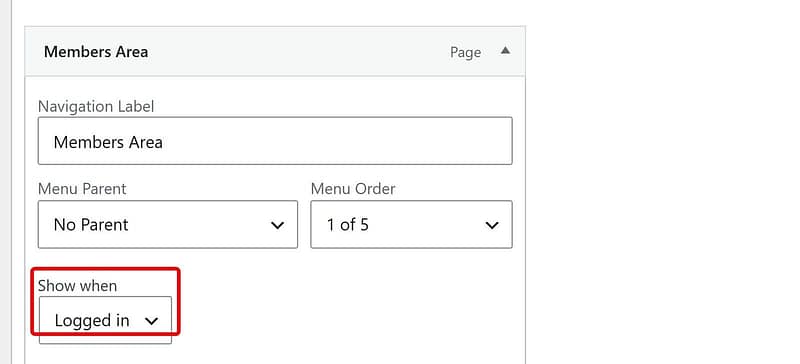
Show when, on each menu item, decides who sees it.
Here's how the demo's header menu is set:
Menu item | Show when |
|---|---|
Members Area and Workouts | Logged in |
Join the Club (the sales page) and Log In (the login page) | Logged out |
My Account | Logged in. It links to the login page, which shows members a "You are already logged in" message with a Log Out link, so members can log out without you building anything extra |

The same header, seen by a visitor and by a member.
The footer menu follows the same rules, and the school wizard in step 6 puts these menus on your course pages too, so the header stays the same wherever members go.
Step 8: Create the Members Area Page (Where Everything Lives)
This is the page members land on after they log in, so it should answer one question straight away: what can I do here today?
Create a regular WordPress page and launch Thrive Architect on it. Then add two elements:

The Post List filter: posts from the Member Workouts category, newest first, three at a time.
The demo's Members Area has three sections, each with a short heading: the course, the three newest Member Workouts, and a second Post List for the Live Q&A Replays.

The Member Workouts section of the demo's Members Area. New posts in the category show up here on their own.
And because you added this page to both products back in step 3, only members can open it.
Step 9: Set Up the Login Page (And Point "Sign Up" to Your Sales Page)
Go to Thrive Apprentice → Settings → Login & access restriction. If you don't have a login page yet, click Create New Page and pick a template, and you'll get a page with Thrive Architect's login form on it. Then set it as your login and registration page.
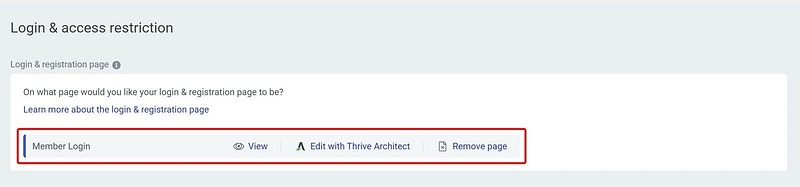
The demo's Member Login page, set as the login and registration page.
Before you move on, open that page in Thrive Architect and look at the bottom of the form. By default, it says "Don't have an account yet? Sign up", and the link opens a free registration form. On a free membership, that's exactly what you want. On a paid one, it signs people up for an account that can't open anything, so the demo changes it to "Not a member yet? Join the club" and links it to the sales page.

The bottom of the demo's login form, with its link pointing at the sales page instead of a free sign-up.
Step 10: Decide What Non-Members See (Access Restriction Rules)
Access restriction rules decide what happens when someone tries to open something they can't. You set them for the whole site in Thrive Apprentice → Settings → Login & access restriction, and there are three situations to cover:
Situation | What the demo does |
|---|---|
User not logged in | The demo sends them to the login page, so a member who's simply logged out can log in and carry on |
Not yet purchased | Someone logged in without access. The demo sends them to the sales page, which is how a Club Member who clicks on a Club Plus replay lands on the page that pitches the upgrade |
Content is locked (drip feed protection) | A member who's reached a week that hasn't opened yet. The demo shows a message instead of redirecting |
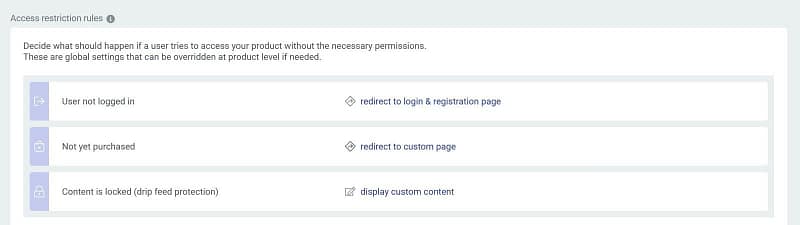
The demo's rules: logged-out visitors go to the login page, non-buyers go to the sales page, and drip-locked lessons show a message.
For that last one, I'd rewrite the default message. Out of the box, it says the content "will be made available to you based on conditions set by the course creator", which is accurate but doesn't help anyone. Click display custom content and edit the message in Thrive Architect. The demo's version tells members a new week opens every seven days and where to find the date.
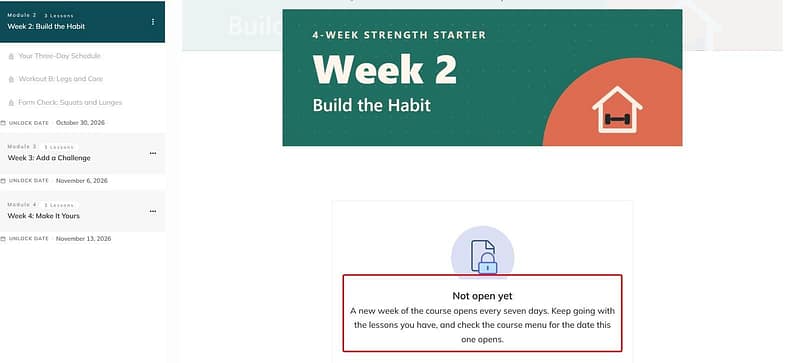
A Week 2 lesson seen by a member before it opens, with the rewritten message and the unlock dates in the sidebar.
These rules apply to every product unless you change them. If one product needs different behavior, use that product's own Access restriction rules tab instead.
Step 11: Build the Sales Page (And Connect Its Buttons to Your Checkout)
Now that the inside of your membership works, it's time for the page that sells it. Create a new page, launch Thrive Architect, and start from a sales page template, so you're editing words and images instead of building a layout from scratch.
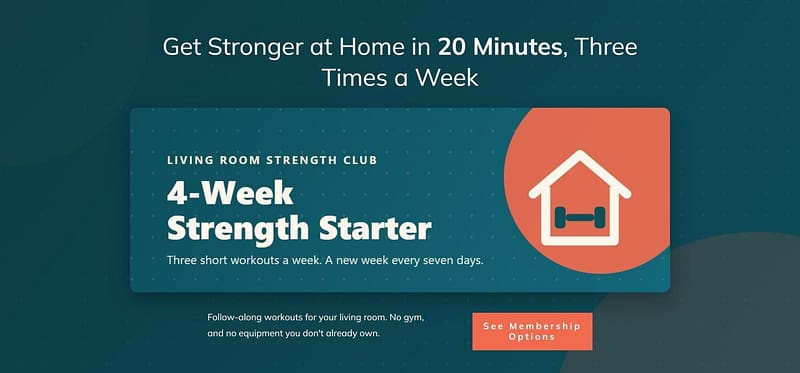
The top of the demo's sales page, built from a Thrive Architect sales page template.
The demo's sales page covers what's inside, how the weekly unlock works, the two tiers side by side, and an FAQ. And if your template comes with sample testimonials, take them out until you have real ones, because a careful buyer will notice placeholder praise.
Then connect each tier's button to its checkout. Select the button, click the Dynamic link icon next to Button link, choose the group for your Thrive Apprentice products, and pick the product. Once that product has a price from step 5, the button opens its checkout.
For help with the copy, start with the 8 elements of a successful sales page and the online course sales page template.
Step 12: Test It as a Member Before You Launch (Thrive Apprentice Lets You Log In as One)
You've built every piece. Now check they work together the way a member will meet them, before anyone pays you.
The easiest way is a test member. Go to Thrive Apprentice → Members, open your test member (or add one with an email address you can read), click Edit access rights, and give them your product. Then click Log in as this user, and you'll see your site exactly as they do, without needing their password. It logs you out of your own account in that browser, so you'll log back in when you're done.
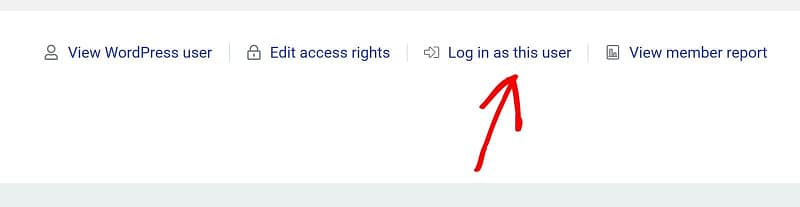
Log in as this user, on any member's page, shows you the site through their account.
Then walk the whole path:
Last, check the email your test member got. When someone is given access to a course, Thrive Apprentice can send them a course welcome email with their login link, a link to the course and their username. You'll find it under Thrive Apprentice → Settings → Email templates, and the demo's version welcomes people to the club and tells them Week 1 is open now.
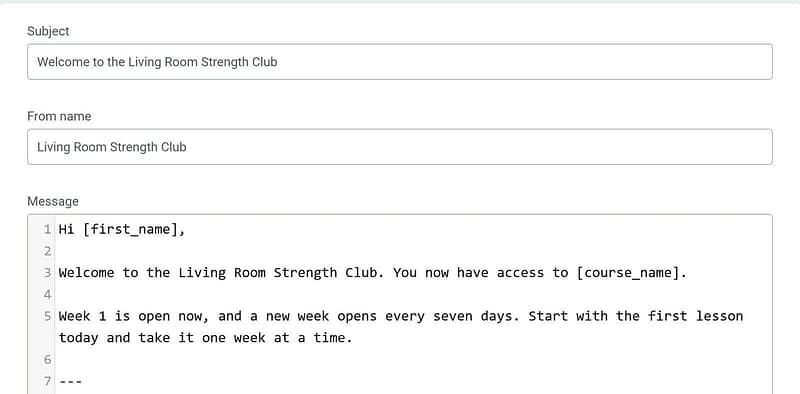
The course welcome email template, rewritten for the club. The shortcodes in square brackets fill in each member's details.
When every one of those checks passes, your membership site is ready for real members.
A Real Membership Built With Thrive Apprentice (Not Mine This Time)
The demo shows you how the pieces fit, but it helps to see a membership that's running for real.
Fingerstyle Zone is guitarist Tobias Rauscher's membership for fingerstyle and percussive guitar players. Tobias has been a Thrive customer since 2019 (Thrive wrote about his earlier academy in 2020), and today his members area runs on Thrive Apprentice.
It follows the same shape as the demo, at a much bigger scale. The core is a 12-module academy, and around it, members get new riffs every week, weekly practice challenges, a private members-only group, and masterclasses from guest guitarists. It starts with a 14-day free trial, then 29€ a month, with yearly and lifetime options too (as of October 2026).
So if you're wondering whether a course, weekly content and a community are enough to build a membership on, that's the model.
Frequently Asked Questions About Building a Membership Site
As you plan your own membership site, you'll probably have a few questions that didn't fit into the steps. These are the ones people ask most.
What Is a Membership Site?
A membership site is a gated part of your website where only registered or paying members can access exclusive content, like courses, templates, video lessons, or community forums. Unlike a regular blog or business site, it's designed to generate recurring revenue by offering ongoing value through a subscription.
What Is the Best Platform for a Membership Site?
It depends on how much control you want. Hosted platforms get you started quickly, but your content, your members and your checkout live on someone else's system. WordPress with a membership plugin takes a little more setup, and in return, you own all of it. To compare the options side by side, see this guide to membership site platforms, and if you're choosing between WordPress plugins, Thrive Apprentice vs MemberPress.
How Do I Create a Free Membership Website?
Build it the same way as a paid one, but unlock the product with a registration instead of a payment. In Thrive Apprentice, open the product's Access requirements tab and use WordPress Role, so people who create an account on your site get access. Keep the login form's "Sign up" link (step 9), because on a free membership, that's how people join.
How Much Does It Cost to Build a Membership Site?
On WordPress, you'll pay for hosting, a domain name and a membership plugin. As of October 2026, Thrive Apprentice on its own is $149 for the first year (renewals are $299 a year), and Thrive Suite, which adds Thrive Architect, Thrive Theme Builder and the rest of the Thrive tools, is $299 for the first year (renewals are $599 a year). Your payment service also takes a fee on each sale, so check the current rates on Stripe, PayPal or Square before you set your prices.
Does Running a Membership Site Take a Lot of Work?
It depends on your setup, but it's much more manageable than people think. Once the site is built, your main focus is:
With the right tools and systems in place, you can keep things running smoothly in just a few hours per week, especially if you batch content or automate emails.
Start Small, and Let Your Members Tell You What to Add Next
Building a membership site can feel intimidating. I've been there. You're juggling tech decisions, trying to map out your content, and wondering if anyone will actually join. It's a lot.
But here's the truth: once you get through that first setup, it gets easier. And the payoff is worth it.
You don't need a huge library on day one. A starter course, one category you'll keep adding to, and a header and login page that work are enough to open the doors. Your members will tell you what they want next, and the category from step 2 is where you'll give it to them.
When you're ready for that part, these will help you keep members around once they've joined:
Ready to Build Yours With Thrive Apprentice?
Everything in this tutorial, from the course and the drip schedule to the payments, the access rules and the welcome email, happens in Thrive Apprentice. The Members Area, the login page and the sales page are built with Thrive Architect, and the rest of the site runs on Thrive Theme Builder. All three come together in Thrive Suite.
Take it step by step. Keep it simple. And give yourself permission to build something imperfect, but real.


