

TL;DR: Let's Talk Building an eCommerce Sales Funnel
Let's talk about turning casual browsers into actual buyers. If you've been running an online store for a while, you know the frustration: traffic comes in, but sales stay unpredictable. You're working hard, but the revenue doesn't match the effort.
You don't need magic. You need a map. A clear path for every person who lands on your site. That's what an eCommerce sales funnel gives you. Think of it as your strategic roadmap for guiding potential customers from that first curious click all the way to becoming loyal, repeat buyers.
I'm going to show you how to design a customer journey that actually converts. This isn't about gimmicks or chasing the latest trend. This is about building a foundation that makes your business predictable and profitable.
3 Key Takeaways:
- Map Your Customer's Mind: Understand each stage of your customer's journey, from first glance to repeat purchase, and speak to their evolving needs.
- Fix the Leaks: Learn how to identify and repair the points where potential customers drop off, improving conversions through better content and user experience.
- Beyond the Sale: Extend your funnel past the initial purchase to build customer loyalty and advocacy that creates long-term growth.
This is about building a business that lasts. Read on to discover strategies that'll change how you approach online selling.
So, you've got your online store. An awesome set of products. But what next?
How are you getting customers?
Are you still hoping customers will magically find you, browse, and buy? Ruh oh.
If your sales feel unpredictable and you aren't sure what to do, you've come to the right post. Most ecommerce entrepreneurs struggle to connect the dots between website visitors and actual revenue.
Your customers are on a journey. If you don't guide them through it, they'll get lost, frustrated, or wander off to a competitor. What if you had a clear, repeatable process that takes someone from "who are you?" to "I love this brand"? That's what an eCommerce sales funnel is for.
This guide will give you a foundational understanding of how to design, build, and improve an eCommerce sales funnel that consistently converts.
You'll learn how to set up a strategic sales process that delivers predictable profits, builds customer loyalty, and scales your business.
If you're just starting out and want a broader overview, we've got a comprehensive guide on how to build a sales funnel from scratch.
Understanding Your Ecommerce Sales Funnel: The Strategic Roadmap to Revenue
Before you can build anything, you need to understand what an eCommerce sales funnel actually is and why you need one.
Think of it as your customer's guided tour through your brand, designed to move them from curiosity to purchase and beyond.
I'd say it's a structured path that guides potential customers from their first interaction with your brand to making a purchase and becoming a loyal advocate. You need one because it provides a predictable framework for customer acquisition, helps you identify and fix leaks in your sales process, and drives consistent revenue growth.
1.1. What is an Ecommerce Sales Funnel? Your Customer's Journey, Mapped
You might hear "sales funnel" and think it sounds aggressive or pushy. But for ecommerce, it's actually the opposite. This is about understanding and anticipating your customer's needs at every stage, then providing the right information and experience to help them make a confident purchase decision. You're guiding them through a series of interactions that build trust and value.
- It's a visual representation: You get to see how customers move through different stages with your brand.
- It's a strategic framework: This lets you plan your marketing efforts to match customer intent.
- It's about guiding, not forcing: You offer value and solutions at each step, making the journey feel natural.
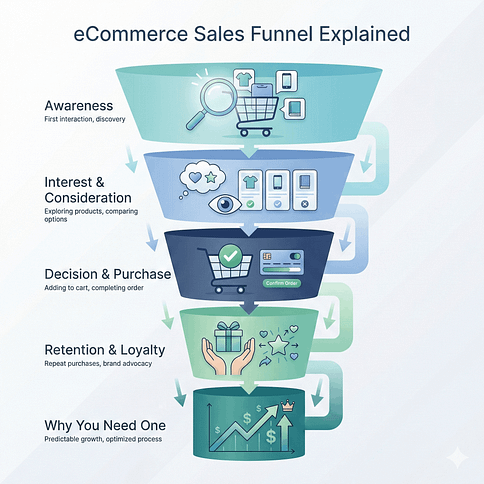
This whole process is essentially about understanding what the buyer's journey is and how to align your efforts with it.
1.2. Why You Need a Defined Ecommerce Sales Funnel: Don't Leave Money on the Table
If you're not intentionally guiding your customers, you're losing sales. A poorly defined or non-existent funnel means you're leaving money on the table. It's like having a beautiful storefront but no clear path to the checkout counter.
- Lost opportunities: Visitors come, but don't know what to do next, so they just leave.
- Wasted ad spend: You're driving traffic to a leaky bucket, and that's just throwing money away.
- Inconsistent sales: Your revenue is all over the place because your process isn't.
A clear ecommerce sales funnel makes sure every interaction has a purpose, moving your customer closer to a purchase and transforming your business from reactive to proactive.
And if you're still in the early stages, figuring out how to start an ecommerce store that actually sells is a great place to begin.
Feeling like your funnel is more “hope” than strategy?
If you’re building this on WordPress, Thrive Suite gives you the structure most ecommerce stores are missing — landing pages built for conversion, smart opt-ins, A/B testing, and automation that actually connects the dots.
Instead of duct-taping plugins together, you get a system designed to move people forward.
2. The Core Stages of Your Ecommerce Sales Funnel: From Stranger to Superfan
Most businesses think the sale is the finish line. But for a truly successful eCommerce sales funnel, it's just the beginning.
You need to understand the distinct phases your customer moves through, and how your actions influence their progress. While the core stages (Awareness, Interest, Desire, Action) are similar to a traditional sales funnel, an eCommerce sales funnel places greater emphasis on digital touchpoints, user experience on your website, and post-purchase engagement.
It often extends to an "Advocacy" stage, focusing on customer retention, loyalty programs, and generating reviews to fuel future sales.
It's also worth exploring the best types of sales funnels to see how different models can apply to your business.
2.1. Stage 1: Awareness, Catching Their Eye When They Don't Know You
At this initial stage, your potential customer might not even know they have a problem, or that your brand exists. Your goal is to introduce yourself and capture their attention. This is where you first make an impression, often without them even realizing they're entering a "funnel."
- Your customer's mindset: "What's this? I might have a need."
- Your objective: Get noticed. Provide value, not a hard sell.
- Tactics that work:
- Content marketing: Blog posts, videos, infographics addressing common pain points. (If you're wondering what this whole content marketing thing is all about, we've got a quick breakdown on what content marketing is.)
- Social media engagement: Build a community, share valuable content.
- Paid ads (top of funnel): Brand awareness campaigns on platforms like Facebook, Instagram, Google Display Network.
- SEO for informational queries: Rank for terms related to their problems, not just your products. (To really nail that, you'll want to learn how to build smarter SEO silos for better traffic and conversions.)
2.2. Stage 2: Interest, Building Connection
Once they're aware, you need to deepen their interest. They're now actively looking for solutions and comparing options. This is where you start to educate them about what you offer and how it could fit into their life, moving them from casual observer to engaged prospect.
- Your customer's mindset: "Tell me more. Is this for me?"
- Your objective: Educate them, demonstrate your expertise, and build trust.
- Tactics that work:
- Detailed product pages: Highlight benefits, not just features.
- Comparison guides: Help them understand their options (including yours).
- Educational content: Webinars, how-to guides, and demonstrations.
- Retargeting ads: Remind them of what they've shown interest in.
- Lead magnets: Offer a free resource (ebook, checklist, discount) in exchange for their email. This is a key part of setting up a complete lead generation funnel.
2.3. Stage 3: Desire, Creating the Feeling of Need
At this point, they understand you and what you offer. Now you need to create a genuine desire for your product. This means addressing their specific pain points and showing them how your product fits perfectly into their life. You're building that "I need this" feeling.
- Your customer's mindset: "I really want this."
- Your objective: Show them why your product is the solution they've been looking for.
- Tactics that work:
- Social proof: Customer reviews, testimonials, case studies.
- High-quality product photography and video: Let them see and imagine owning the product.
- Clear value proposition: Explain exactly what makes you different and better. (If you're struggling to articulate that, check out these tips to increase conversions on your sales page.)
- Scarcity and urgency (used ethically): Limited-time offers or low stock alerts (only if genuine).
- Free trials or samples: Let them experience your product risk-free.
2.4. Stage 4: Action, Making the Purchase Easy
They want your product. Now you need to make buying as frictionless as possible. This is where you remove every obstacle that might stop them from completing the purchase. A clunky checkout process can kill conversions at the last second.
- Your customer's mindset: "Okay, I'm ready to buy."
- Your objective: Make the purchase simple, secure, and fast.
- Streamlined checkout: Minimize the number of steps and required fields.
- Multiple payment options: Offer credit cards, PayPal, Apple Pay, etc.
- Guest checkout: Don't force account creation.
- Clear shipping costs and timeframes: No surprises at the end.
- Trust signals: Display security badges, money-back guarantees, and clear return policies.
- Abandoned cart emails: Remind them of what they left behind, maybe with a small incentive.
2.5. Stage 5: Advocacy, Turning Customers into Champions
The sale isn't the end. This is where the real long-term value is built. You want to turn that one-time buyer into a repeat customer and eventually a brand advocate who tells everyone about you. This stage is about creating an experience so good they can't help but come back and bring their friends.
- Your customer's mindset: "I love this brand."
- Your objective: Build loyalty, encourage repeat purchases, and generate referrals.
- Tactics that work:
- Post-purchase emails: Thank them, confirm their order, and provide tracking.
- Loyalty programs: Reward repeat purchases with points, discounts, or exclusive perks.
- Personalized recommendations: Suggest products based on their purchase history.
- Request reviews: Make it easy for them to share their experience.
- Exclusive offers: Give your existing customers first access to new products or special deals.
- Engage on social media: Encourage user-generated content and share customer stories.
3. Building Your Ecommerce Sales Funnel: The Step-by-Step Blueprint
Now that you understand the stages, let's talk about how to actually build your eCommerce sales funnel. This isn't something you set up overnight, but with a systematic approach, you can create a funnel that consistently drives sales.
3.1. Step 1: Define Your Ideal Customer and Their Journey
Before you do anything else, you need to know exactly who you're selling to. A generic funnel built for "everyone" won't convert anyone. You need to get specific.
- Create detailed buyer personas: Go beyond basic demographics. What are their pain points? What motivates them? Where do they hang out online?
- Map their current journey: How do they currently discover products like yours? What questions do they ask? What objections do they have?
- Identify the gaps: Where is your current process failing them? Where are they getting stuck or confused?
3.2. Step 2: Create Content for Each Stage
You can't just create one piece of content and expect it to work at every stage. You need different content that speaks to where your customer is in their journey.
- Awareness stage content: Blog posts answering common questions, social media posts, SEO-optimized articles, educational videos.
- Interest stage content: Product comparison guides, email courses, webinars, case studies.
- Desire stage content: Product demos, customer testimonials, detailed product pages with all the answers they need.
- Action stage content: Clear calls-to-action, simplified checkout pages, trust signals.
- Advocacy stage content: Thank you emails, loyalty program details, referral incentives, post-purchase tips.
3.3. Step 3: Set Up Your Email Sequences
Email is your direct line to potential and current customers. Set up automated sequences that nurture leads and re-engage customers.
- Welcome sequence: Introduce your brand to new subscribers.
- Abandoned cart sequence: Remind them of what they left behind (with a gentle nudge or incentive).
- Post-purchase sequence: Thank them, ask for feedback, suggest related products.
- Re-engagement sequence: Win back customers who haven't bought in a while.
3.4. Step 4: Design Your Website for Conversion
Your website is the backbone of your funnel. Every page should guide visitors toward the next logical step.
- Clear navigation: Make it easy to find products and information.
- Compelling product pages: High-quality images, detailed descriptions, reviews, and clear CTAs.
- Frictionless checkout: Remove as many steps as possible.
- Mobile optimization: Most ecommerce traffic is mobile. If your site doesn't work well on phones, you're losing sales.
3.5. Step 5: Implement Tracking and Analytics
You can't improve what you don't measure. Set up proper tracking so you can see exactly how people move through your funnel.
- Google Analytics: Track traffic sources, page views, and conversion rates.
- Ecommerce tracking: See which products are popular, where people drop off in checkout, and what your average order value is.
- Heatmaps and session recordings: Tools like Hotjar show you exactly where people click, scroll, and get confused.
3.6. Step 6: Test, Measure, and Optimize
Your first attempt won't be perfect. The most successful funnels are constantly tested and improved.
- A/B testing: Test different headlines, images, button colors, and page layouts to see what converts best.
- Analyze drop-off points: Where are people leaving? Fix those spots first.
- Gather feedback: Ask customers what almost stopped them from buying.
- Iterate regularly: Make small improvements based on data, not guesses.
If You’re Serious About Fixing the Leaks…
So, here's the thing:
Most ecommerce funnels don’t fail because of bad products.
They fail because the pieces don’t talk to each other.
Your landing pages live in one plugin.
Your opt-ins live somewhere else.
Your email automation depends on five separate integrations.
Your A/B testing? Maybe later.
That’s where Thrive Suite changes the game.
When you use:
- Thrive Architect to build high-converting landing and product pages
- Thrive Leads to capture and segment visitors properly
- Thrive Optimize to test what actually converts
You’re not just “adding tools.”
You’re building a connected funnel engine.
Everything works together. Everything is designed around conversion. And you stay in control because it’s all native to WordPress.
If you’re tired of patchwork funnels and unpredictable revenue, this is the infrastructure upgrade.
4. Common Ecommerce Sales Funnel Mistakes (And How to Fix Them)
Even with the best intentions, most businesses make critical mistakes that sabotage their funnel. Here are the big ones I see over and over again.
4.1. Mistake 1: Treating All Traffic the Same
Someone who just discovered your brand needs different messaging than someone who's visited five times. If you treat them all the same, you'll lose both.
The fix: Segment your audience. Use retargeting ads for warm traffic. Send different email sequences based on behavior. Personalize product recommendations.
4.2. Mistake 2: A Complicated Checkout Process
Every extra field, every extra click, every moment of confusion is an opportunity for someone to change their mind.
The fix: Simplify ruthlessly. Offer guest checkout. Save payment info for returning customers. Make shipping costs clear upfront.
4.3. Mistake 3: No Post-Purchase Strategy
You spent money and effort getting that sale. If you don't have a plan to bring them back, you're wasting that investment.
The fix: Set up automated post-purchase emails. Create a loyalty program. Ask for reviews. Make it easy for them to buy again.
4.4. Mistake 4: Ignoring Mobile Users
If your site isn't mobile-friendly, you're probably losing half your potential customers.
The fix: Test your entire funnel on mobile. Make buttons big enough to tap easily. Speed up your mobile site. Use mobile-friendly payment options like Apple Pay.
4.5. Mistake 5: Not Tracking the Right Metrics
Vanity metrics like total traffic mean nothing if they don't convert to sales.
The fix: Focus on conversion rates at each stage, cart abandonment rate, customer lifetime value, and cost per acquisition.
5. Advanced Strategies to Supercharge Your Ecommerce Sales Funnel
Once you've got the basics down, these advanced tactics can take your funnel from good to exceptional.
5.1. Use Dynamic Content and Personalization
Show different content based on what you know about the visitor. Someone browsing women's shoes shouldn't see men's product recommendations.
- Personalized product recommendations: Use browsing and purchase history to suggest relevant products.
- Dynamic email content: Show different products to different segments in the same email campaign.
- Location-based offers: Show shipping promotions or local events based on where they are.
5.2. Implement Retargeting and Remarketing
Most people won't buy on their first visit. Retargeting keeps your brand in front of them as they browse the internet.
- Facebook/Instagram retargeting ads: Show ads to people who visited your site or added items to cart.
- Google Display retargeting: Follow visitors around the web with relevant ads.
- Email retargeting: Send emails based on specific pages they visited or products they viewed.
5.3. Create a VIP Customer Experience
Your best customers deserve special treatment. It encourages repeat purchases and turns them into advocates.
- Exclusive early access: Let loyal customers shop new products before everyone else.
- VIP-only discounts: Reward your biggest spenders with special deals.
- Personal touches: Handwritten thank you notes or surprise gifts in orders.
5.4. Build a Referral Program
Your happy customers are your best salespeople. Make it easy and rewarding for them to spread the word.
- Incentivize both parties: Give the referrer and the new customer a discount.
- Make sharing easy: Provide pre-written social media posts and shareable links.
- Track and reward top referrers: Recognize and reward customers who bring you the most business.
5.5. Use Scarcity and Urgency (Ethically)
Real scarcity creates genuine urgency. Fake scarcity destroys trust.
- Limited inventory alerts: "Only 3 left in stock" (if it's actually true).
- Flash sales: Time-limited offers that create a real deadline.
- Seasonal products: Items that genuinely won't be available later.
6. Measuring the Success of Your Ecommerce Sales Funnel: Metrics That Actually Matter
You can't manage what you don't measure. But not all metrics are created equal. Here are the ones that actually tell you if your funnel is working.
6.1. Conversion Rate by Funnel Stage
Track the percentage of people who move from one stage to the next. This shows you exactly where people are dropping off.
- Traffic to add-to-cart rate: How many visitors add something to their cart?
- Add-to-cart to checkout rate: How many people who add items actually start checkout?
- Checkout to purchase rate: How many who start checkout complete their purchase?
6.2. Average Order Value (AOV)
This tells you how much customers spend on average. Increasing AOV is often easier than getting new customers.
How to improve it: Bundle products, offer free shipping thresholds, suggest complementary items at checkout.
6.3. Customer Lifetime Value (CLV)
How much is a customer worth to you over their entire relationship with your brand? This tells you how much you can afford to spend to acquire them.
How to improve it: Increase purchase frequency through email marketing, loyalty programs, and personalized recommendations.
6.4. Cart Abandonment Rate
The percentage of people who add items to their cart but don't complete the purchase. The average is around 70%, but you can improve yours.
How to improve it: Send abandoned cart emails, simplify checkout, show shipping costs earlier, add trust signals.
6.5. Customer Acquisition Cost (CAC)
How much you spend (on ads, content, tools) to acquire each new customer. You need to know this to make sure you're profitable.
Formula: Total marketing spend / Number of new customers acquired
6.6. Return on Ad Spend (ROAS)
How much revenue you generate for every dollar spent on advertising.
Formula: Revenue from ads / Cost of ads
What's good? 4:1 is typically break-even. 3:1 or higher means you're making money (after product costs and overhead).
7. Tools to Build and Manage Your Ecommerce Sales Funnel
You don't need a massive budget to build an effective funnel, but the right tools make everything easier and more effective. Here are the essentials and some powerful additions.
7.1. Your Ecommerce Platform
This is your foundation. Everything else connects to this.
- Shopify: The most popular option for a reason. It's user-friendly, has tons of apps, and handles everything from inventory to payments.
- WooCommerce (WordPress): Great if you want more control and already use WordPress. It's free (though you'll pay for hosting and extensions).
- BigCommerce: A solid middle ground with powerful built-in features, less reliance on apps.
7.2. Email Marketing Automation
Email is still one of the highest-ROI marketing channels. You need a platform that can handle automation.
- ConvertKit: Simple, creator-focused, great for content-driven brands.
- ActiveCampaign: More powerful automation features, better for complex funnels.
- Klaviyo: Built specifically for ecommerce, integrates deeply with Shopify and other platforms.
7.3. Analytics Tools
You need to know what's working and what isn't. These tools show you the data.
- Google Analytics: Free and essential. Track traffic sources, user behavior, and conversion rates.
- Google Analytics 4 (GA4): The newer version with better event tracking and cross-platform insights.
- Hotjar: Heatmaps and session recordings show you exactly what users do on your site.
7.4. Landing Page Builders
Generic website pages often don't convert as well as dedicated landing pages designed for a single purpose. These tools help you create those focused pages. They strip away distractions and guide visitors towards a specific action.
- Thrive Architect (for WordPress users): This is a solid choice for WordPress. It's a drag-and-drop builder that lets you create highly optimized landing pages, sales pages, and opt-in forms without needing any code. This means you can quickly build pages tailored to each stage of your funnel.
- Unbounce, Leadpages: These are standalone landing page platforms that integrate with various ecommerce and marketing tools. They're great if you need to quickly spin up high-converting pages for specific campaigns.
7.5. A/B Testing & Optimization Tools
Never assume your first idea is the best. These tools help you test different versions of your pages, headlines, and calls-to-action to see what truly resonates with your audience. This iterative testing is how you continuously improve your funnel, making small, data-backed changes that add up to big results.
- Google Optimize (free, but being sunsetted), VWO, Optimizely: These platforms allow you to create different variations of a webpage and show them to different segments of your audience. They then track which version performs better against your chosen goals (higher conversion rate, lower bounce rate).
- Built-in A/B Testing: Many email marketing platforms and landing page builders now include their own A/B testing features, so you might not need a separate tool for every test.
7.6. Advertising Platforms
To drive traffic into the top of your funnel, you'll likely use paid advertising. These platforms allow you to target specific audiences and measure your ad performance. They are essential for getting your brand in front of new potential customers and filling the top of your ecommerce sales funnel.
- Google Ads (Search & Display): Important for capturing demand when people are actively searching for products or solutions. The Display Network is great for brand awareness.
- Facebook/Instagram Ads: Powerful for audience targeting based on interests, demographics, and behaviors. Excellent for both awareness and retargeting campaigns.
- Pinterest Ads, TikTok Ads: Depending on your product and target audience, these platforms can be highly effective for visual discovery and reaching younger demographics.
Choosing the right tools depends on your budget, your technical comfort level, and the specific needs of your business. My advice? Start with the essentials (your ecommerce platform, analytics, and email marketing) and then add more specialized tools as your needs grow and your funnel becomes more sophisticated. The goal is to make your life easier and your funnel more effective, not to collect every shiny new piece of software.
FAQ Section: Your Most Pressing Questions About Ecommerce Sales Funnels, Answered
Your Path to Predictable Growth
So as you can see, building an effective eCommerce sales funnel isn't a one-time project you check off your list. It's an ongoing process of understanding your customer, improving their journey, and consistently refining your approach based on what the data tells you. But when you get it right, it transforms your business from a guessing game into a predictable engine for growth.
I've given you the blueprint, the stages, and the practical steps to start building a more intelligent sales process. You now have a clearer picture of how to guide your customers, reduce friction, and build a business that sells and fosters lasting relationships.
Your next step? Pick one stage of your current customer journey and start mapping it out. Where are people coming from? What do they see? What do you want them to do next? Even a small improvement in one area can have a ripple effect across your entire funnel. You've got this.
Ready to Build a Funnel That Actually Feels Intentional?
Right now, you have two choices.
You can keep tweaking pieces — hoping your checkout converts better, hoping your emails land, hoping your ads perform.
Or you can build a system designed to guide every visitor intentionally from first click to repeat purchase.
That’s what Thrive Suite helps you do.
Not just prettier pages.
Not just more opt-ins.
But a connected, conversion-focused ecosystem where:
- Your landing pages are strategic
- Your segmentation is smart
- Your testing removes guesswork
And your ecommerce sales funnel finally feels predictable.
If you’re building on WordPress and you want control without complexity, this is your next step.
👉 Get Thrive Suite and start building a smarter funnel today


