


TL;DR: How to Make a Personality Quiz
A personality quiz sorts people into types based on how they answer, then tells each person something about themselves that feels true. To make one people finish and share:
- Pick 3-5 types: and tie each one to something you offer
- Write the results first: each one should read like a compliment and end with a next step
- Write questions people see themselves in: scenarios and choices, not "rate yourself from 1 to 5"
- Map every answer to a type: so every result is reachable and ties are rare
- Decide what you ask for: then send each type a different first email
- Build it and take it as every type: in WordPress, that's a Category quiz in Thrive Quiz Builder
Most of the attention goes to the questions, but the results are where a personality quiz works or doesn't, so that's where I'd put the most time.
If you're here, you probably want people to engage with your business in a way a signup form never manages: to stop, pay attention, and tell you something about themselves. Personality quizzes are unusually good at that, because people don't take them for you. They take them to learn who they are, and when the answer feels right, they pass it on.
That's how Kaye Putnam's brand archetype quiz has been taken by more than 250,000 people. Kaye is a brand strategist and a Thrive customer we first wrote about in 2020, and her quiz is twelve questions, about three minutes, and doesn't ask for an email address at all.
So this guide is mostly about the design: how to choose your types, write results people want to share, and write questions that sort people properly. Then I'll show you the build in WordPress, using a four-type quiz called What's Your Marketing Superpower? that we built in Thrive Quiz Builder for this guide.
Personality Quizzes Still Work, and AI Is Part of the Reason
It's fair to wonder whether personality quizzes have had their moment. The numbers say they haven't. The free 16Personalities test alone has been taken more than 1.58 billion times, according to the counter on its homepage, and people are still taking it every day.
They hold attention in a way most content doesn't, too. Interact, a quiz tool, tracks how people move through the lead-generation quizzes its customers build, and 65% of people who start one finish it. On average, 40.1% of the people who start a quiz end up joining an email list. Interact says those numbers have barely moved since it started measuring in 2014.
And AI has made that kind of content more useful to a business. When Google shows an AI summary, people click through to websites far less often. In Pew Research Center's 2025 study, users clicked a search result on 8% of visits to pages with an AI summary, compared with 15% when there wasn't one. More and more general questions get answered before anyone reaches your site. But a summary can't give your reader their result from your quiz, matched to your offers, so a quiz gives people a reason to come to you that a search page can't replace.
It also gives people the personal treatment they've come to expect. In McKinsey's 2021 research, 71% of consumers said they expect companies to deliver personalized interactions, and 76% said they get frustrated when that doesn't happen. A personality quiz is one of the simplest ways to deliver that, because people tell you what they're like before you've sent them a single email.
So let's make one people actually finish.
How to Make a Personality Quiz (Start With the People, Not the Questions)
Here's the quiz we'll build along the way, so the examples make sense. What's Your Marketing Superpower? asks five questions and gives each person one of four types:
Each type points to a different kind of offer. That's the first decision you'll make, and it's the one most personality quizzes skip.
Step 1: Pick 3-5 Types, and Tie Each One to Something You Offer
Every personality quiz is really a sorting exercise, so start with the groups you're sorting people into. Three to five is a good range for a first quiz. With fewer than three, the result feels like a coin toss. With more than five, you'll spend weeks writing results before anyone has taken the thing, which is exactly why our 2021 quiz for the Thrive blog stopped at five.
Kaye's quiz has twelve, but she has a full write-up for every one of them, so each result has real depth behind it. And notice that she didn't invent them. Brand archetypes are a framework people already recognize, which is part of why her results feel credible: there's a system behind them. You can do the same with any framework your audience already knows, or name your own types, as long as each one describes a real way your customers differ.
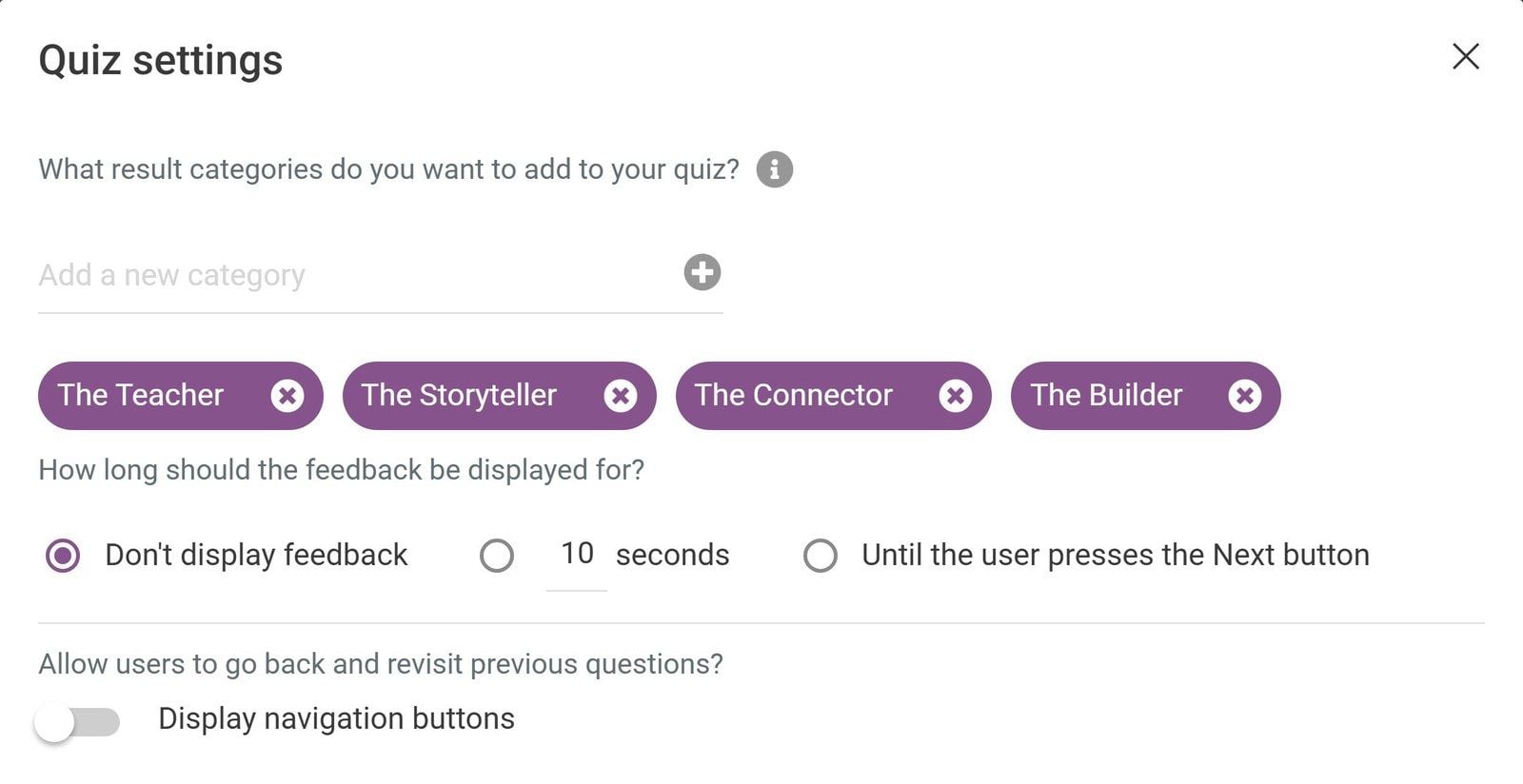
What turns a fun quiz into a business tool is tying every type to something you can offer. In our quiz, each superpower points to a different kind of offer: a course for The Teacher, a newsletter for The Storyteller, a community for The Connector, and a template or toolkit for The Builder. Our 2021 quiz worked the same way, with every result recommending a different kind of opt-in offer. A type that doesn't lead anywhere might still be fun, but it won't do anything for your business.
In Thrive Quiz Builder, your types are the quiz's result categories:
Step 2: Write the Results Before the Questions, and Make Each One a Compliment
If you only get one part of your quiz right, make it this one, because the result is the whole reason anyone takes a personality quiz. It's the part people read twice, screenshot, and send to a friend.
So write your results first, and write them the way Kaye does. This is what her quiz shows you at the end:
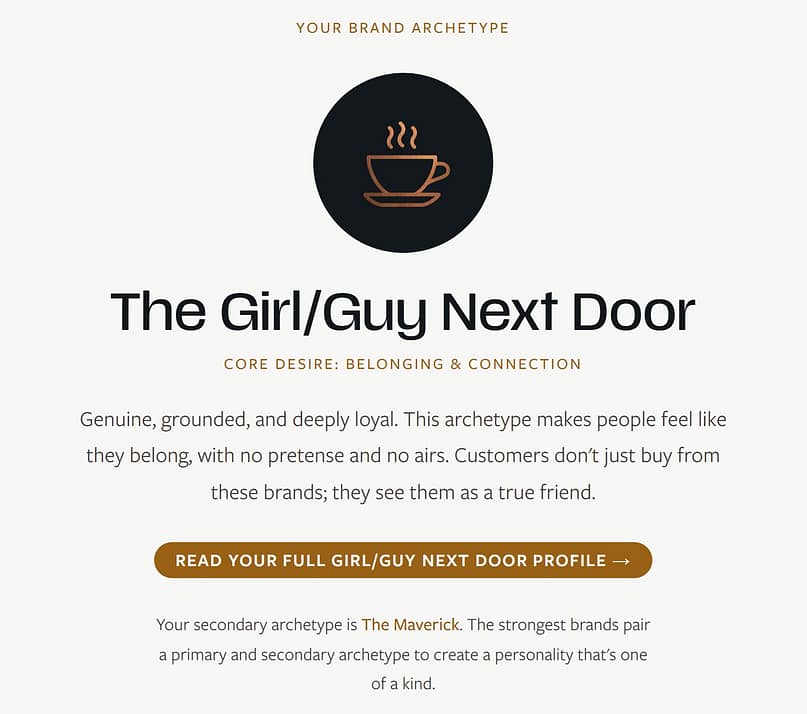
The result page at the end of Kaye Putnam's brand archetype quiz
Three things are doing the work there:
Ours follow the same pattern on a smaller scale. Each one opens with a compliment, then names the offer that fits and the first step to take:
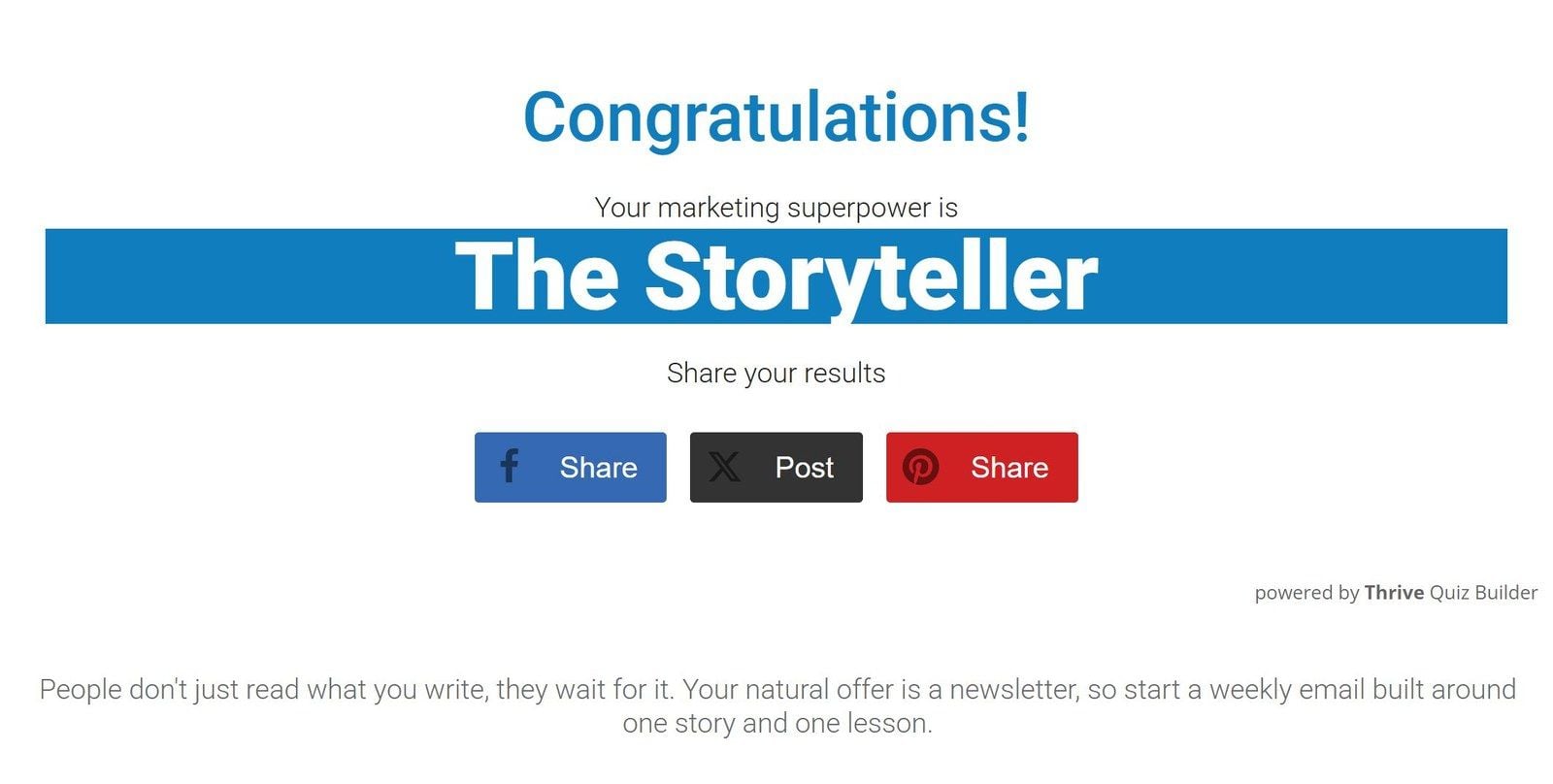
The Storyteller result, written as a compliment with a next step.
Once your results are written, they also tell you what your questions need to do, which makes the next step a lot easier. That's the back-to-front method we used on our 2021 quiz: results first, questions second.
Step 3: Write Questions People See Themselves In
A good personality quiz question asks about something people enjoy thinking about, which is themselves, in a situation they recognize. "Rate your communication skills from 1 to 5" asks people to judge themselves, and most will pick the middle. "A friend asks for help with something you know well. What do you do first?" asks them to picture a moment, and the answer they pick tells you far more.
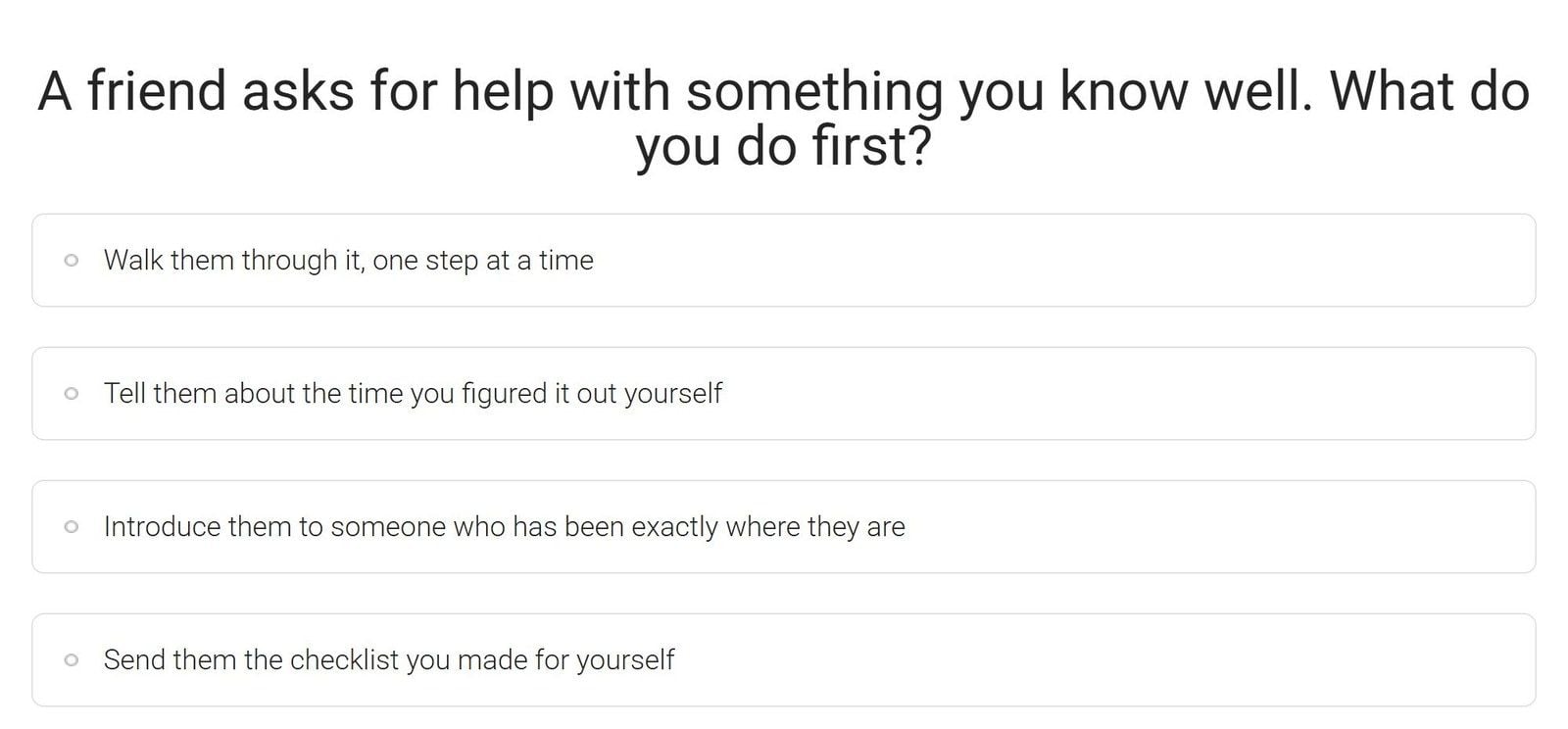
A scenario question, with one answer for each type.
Kaye's quiz does this really well. Instead of asking you to describe your brand, one question asks which character it's most like, with options from Sherlock Holmes to Bugs Bunny to the Fairy Godmother:
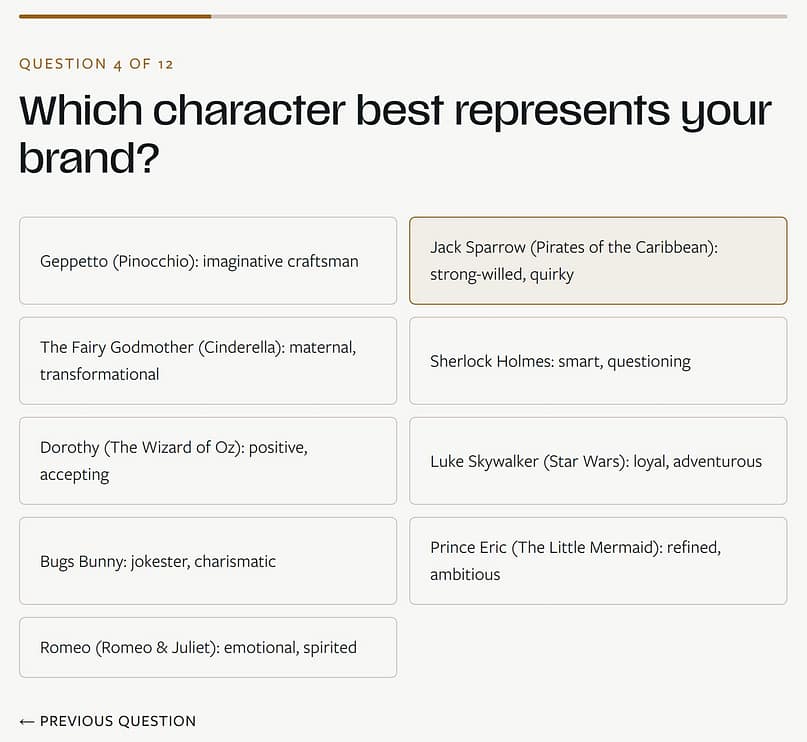
Question 4 of 12 in Kaye Putnam's quiz.
It's fun to answer, it's hard to answer "correctly" on purpose, and every option quietly points to an archetype.
If you're stuck, these four formats cover most good personality quiz questions:
As for how many, five to seven questions is plenty for most quizzes. Kaye's has twelve, and she tells people upfront that it takes about three minutes. But our 2021 quiz is a useful warning: it had thirteen, with branching so that nobody answered all of them, and the questions were still where we lost the most people, about 40% of them.
Step 4: Map Every Answer to a Type (and Plan for Ties)
Each answer should point to one type, and every question should give every type a fair chance. The simplest way to guarantee that is the pattern we used: four answers per question, one for each type. If a type only shows up in two of your questions, it'll almost never win, and the people who should get it will end up somewhere else.
In Thrive Quiz Builder, every answer has a Category dropdown, so the mapping happens as you write. We also gave each answer a tag that matches its type, which comes in handy in step 5:
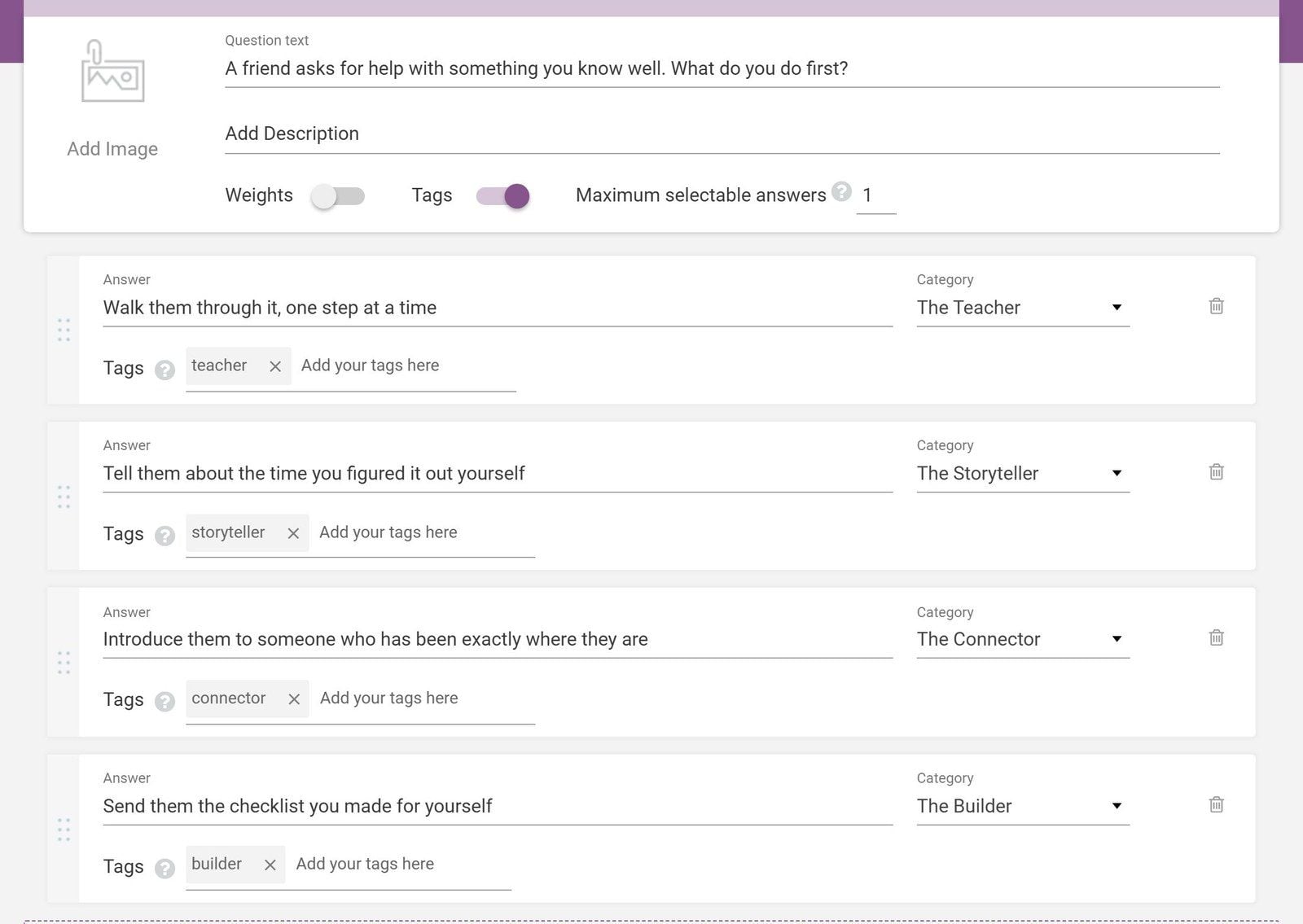
Every answer points to one type and carries a matching tag.
Ties will happen, especially with only five questions. You can make them rarer by switching on Weights and letting your strongest question count for more. But I like how Kaye's quiz deals with it. Alongside the main archetype, it shows you a secondary one, so your result is a pair rather than a single winner, and a close call becomes a more personal result instead of a confusing one.
And if some of your questions only make sense for some people, you can branch. Our 2021 quiz asked "How outgoing and comfortable are you in front of people?" early on, then sent the two groups down different sets of questions, so nobody had to answer questions that didn't apply to them:
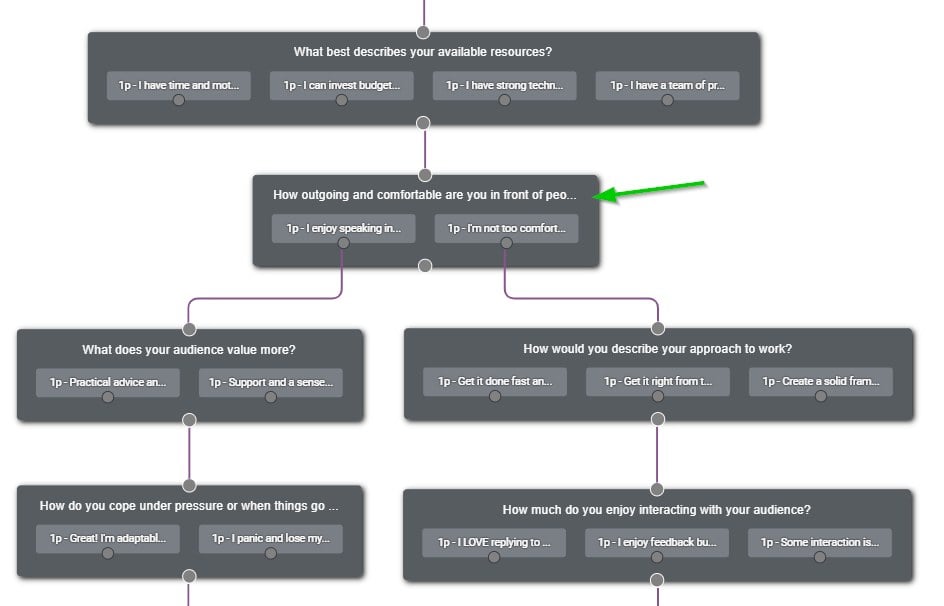
The branching question in our 2021 quiz, splitting people into two paths.
Step 5: Decide What You Ask For, Then Email Each Type Differently
Kaye's quiz asks for nothing at all, and it's still been taken by more than 250,000 people. If your goal is growing an email list, you'll want an opt-in gate between the last question and the result instead. Both approaches work, and we've walked through each of them with real examples in our quiz funnel examples.
If you do collect emails, don't send every type the same welcome. Because each answer carries a tag, someone who comes out as The Storyteller lands in your email service already labeled, and their first email can be about starting a newsletter instead of a generic hello. It's the part of a personality quiz most people never set up, and it's the part that turns a fun result into a relationship.
Step 6: Build It in WordPress (the Short Version)
In Thrive Quiz Builder, a personality quiz is a Category quiz. The short version of the build looks like this:
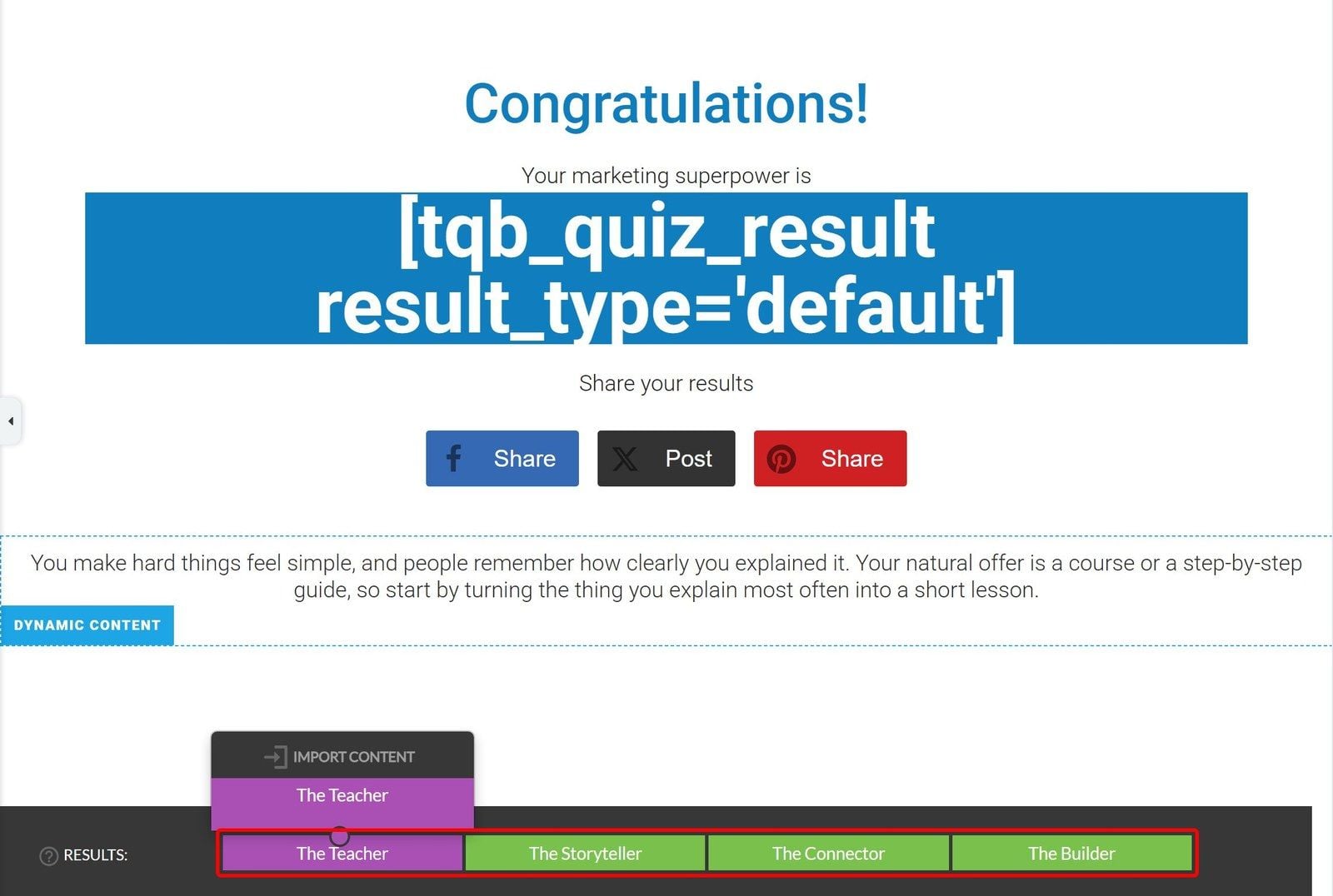
A tab for each type, and a different result under each one
For every click of the full build, including the opt-in gate, the splash page and adding the quiz to a page, follow our guide to making a quiz in WordPress. Everything in it applies to a personality quiz.
Step 7: Take It Once as Every Type Before Anyone Else Does
Before you share your quiz, take it once for every type. With one answer per type in every question, that's quick: pick every first answer, then every second, and so on, and check that each run lands on the type it should. We did that with our quiz, and all four runs landed where they should.
Then keep an eye on the Questions report once real people start taking it. It shows how people answered each question and how many dropped off at it. If one type almost never comes up, your questions are leaning away from it. If people drop out at one particular question, that's the one to rewrite first.
Frequently Asked Questions About Making a Personality Quiz
These are the questions that come up most when people sit down to make their first personality quiz.
How Can I Create My Own Personality Test?
Start with the types, not the questions. Decide on three to five types, write a short result for each one, then write questions where every answer points to a type. Build it in a quiz tool that scores by category, like Thrive Quiz Builder on WordPress, and take it once as every type before you share it. If you want a scientifically validated test, like the Big Five, that's a different job that takes research and testing, and most marketing quizzes don't need one.
How Many Questions Should a Personality Quiz Have?
Five to seven is enough for most personality quizzes. Kaye Putnam's quiz has twelve and tells people upfront that it takes about three minutes, which helps people commit. Our 2021 quiz had thirteen, with branching, and still lost about 40% of the people who started the questions, so start short and add more only if your report shows people are happy to keep going.
How Many Results Should a Personality Quiz Have?
Three to five for a first quiz. Every result needs its own write-up and its own next step, so each extra type adds real work. Kaye's quiz has twelve, but each of those archetypes has a full profile written for it.
Can I Make a Personality Quiz in Google Forms?
You can, but it isn't built for it. Google Forms quizzes are designed around right and wrong answers, so to sort people into types you'd have to send each answer to a different section yourself, and there's no proper results page at the end. It's fine for a quick quiz among friends. For a quiz that grows your business, you'll want a tool that scores by type and lets you design the result.
Are Personality Quizzes Free to Make?
There are free personality quiz makers, like uQuiz and Quotev, that work well for fun quizzes. For a business quiz on your own site, with an opt-in gate, answer tags and reports, Thrive Quiz Builder costs $199 a year on its own, or it's included in Thrive Suite at $599 a year (prices as of October 2026).
A Personality Quiz Is Only as Good as Its Results
The results are the part of a personality quiz people remember, so write them first, and make every one of them something a person would be glad to hear about themselves. The questions, the mapping and the build all follow from there.
Then tie each type to an offer, send each one a different first email, and let the report tell you which questions to fix.
For more ways to use quizzes in your business, read our guide to creating a quiz as a lead magnet. And to see Kaye's quiz next to three other quiz funnels, have a look at our quiz funnel examples.
Ready to Build Yours With Thrive Quiz Builder?
Thrive Quiz Builder has everything a personality quiz needs: category scoring, answer tags that go to your email service, results you design yourself with a different message for every type, and reports that show you where people drop off. It's available on its own or as part of Thrive Suite, alongside Thrive Leads for your other signup forms.
Four types and five good questions are plenty for a first personality quiz, so start there.


