


TL;DR: Quick Takeaways for the Busy Strategist
If you’re here, you’re likely tired of the noise. You’ve heard the buzzwords, seen the endless stream of mediocre blog posts, and maybe you suspect that content marketing is more than just publishing something new every Tuesday. You’re right. It’s a strategic business asset.
Here is the strategic view:
- Definition Upgrade: Content marketing is a strategic business approach focused on building trust and solving audience problems before they buy. I’m not just talking about writing blogs.
- The Core Shift: Stop selling; start helping. Content acts as a magnet, pulling in qualified leads rather than pushing generic sales messages.
- The Asset Mindset: Treat every piece of content (blog, video, podcast) as a long-term business asset that generates compounding returns (like real estate), not a fleeting expense.
- Your First Step: Don’t try to be everywhere at once. Choose one content format and one distribution channel, execute it flawlessly, and then expand.
If you’ve spent any time online trying to grow a business, you know the feeling: You’re constantly being told you need more content. More blog posts, more videos, more tweets, more stories. It feels like a never-ending, exhausting race, and frankly, most of the advice out there is designed to sell you a quick-fix course, not a sustainable business strategy.
The confusion is understandable. Most people mistake content marketing for content creation. They think the goal is simply to fill a quota.
But that’s a fundamental misunderstanding of what we’re actually doing here.
I believe that content marketing is the single smartest investment you can make in your business today. It’s not a marketing tactic; it’s an asset-building strategy that reduces risk and builds long-term equity. Over the next few thousand words, I’m going to cut through the jargon, show you exactly how to define content marketing in a way that makes sense to your CFO, and walk you through the framework I use to build content engines that actually drive measurable ROI.
We start by addressing the biggest hurdle: the fear of overwhelm.
If you're ready to move past just 'writing blogs' and build a scalable system, you'll want to check out our full guide on creating a solid Content Marketing Blueprint: How to Plan It Like a Pro.
I get it. When you first explore strategic marketing, the sheer volume of advice can make you feel like you need to hire a full-time writing staff just to keep up. The pressure to produce, produce, produce is real.
I talk to smart business owners every week who are intimidated by the idea of content creation. They look at their competitors and think, "I have to write 100 blog posts just to catch up!" That feeling of content overload is the beginner’s trap, and it’s exhausting.
If you feel like you're constantly running into walls, we've got 7 Ways to Overcome the Greatest Challenges for Online Businesses that might help you break through.
1.1. The Beginner's Trap: "I Have to Write 100 Blog Posts!"
The reality is simple: Consistency beats volume. A few exceptional pieces of valuable content are always better than a hundred mediocre ones. If you feel like you need to publish daily just to stay relevant, you’re looking at content the wrong way—as a chore, not as an asset.
We found that using proven Content Patterns: How to Create Better Content, Faster is the secret weapon for maintaining that consistency without burning out.
1.2. The Shift: Moving from "Selling" to "Serving"
Content marketing has become the dominant strategic marketing approach because traditional interruption marketing (the loud, flashing ads that demand your attention) is failing. We’ve all developed an advanced form of ad blindness.
Modern audiences crave value. They are looking for answers, not pitches.
When you shift your mindset from "How do I sell this product?" to "How do I solve this person’s problem?", your content stops being a sales brochure and starts being a relationship-building tool. You become the trusted advisor, and that trust is the most valuable currency in business today.
If you want to truly nail that relationship building, learning How to Connect with Your Target Audience Using This Pixar Technique is a game-changer.
Quick Check: Is Your Content Marketing Working Hard Enough?
Content builds the trust, but the tools capture the lead. If you’ve invested in writing a great article that solves a problem, you need to make sure that asset is converting readers into measurable leads.
That means having smart, non-intrusive calls-to-action, quizzes, and opt-in forms that work well with your content.
Check out Thrive Suite so you can turn those valuable assets into measurable leads, quickly and without needing a developer. Stop letting your best content leak leads.
Ask ten different marketers what content marketing is, and you’ll get ten slightly different answers, usually involving a lot of jargon. Let’s cut through that.
2.1. The Standard Definition (And Why It’s Incomplete)
The standard definition, courtesy of the Content Marketing Institute, is creating and distributing valuable, relevant, and consistent content to attract and retain a clearly defined audience. That’s accurate, but it feels a little dry, doesn't it?
Here is the Thrive Upgrade:
Content marketing is the continuous process of mapping your unique expertise to your audience's specific pain points, resulting in digital assets that drive measurable business outcomes over time.
Notice the emphasis on assets and measurable outcomes. I’m not talking about fluffy brand awareness here; I’m talking about building things that generate ROI.
Speaking of ROI, you need to be aware of the Content Marketing ROI: Uncomfortable Truths You Should Know before you invest too much time and money.
Before you start mapping anything, you should definitely know the difference between a Reader Persona vs Buyer Persona (Which One Do You Need?) to ensure you're talking to the right people.
2.2. Why Content Marketing is Important: The Business Case for Authority
If you’re running a business, you don’t invest time and money into something just because it’s trendy. You do it because it moves the needle. Content marketing is important because it solves three core business problems that traditional advertising struggles with: cost, trust, and longevity.
First, it’s a hedge against rising ad costs. As competition for paid traffic increases, the cost of acquiring a customer through ads skyrockets. Organic content, while requiring an initial investment, lowers your Customer Acquisition Cost (CAC) over time because the asset continues to work for free long after you publish it.
If you're operating with a tight budget, these 8 Best Bootstrap Marketing Strategies (Build on a Budget) are exactly what you need to keep those CAC numbers low.
Second, it builds authority. When you consistently provide valuable answers and insights, you establish yourself as the expert. People buy from experts they trust. Content is the proof of your expertise.
Finally, it’s the foundation of your future growth. Every piece of content you produce is a permanent, indexed entry point into your business. It’s like setting up a new virtual storefront that never closes and never stops attracting the right kind of buyer. If you want sustainable, predictable growth, you need content assets.
2.3. Content Marketing vs. Traditional Advertising
This is where the strategic difference becomes crystal clear. Many businesses treat content creation like a campaign expense — a cost to be minimized. But content is an investment, fundamentally different from advertising.
When you run an ad, the moment you stop paying, the results stop. When you publish a piece of high-quality content, it can continue generating traffic and leads for years. That’s the power of building equity.
Content vs. Traditional Advertising
Feature | Content Marketing | Traditional Advertising |
|---|---|---|
Goal | Build Trust & Authority | Generate Immediate Sales |
Cost Structure | Investment (Compounding Asset) | Expense (Depreciating) |
Audience View | Sought Out (Pull) | Interruption (Push) |
Timeline | Long-Term ROI | Short-Term Spike |
2.4. The Three Pillars of Effective Content Strategy
For any content operation to be successful, you need these three things working together. If any pillar is weak, the whole structure wobbles.
Pillar 1: Strategy (The Map)
You need to know exactly who you are talking to, what problems they have, and what success looks like for your business. This is the foundation. Without a solid strategy, you’re just throwing spaghetti at the wall and hoping it sticks.
Pillar 2: Creation (The Asset)
This is the actual production of high-quality, relevant content types—the blogs, videos, podcasts, and tools. This must be excellent. Mediocre content is worse than no content because it wastes your time and damages your authority.
Pillar 3: Distribution (The Engine)
You can write the greatest guide ever, but if no one sees it, it’s useless. Distribution is how you get your valuable content in front of the right people at the right time, using channels like SEO, email, and social media.
One of the biggest mistakes I see businesses make is treating content like a treadmill. They publish, see a small traffic bump, and then have to scramble to publish again just to maintain that level. It’s exhausting, and it leads straight to burnout.
That happens when you view content through the lens of a traditional sales funnel. Funnels are linear; they assume the process ends when the sale is made.
A better framework is the Content Flywheel.
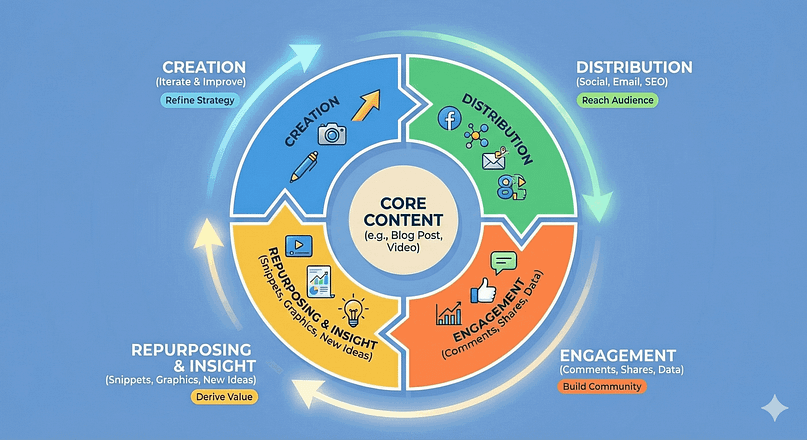
The Flywheel is a circular model where the momentum you generate in one stage feeds the next, creating compounding growth. Instead of losing energy at the bottom, the sale itself creates energy for the next cycle.
3.1. Breaking the Content Treadmill Cycle
The problem isn't the content itself; it's the expectation that content is a one-time campaign. If you treat content like a campaign—once it’s done, you stop—you’ll always feel like you’re running in place. The Flywheel forces you to think about how every piece of content contributes to the next action, not just the final sale.
3.2. Stages of the Content Flywheel
Content needs to be mapped to the three stages of the customer journey to keep the flywheel spinning. If you only focus on one stage, the wheel stalls.
Attract (Awareness)
This content solves top-of-funnel problems. Think of the person who knows they have a headache but doesn't know the cause. Your content educates them on the cause. (Example: "What is X?", "5 Signs Your Business Needs Y")
For an advanced way to attract and segment leads right at the top of the funnel, take a look at This Is My Proven Interactive Content Strategy for Lead Gen.
Engage (Consideration)
Once they know the problem, they start looking for solutions. This content builds trust and shows your expertise. It demonstrates how you solve the problem better than anyone else. (Example: "How to set up X step-by-step," Case Studies, Webinars)
One excellent way to turn those readers into highly qualified leads is to Boost Your Sales: How to Use Content Upgrades to Rev Up Your Conversion Rates.
Delight (Decision/Retention)
This content supports customers post-purchase and encourages advocacy. When your content helps your existing customers succeed, they become your best marketing channel, referring new people and restarting the "Attract" phase. (Example: Advanced tutorials, Community forums, Exclusive guides)
3.3. Measuring Content ROI: Beyond Vanity Metrics
If you’re investing time and money into content, you need to know it’s working. The true Return on Investment (ROI) of content is rarely measured by social media likes.
And since content is an asset, you also need to know How to Avoid Content Decay & SEO Optimize Your Old Posts so your investment keeps paying off. How to Avoid Content Decay & SEO Optimize Your Old Posts
Key Metrics for Content ROI
- Qualified Leads Generated: How many people converted from reading your content (e.g., downloaded an ebook) into a sales-qualified lead?
- Cost Per Acquisition (CPA) Reduction: Over time, your organic content should reduce the amount you have to spend on paid ads to acquire a customer.
- Customer Lifetime Value (CLV) Increase: Content that delights and retains customers makes them stick around longer and buy more.
If your content is generating leads that cost less and stay longer, that’s a successful content strategy.
A common mistake is creating content that only addresses the "Decision" stage—the stuff that screams "Buy Now!" If you haven't built trust in the Awareness and Consideration stages, no one will listen to your pitch.
You'll want to structure your content types based on where your audience is in their thought process.
4.1. The Three Stages of Need and the Content That Fills Them
The best way to structure your content library is to ask: What does my audience need to know right now? Then, create content that perfectly matches that need.
Content Mapping to the Customer Journey
Customer Stage | Audience Mindset | Content Goal | Example Content Types |
|---|---|---|---|
Awareness | "I have a problem, but I don't know the solution." | Educate and Define | Blog Posts, Infographics, Short Videos, Glossary Terms |
Consideration | "I know the solution, now who can provide it?" | Build Trust and Compare | Ebooks, Webinars, Case Studies, Comparison Guides, Tools |
Decision | "I am ready to buy, but need final confirmation." | Convert and Reassure | Testimonials, Free Trials, Product Demos, Pricing Guides, FAQs |
Content doesn't just mean words on a page. The best content strategy uses multiple formats to reach people where they prefer to consume information. You need to stop thinking about formats as interchangeable options and start viewing them as strategic tools, each with a specific job in the Flywheel.
5.1. Long-Form Text: The SEO Powerhouse
This is your foundation. Long-form text includes your blog posts, comprehensive guides, white papers, and detailed tutorials. These assets are critical for search engine traffic and establishing deep authority.
Benefits of Long-Form Text
When you write a 3,000-word guide that genuinely answers every permutation of a user’s question, Google rewards you. This format lets you capture a wide range of long-tail keywords and signals to search engines that you are the definitive source on a topic.
More importantly, it builds trust. Someone who spends 15 minutes reading your guide is deeply engaged. They are no longer a casual browser; they are actively seeking expertise, and you are providing it.
Best Practice: The Pillar Page
You might want to structure your text content using the "Pillar and Cluster" model. The Pillar is a massive, comprehensive guide on a broad topic (e.g., "The Ultimate Guide to Remote Team Management"). The Clusters are shorter, more specific articles that link back to the Pillar (e.g., "5 Tools for Asynchronous Communication"). This structure is excellent for SEO because it clearly maps your expertise and authority for both users and search engines.
5.2. Video Content: Building Personal Connection and Demonstrating Expertise
Video is no longer optional. It’s the fastest way to build a personal connection with an audience and demonstrate complex processes.
Benefits of Video
Video content, whether it’s short-form social clips or long-form YouTube tutorials, reduces the perceived distance between your brand and the viewer. Seeing a human face or watching a product demonstration unfold step-by-step is far more compelling than reading a static description.
Video is perfect for the Consideration stage. If your product is software, a detailed 10-minute video showing exactly how to set up a specific feature will convert far better than a screenshot gallery. It removes friction and answers unspoken questions before they become objections.
Best Practice: Focus on Utility, Not Production Value
Don't let the fear of fancy equipment paralyze you. A simple, well-lit video recorded on a modern smartphone that provides genuine utility is infinitely better than a highly polished video that says nothing. Focus on solving a problem clearly and quickly.
5.3. Audio Content: The Commuter Companion (Podcasts)
Podcasting is the ultimate format for capturing attention when your audience is busy doing something else—driving, exercising, or doing chores.
Benefits of Audio
Audio builds incredible loyalty. Listeners invite your voice into their headphones for 30 to 60 minutes at a time. This sustained, intimate exposure builds a level of rapport that few other formats can match. It’s a fantastic vehicle for thought leadership, interviews with industry experts, and deep-dive strategic analysis.
If your audience consists of busy professionals, a podcast lets them consume your most valuable content without requiring them to sit in front of a screen.
Best Practice: Consistency and Niche Focus
Podcasts thrive on consistency. Pick a schedule you can maintain (weekly or bi-weekly) and stick to it. Don’t try to cover everything. Find a very specific niche—the intersection of your expertise and your audience’s deepest pain points—and own it completely.
5.4. Interactive Content: The Lead Generation Engine
Interactive content is anything that requires the user to input information and receive a personalized result. Think quizzes, calculators, assessment tools, and surveys.
Why Interactive Content Works
This format is a lead capture machine because it offers immediate, high-value utility in exchange for contact information. People are happy to give up an email address if they get a personalized result—like a "Content Strategy Score" or a "Project Cost Estimate"—that they can use immediately.
Interactive tools are also incredibly engaging. They hold attention far longer than a static blog post and provide you with valuable zero-party data about your audience’s current situation and needs. This data is gold for segmenting your email lists and refining your product messaging.
The Content Asset Problem: Building the Engine
You understand the strategy now: Content is a compounding asset. But an asset is only valuable if it performs its job reliably—attracting traffic, building trust, and converting leads. You need a system that executes the strategy.
Here’s the reality check: Most marketing tools are built for campaigns, not assets. They focus on quick fixes and flashy pop-ups that annoy readers.
Your website should be the most reliable, high-performing asset you own.
Check out Thrive Suite—it's a unified system designed to execute your content strategy. It gives you the tools to build landing pages that convert, interactive quizzes that capture leads, and content that is structured for maximum authority and SEO performance. Stop piecing together tools that barely talk to each other. Get the integrated toolkit designed for strategists who care about building long-term equity.
If you want your content to truly function as a business asset, you can’t just publish and pray. You need systems that maximize the value of every hour you spend creating.
6.1. The 10x Content Rule: Creating Assets, Not Just Articles
I often tell clients to stop aiming for "good enough." Aim for 10x.
The concept is simple: Instead of writing ten average, 800-word posts that barely scratch the surface of a topic, create one piece that is ten times better than anything else online. This means it’s more comprehensive, better designed, more actionable, and perhaps includes original research or unique data. A 10x piece of content is a magnet. It attracts high-quality backlinks, dominates search results, and establishes you instantly as the authority on the subject.
6.2. Content Atomization: Getting 20 Pieces from 1 Asset
This is the secret to getting off the content treadmill. Once you have that single, massive 10x guide, break it down. You "atomize" it.
How to Atomize Your 10x Content
Take a 4,000-word ultimate guide:
- Pull out the key statistics for 10 social media graphics.
- Record yourself reading the introduction and conclusion for a short podcast episode.
- Turn the core framework into a slide deck for LinkedIn.
- Use the FAQ section to answer 5 separate questions on Quora or Reddit.
This strategy lets you maximize reach across various distribution channels without constantly needing new ideas. You create one asset, and you feed your entire ecosystem for weeks.
6.3. Content Audits: Pruning for Growth (The Gardener Approach)
Content isn't static. It decays.
"Content decay" occurs when an older piece of content that was once a high performer starts losing traffic and ranking position. Statistics become outdated, links break, and competitors publish better guides.
You'll want to conduct regular content audits (every 6–12 months) to identify underperforming assets. For every piece of content, you have three options: Update, Improve, or Delete. Sometimes, deleting an old, weak article is the best way to signal to search engines that the rest of your site is high-quality.
6.4. The Future of Content: AI, Ethics, and Community Building
If you’re building a strategy for the next three to five years, you have to look past today’s tactics. The landscape is shifting rapidly, driven by two major forces: the rise of generative AI and the audience’s demand for authenticity.
AI as a Co-Pilot, Not a Replacement
AI is here to stay, but it’s a tool for efficiency, not a shortcut to authority. You can use AI to draft outlines, summarize research, or generate ideas for atomization. Think of it as a highly capable, very fast junior assistant. It handles the mechanical work. However, the unique expertise, the strong opinions, the proprietary data, and the human voice—the things that make content 10x—must still come from you. If your content is 100% AI-generated, it will sound exactly like everyone else's, and you will lose the battle for trust.
If you’re worried about the writing part, remember that How AI Actually Enhances Creative Content (Not Kills It) when used correctly, so don't be afraid to leverage new tools.
The Ethical Imperative: Transparency and Trust
As content becomes easier to generate, the value of verifiable content skyrockets. Audiences are getting smarter about distinguishing between a genuine expert and a polished script. You build trust by being transparent about your sources, your data, and your methodology. If you use AI to assist in creation, don't hide it, but make sure the final output reflects your unique, human-vetted expertise. Ethical content sourcing isn't just a nice-to-have; it’s a competitive differentiator.
Shifting to Community-Centric Content
The next wave of authority building isn't just broadcasting information; it’s helping conversation happen. Instead of just creating content for your audience, you create spaces with them. This means investing in private communities, specialized newsletters, or exclusive content channels where your audience can interact directly with each other and with your experts. This shift moves you from being a publisher to being a community leader, which is the ultimate form of long-term customer retention.
The strategy sounds great on paper, but the reality of execution often hits roadblocks. Smart strategists anticipate these challenges and build solutions into their plan from the start. If you’re struggling to get momentum, chances are you’re hitting one of these common hurdles.
7.1. Gaining Executive Buy-In (Selling Content Internally)
The biggest challenge isn't usually the writing; it’s convincing the people who hold the budget that content is an investment, not a marketing expense. Executives are trained to look for immediate ROI, and content takes time.
To win this argument, you need to speak their language: money and risk. Stop talking about "brand awareness" and start talking about "Cost Per Acquisition (CPA) reduction." Show them the case study where a competitor’s blog post replaced $10,000 worth of paid search clicks. Frame your content plan as a hedge against rising ad costs and a way to build proprietary, owned assets that competitors cannot easily copy. When you show the CFO that content reduces risk and builds long-term equity, they listen.
7.2. Budgeting Content: Doing More with Less
If you don't have the budget for a full in-house team, you need to be surgical with your resources. The key here is focusing on quality over quantity, which we already covered, but also prioritizing high-impact formats.
You could try focusing your limited budget on a single, massive 10x piece of content once per quarter. Then, spend the rest of your budget on atomization and distribution (Section 6.2). It’s cheaper to hire a freelancer to turn a fantastic guide into 20 social snippets than it is to hire them to write 20 mediocre blog posts from scratch. When resources are tight, invest in the asset that will generate the most compounding returns, usually a comprehensive guide or a proprietary tool.
7.3. Structuring Your Content Team (Internal vs. Outsourced)
The question of who does the work often paralyzes new content initiatives. There is no single right answer, but there is a smart approach.
Internal vs. Outsourced Content Roles
You need to keep the strategy and the voice internal. Nobody knows your business, your customers, or your unique expertise better than you do. That means the Content Strategist and the Subject Matter Expert (SME) should be internal roles.
The production and distribution can often be outsourced. Writing, editing, graphic design, video editing, and SEO execution are all highly specialized skills that you can efficiently source externally. This structure lets you maintain quality and authority while scaling production capacity without bloating your internal payroll.
If the idea of a full-blown content strategy feels too big, let’s simplify. You don’t need a 50-page document to start. You need clarity and a commitment to consistency.
8.1. Step 1: Define Your Audience Persona (The Who)
Go beyond demographics. I don’t care if your audience is "25-45 year old women." I care about their fears, their aspirations, and the specific questions they type into Google at 11 PM when they can’t sleep. What is the single biggest problem your product solves? That problem is the center of your content universe.
8.2. Step 2: Identify Your Niche Authority (The Why)
Why should anyone listen to you? Every business has a unique perspective, a specific methodology, or proprietary data. This is your competitive edge. Your content should reinforce this authority. If you sound exactly like your three biggest competitors, you’re just adding noise. Find the unique angle only you can offer.
8.3. Step 3: The Minimum Viable Content (MVC) Plan
Don't try to cover everything at once. Focus on 5 core topics that solve immediate, high-value audience problems. Create one high-quality, 10x piece for each of those five topics. Publish them, distribute them effectively, and then measure the results for 90 days before expanding your scope. This focused approach checks that you prioritize quality over rushed quantity.
8.4. Step 4: Choose Your Home Base (The Where)
Select the platform you can master first. This usually means starting with a blog or resource center on your own website. Remember, social media platforms are rented land. Your website is the only platform you truly own. All your distribution efforts—social posts, emails, ads—should ultimately drive traffic back to your owned assets where you control the conversion environment.
Content marketing is a long-term strategy. While initial traffic spikes might occur within 3–6 months, significant ROI, such as consistent lead generation and authority ranking, typically takes 9–18 months of consistent, high-quality effort. Patience is key.
So as you can see content marketing is not a temporary trend. It's the fundamental shift in how businesses earn attention and build trust in the digital age.
If you view content as a strategic asset (something that builds equity, generates compounding returns, and reduces your reliance on expensive paid channels) you move past the noise. You stop chasing short-term traffic spikes and start building lasting authority.
Start building your content assets today. They are the foundation of tomorrow's growth, and they are the smartest investment you can make in your business.
Ready to Build Your Content Assets That Convert?
You've done the hard work of creating 10x content. Now, you need the tools to make those assets perform. The difference between content that sits on a server and content that converts is the execution—the landing pages, the quizzes, the smart opt-in forms.
It’s an integrated system that lets you build, test, and measure your assets without friction, so you can focus on the strategy, not the code. See how Thrive Suite helps smart strategists build profitable content assets and accelerate their ROI.


