
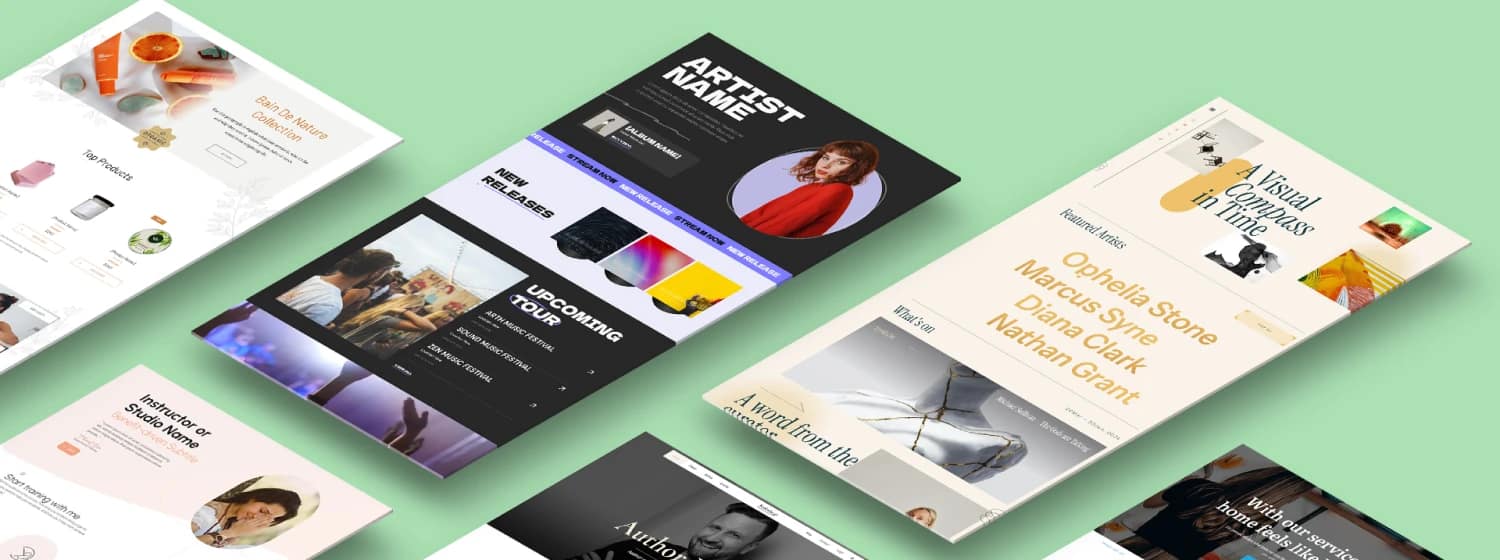

TL;DR: Building a Personal Branding Website That Actually Works
You know that feeling when you search for someone online and find… nothing? Or worse, outdated, irrelevant stuff? This guide is all about making sure that doesn't happen to you. I'm going to show you how to build a personal branding website that puts you in control of your online story, helps you stand out, and brings opportunities your way.
Here are the three big ideas I want you to walk away with:
- See what good looks like first: I break down nine real personal branding websites, including two Thrive customers and my own, so you know exactly what you're building toward.
- Strategy comes before design: Before you pick colors, figure out what your site needs to do for you, who it's for, and what you want to be known for. This makes building it so much easier.
- You can build it yourself, strategically: I'll walk you through the essential elements and show you how to use tools I trust (like Thrive Theme Builder and Thrive Architect) to create a site that feels like you, without needing a design degree.
If you're ready to stop blending in and start attracting the right opportunities, I promise this guide will give you a clear path forward.
You know, sometimes I Google myself.
(It’s called personal brand management, okay? And yes, I do it.)
When I do, the first few results are usually my personal branding website, my LinkedIn profile, and a couple of TEDx talks I gave back in my third year of university (yes, that TED). What's interesting is those exact links helped me land my first real online opportunities , while I was still in school. Things really took off from there.
That's the thing about having a personal branding website: it works for you even when you're not in the room. It’s one of the smartest ways to take control of how you show up online and what people remember you for.
Social media is great, but it only tells part of your story. A personal site gives you the full stage , your voice, your work, your way. It’s your digital home base, a place you fully control, where you tell your story, showcase your work, and connect with the right people.
If you don’t have one yet, you might feel like you’re already behind. And honestly? You kind of are. Think about this:
So, if you're applying for jobs, freelancing, launching something new, or just tired of blending in online, now is the time to take control of your narrative.
In this guide, you'll see what a great personal branding website looks like first: nine real examples, including two from Thrive customers and, yes, my own. Then I'll walk you through building yours, from the key elements and platform choice to the exact tools I use in my own stack.
Let’s make something you’re proud to send people to.
It's all about taking charge of your narrative, and if you're an entrepreneur, you'll definitely want to check out our guide to personal branding for entrepreneurs.
What to Include on Your Personal Website: Key Elements for Impact
A personal branding website isn’t one size fits all. It takes different shapes depending on what you want your brand to do for you , attract clients, land opportunities, or build long-term authority.
At the very least, your site should clearly communicate who you're, what you do, and how someone can work with or contact you. A strong personal branding website typically includes:
Your Homepage: The First Stop
Your homepage is your elevator pitch in website form: who you are, what you offer, and where to go next. You just watched nine sites do this, and Justin's page is basically this checklist executed perfectly.
- Headline: A clear, benefit-driven statement that says who you're and what you do.
- Introduction: A short paragraph that expands on your headline and sets the tone.
- Call-to-Action (CTA): What do you want people to do next? (e.g., "Learn More," "View Portfolio," "Book a Call").
- Social Proof: A few key testimonials or logos of places you've worked.
💡Creating that perfect first impression is important, so here's how to create a homepage that really makes a strong impact.
About Me/Bio: Building Connection
This is your story, not your resume. What drives you, what you value, and what makes you, you.
- Your Story: How did you get here? What drives you?
- Your Values: What's important to you in your work?
- Your Expertise: Briefly highlight your key skills and experience.
- Professional Photo: A high-quality, authentic image that looks like the real you.
💡Getting your story right on your site is super important, and we've got a guide on how to build an 'About' page on WordPress that helps you do just that.
Portfolio/Work Samples: Show, Don't Just Tell
Don't just list past projects. Show what your work changed for the people who hired you.
- Case Studies: Detail the problem, your solution, and the results.
- Project Galleries: Visual examples of your work (design, photography, writing samples).
- Media Features: Links to articles, podcasts, or videos where you've been featured.
💡If you're looking to really impress with your past work, you might want to check out our guide on creating a portfolio website that lands clients.
Services/Offerings: How You Help People
If you sell services or products, spell out what you do, who it's for, and how to hire you.
- Clear Service Descriptions: What do you offer? What problems do you solve?
- Target Audience: Who do you help specifically?
- Process: Briefly explain how you work.
- Pricing (Optional): You might include starting rates or package details.
Testimonials/Social Proof: Credibility in Action
Nothing builds trust faster than other people vouching for you.
- Client Quotes: Short, impactful statements from satisfied clients or colleagues.
- Logos: If you've worked with recognizable brands, display their logos.
- Endorsements: Screenshots of LinkedIn recommendations or social media praise.
💡Collecting and showcasing those glowing reviews is simpler than you think, and this guide shows you how to collect and display testimonials effectively.
Contact Page: Make it Easy to Connect
Don't make people hunt for a way to reach you.
- Contact Form: A straightforward way for people to send you a message.
- Email Address: A professional email address.
- Social Media Links: Direct links to your active professional profiles.
💡Making it easy for people to get in touch is key, and our step-by-step guide to creating a contact page in WordPress will walk you through it.
Blog/Insights: Your Voice as a Thought Leader
If you want to share your ideas, establish authority, or improve your site's SEO, a blog is a powerful tool.
- Regular Content: Share articles, guides, or reflections relevant to your expertise.
- Industry Insights: Offer your unique perspective on trends or challenges.
- Resource Library: Curate helpful tools or downloads for your audience.
A blog can really drive your authority, and if you're thinking bigger, creating a content hub on WordPress can take that to the next level.
Clear Calls to Action: Guiding the Journey
Guide visitors to one next step on every page. And audit your CTA against your own copy, like I had to on my site: my page invites people to work with me and the button still says "View Resume." If the copy and the button make different invitations, one of them is lying.
Optional but powerful: a lead magnet that helps you grow your email list. This could be a checklist, a template, or a short guide related to your expertise.
Top Personal Branding Website Examples (and What Makes Them Work)
Before we dive into the techy stuff, let’s get inspired.
A great personal branding website doesn’t need to be flashy or complicated , but it does need to be intentional. These three examples show how different styles, professions, and personalities can shine online while still ticking all the right strategy boxes.
Ali Abdaal: Calm, Clear, and Conversion-Friendly
I discovered Ali Abdaal back in 2020, somewhere between pandemic boredom and “maybe I should get my life together.” I found him on YouTube and he quickly became one of my all-time favorite productivity creators.
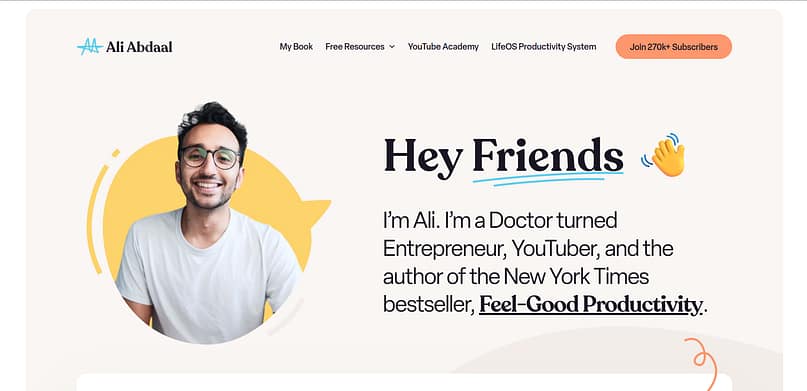
His website is just like his content: calm, clear, and quietly persuasive. It opens with a strong personal statement, offers a handful of thoughtful resources (hello, free Notion templates), and directs you to his courses or newsletter without shouting. It’s clean, conversion-friendly, and built to work on autopilot.
- A short, snappy headline that explains exactly what you do.
- An opt-in form with a freebie that actually feels valuable.
- A homepage that feels like a welcome mat, not a sales pitch.
Ann Handley: Smart, Warm, and Completely Human
Ann Handley is one of the reasons I became a better writer. Her book Everybody Writes should basically be required reading if you create content, and her website reflects everything she teaches.
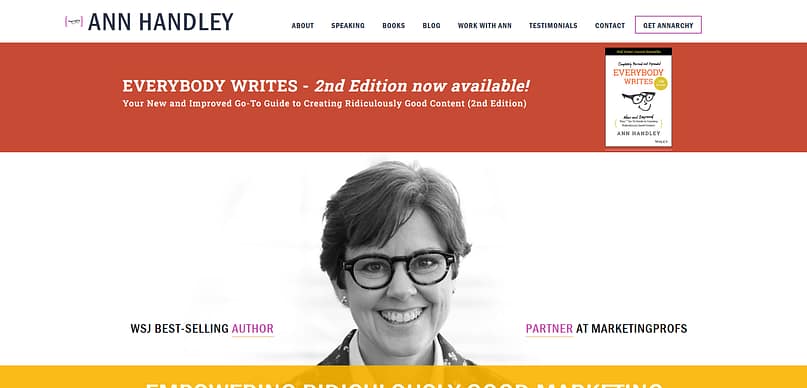
It’s smart, warm, and completely human. From the dog cameo on her About page to her wonderfully nerdy newsletter signup (“Total ANNARCHY”), everything feels like her , voice, humor, and all. But it’s not all fluff: you’ll also find her speaking reel, portfolio, and ways to work with her clearly outlined.
- A strong, consistent tone of voice that matches your brand.
- A photo that looks like the real you, not a stiff headshot.
- Playful CTAs and copy that sound like a human, not a robot.
Chris Do: Authority Through Evolution
Chris Do helped me survive my visual media degree , truly. I’ve been following him since the days his site declared, “I help creatives make money doing what they love.”
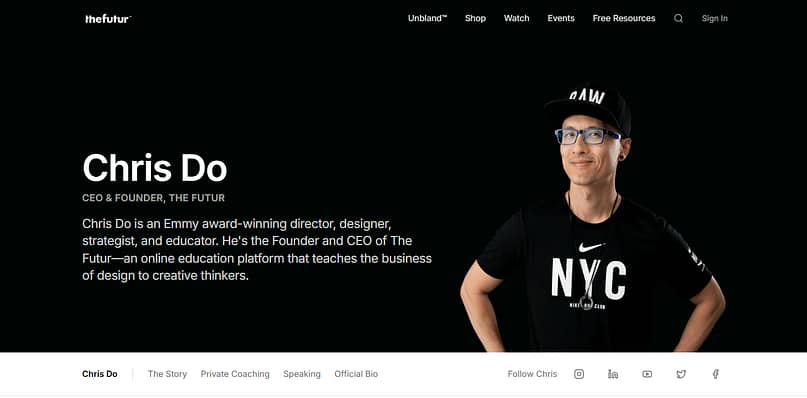
These days, that bold line’s gone, but the mission is still loud and clear. His site now leads you into The Futur: a hub for creative entrepreneurs packed with masterclasses, coaching, and resources to help you build a brand and a business.
- A brand that evolves with you.
- Authority through valuable, clear content.
- A site that feels serious but never stiff.
Your personal branding website doesn’t have to be perfect , it just has to feel like you and give people a reason to stick around. And yes, you can build something just as clear, beautiful, and strategic using tools that don’t require a design degree. I’ll walk you through exactly how in the next section.
Justin Welsh: One Offer, Zero Noise
Justin Welsh runs one of the most talked-about one-person businesses on the internet, and his website behaves exactly like you'd hope: it does one thing.
I'm not an avid follower of Justin's brand, but it wouldn't make sense to not include him in this list of examples to follow.
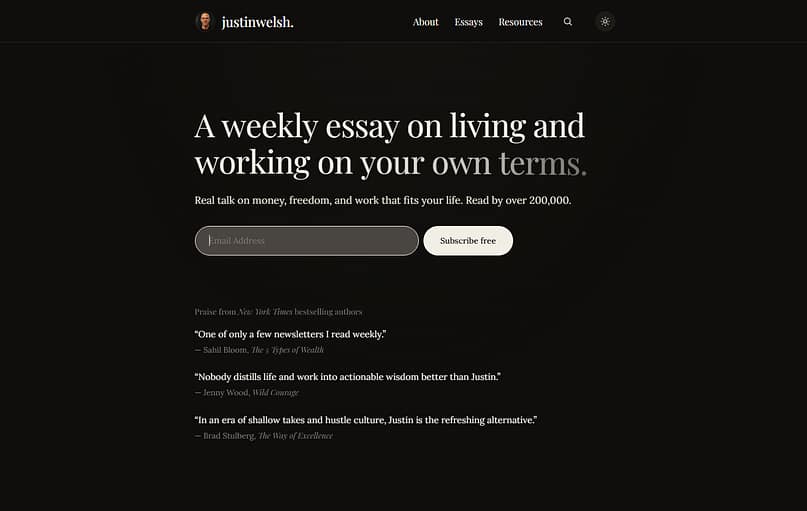
Justin's whole homepage is an invitation to his newsletter, and I love how disciplined that is.
The headline sells the essay, not the man: "A weekly essay on living and working on your own terms."
The subline stacks the proof: "Real talk on money, freedom, and work that fits your life. Read by over 200,000."
Then an email field, a "Subscribe free" button, and quotes from bestselling authors. That's it. Honestly, the restraint is what impressed me most. I kept waiting for the usual grid of offers or a popup fighting me for attention, and it never came. The site knows its job is to start a relationship, and it trusts the newsletter to do the rest. I think that takes more confidence than most of us have.
Seth Godin: The Earned Exception
I open Seth Godin's daily newsletter religiously. He's been in the marketing/branding space for a while but I've always been fascinated by his, almost, "against the grain" approach.
Earlier in this guide I tell you to lead with what your visitor came for. Seth Godin leads with his mission instead: "The work of spreading ideas that matter." So is he breaking the rule?
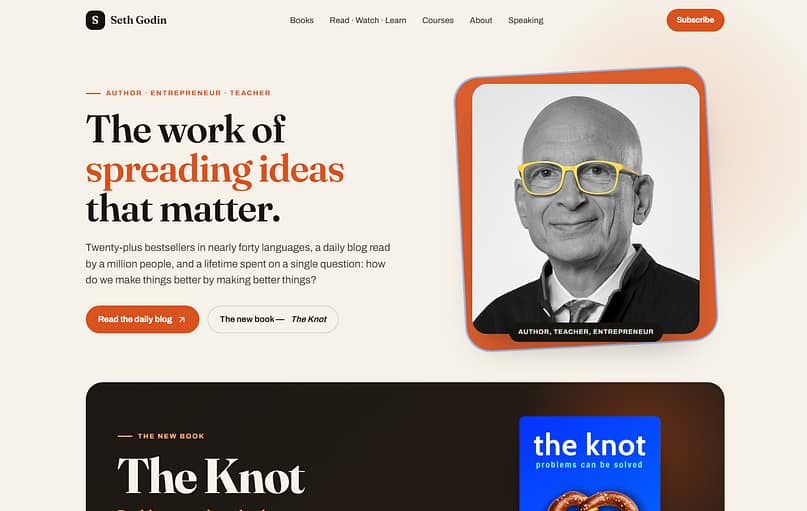
Well let's look at it like this: the subline is quietly doing the outcome work, and it's doing it with receipts. "Twenty-plus bestsellers in nearly forty languages, a daily blog read by a million people, and a lifetime spent on a single question."
When your credentials read like that, mission-first is not a risk, it's the brand. The detail I liked most is the primary button: not "join my list," but "Read the daily blog." No lead magnet, no bribe, just an invitation into the work itself.
I went in expecting to find something to critique, and instead I caught myself admiring how every choice assumes you'll stick around once you start reading. Even the famous yellow glasses are doing the visual identity work a whole brand palette usually has to do.
Just be honest with yourself about the lesson here: Seth earned every rule he breaks. If you're still building your name, borrow his clarity and his consistency, not his exceptions.
Amy Porterfield: The Confident Funnel
Amy Porterfield's site is what it looks like when a personal brand and a course business are the same machine, tuned and humming.
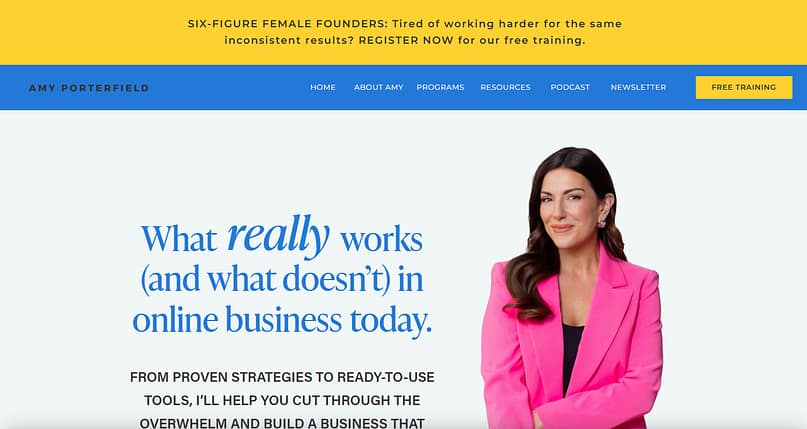
I expected the usual course-creator clutter here, because Amy sells a lot of things.
Instead, the headline promises curation, which is exactly what her overwhelmed audience wants: "What really works (and what doesn't) in online business today." I like the portrait too; that pink blazer against the blue is a brand decision, not an outfit.
But what won me over is where everything points. There's a whole menu up top, programs, podcast, newsletter, yet the announcement bar and the standout button agree on one priority: the free training. Many offers, one dominant path. That's the discipline I find missing on most multi-offer sites.
Debi McKee (Rescue Dogs 101): The Audience Is the Hero
Debi is one of our own customers, and her story is worth reading in full (her case study is on our blog).
Her site, built with Thrive Theme Builder, shows a version of personal branding nobody on this list so far represents: the personal brand where the person steps back and the audience steps forward.
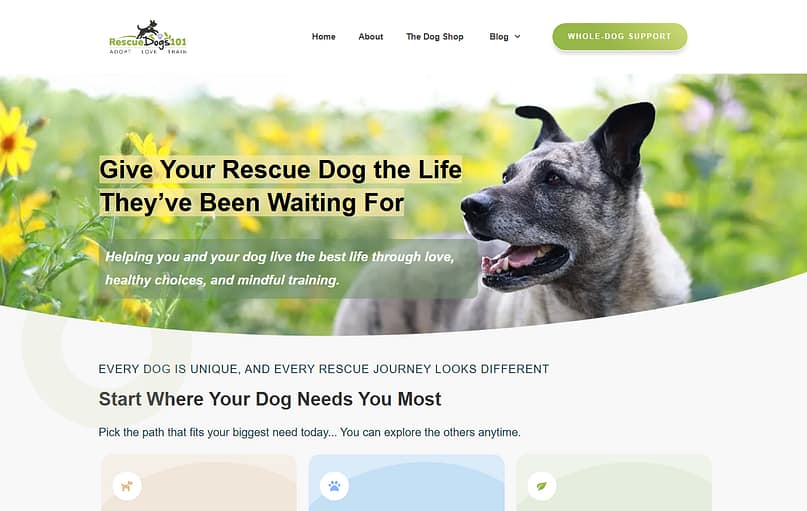
The hero isn't Debi.
As you can see, it's a rescue dog, mid-grin, and a headline aimed straight at the reader's heart: "Give Your Rescue Dog the Life They've Been Waiting For."
I'm a sucker for dogs, so this was perfect to me. And for Debi's cause and target audience, it's perfect too.
I know everything in personal branding says show your face... But this page makes the case that the smarter move can be showing your reader's world instead. Debi's expertise powers everything, but the site leads with the visitor's dog, not the founder's face.
Then comes my favorite touch: a "Start Where Your Dog Needs You Most" section that routes readers by their actual problem ("Pick the path that fits your biggest need today... you can explore the others anytime"). That's the same routing move I use on my own site, executed as pick-a-path cards, and it works because rescue-dog owners arrive with very different emergencies.
Camille Freeman (Bloom & Grow): One Reader, Named Out Loud
Camille is also a Thrive customer (her case study is on our blog too, and lesson four in it is about newsletters, which will make sense in a second). Her site is the cleanest demonstration on this list of the most underrated branding move there is: naming your reader.
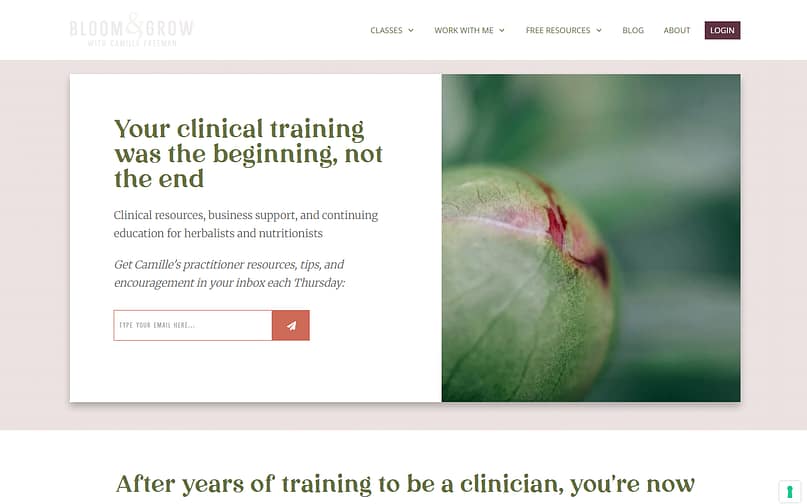
The headline speaks to one precise person: "Your clinical training was the beginning, not the end."
I read that and immediately knew who it was for, and just as importantly, who it wasn't for. If you're a herbalist or nutritionist staring down the business side of practice, that sentence grabs you by the collar, and the subline confirms it's for you: "Clinical resources, business support, and continuing education for herbalists and nutritionists."
Everyone else bounces, and that's the point. The detail I keep coming back to is the newsletter signup (running on Thrive Leads, since we're keeping receipts in this article): it promises practitioner resources in your inbox "each Thursday." Not "subscribe for updates." A named day, a named reader, a named outcome. I like everything about that.
And Finally, Mine: Chipo Faith (Practicing What I Preach)
It would be a little rich of me to review everyone else's personal branding website and then hide my own. So here it is, last on purpose, with the same honest treatment. And remember those Google results I mentioned at the start? This site is the reason they exist.
My site has one job: helping people who just met my work somewhere (a byline, a talk, a newsletter) land in one place and get to know me. That's why the headline is simply "Hi. I'm Chipo," with "writer, speaker, and marketer" right below it.
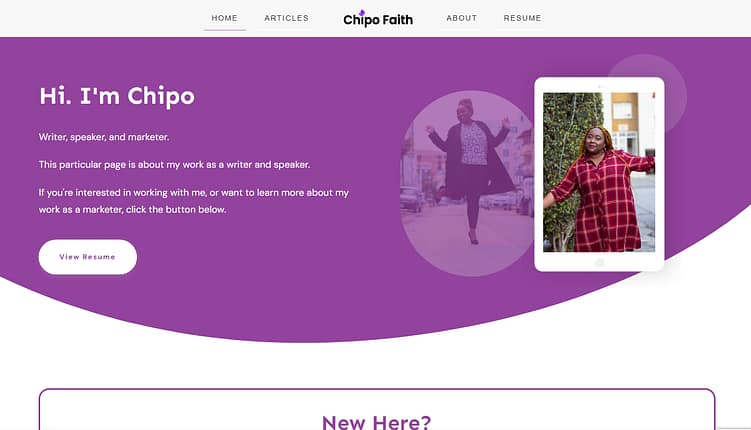
On a personal branding site, YOU are the outcome visitors came for, so leading with identity isn't skipping the value proposition; it IS the value proposition. The photos have movement and joy in them on purpose, because on a personal site, the person is the product demo.
There's a more subtle decision in the copy, too. I wear a few hats, so one line scopes the page: it tells visitors this site is about my work as a writer and speaker, and routes everyone else where they need to go. One honest scoping line beats a homepage that tries to please everybody.
And in the spirit of honest reviews: the thing I'd still change is my button. My copy invites people to work with me, and then the CTA says "View Resume."🫠
A resume is for employers; the people I'm inviting want to see work and start a conversation. That mismatch is on my own fix list, and I'm showing it to you anyway, because a perfect self-review would just be an ad, and because your first version will have something like this too. Mine still does.
(Built with Thrive Theme Builder and Thrive Architect, which happens to be exactly the stack I walk you through later in this guide.)
So that's what good looks like, mine included. Different styles, different professions, same underlying move: each of these people owns their story online instead of renting it from an algorithm. When someone Googles them, the first impression is theirs.
That's the job your site will do for you, and you just saw the exact toolkit I built mine with. So let's build yours. Here's what needs to be on it first.
Laying the Foundation: Your Pre-Build Strategy
Already know what you're building? No prob!
It’s tempting to jump straight into picking themes and templates , but your personal branding website should be more than just a good-looking homepage.
To make it work for you (and not just exist), you need to lay the right foundation. Here’s what to think through before you touch a single design element:
Before you get lost in the fun stuff, it's smart to plan your website like someone who actually wants results.
1. What’s the purpose of this website?
What do you actually want it to do for you?
- Help you land freelance clients?
- Act as a digital resume?
- Position you as a thought leader?
- Capture leads for your business?
Your answer shapes everything , from your copy to your homepage layout.
2. Who is this site really for?
It’s your personal brand, but it’s not just about you. Think about your ideal audience:
- Who are they? (Potential clients, employers, collaborators?)
- What are they looking for?
- What questions do they've that you can answer?
If you understand your audience, you’ll build a site that speaks their language and holds their attention.
3. What do you want to be known for?
This is your positioning. Your hook. Your differentiator. Ask yourself:
- What’s the thread that ties your skills, values, and experiences together?
- How do you want people to describe you after visiting your site?
- What makes your approach or personality stand out?
This doesn’t have to be perfect. Focus on being honest. The goal is clarity, not branding buzzwords.
When it comes to your brand, sometimes you need to break the rules of small business branding to really stand out
Once you’ve got these three things on paper (yes, write them down), everything else becomes easier. I mean content, structure, design, and even SEO.
And if you're wondering whether a full website or something more focused is right for your goals, it's helpful to understand the difference between landing pages and websites.
Your Pre-Flight Checklist: 4 Things to Secure Before You Build
Before you start picking themes or obsessing over fonts, there are a few non-negotiables you’ll want to have locked in.
This is your foundation , the behind-the-scenes stuff that makes everything else run smoother and look more professional. Skipping these steps is like showing up to a job interview in your pajamas. Technically possible... but not the vibe.
Here’s what to sort out first:
✅ A Clean, Professional Domain Name
Ideally, this is YourName.com. If that’s already taken, go for something simple and relevant , like YourNameConsulting.com, YourNameWrites.com, or even YourName.co.
Pro tip: Register a few variations to protect your brand, and consider adding domain privacy to keep your personal info off the internet. Most domain providers make this easy (and cheap).
✅ A Professional Email Address
Skip the [email protected]. You’re building a brand , not applying for student discounts.
Something like [email protected] or [email protected] looks instantly more legit. You can usually set this up directly through your domain registrar or hosting provider.
✅ High-Quality Headshots
Yes, you need them. Even if you hate being on camera.
At minimum, aim for:
If you’re not ready to book a photographer, grab a tripod and natural light , and take the time to frame a shot you’ll feel good about.
✅ Your Core Elevator Pitch
This is the heart of your homepage copy , and it should be sharp before you ever open a website builder.
Can you clearly say who you help and how you help them in one or two lines?
Think:
“I help founders turn scattered thoughts into strategic content.”
“I’m a visual designer for SaaS brands who want their sites to actually convert.”
Get this nailed down, and everything else , from your About page to your CTA , flows much easier.
How to Build Your Personal Branding Website
Your site doesn’t need bells and whistles. It just needs to be thoughtfully built, aligned with your goals, and easy to navigate , the kind of site that makes someone say, “Ah, I get what they do,” within a few seconds.
How to Choose Your Platform: A Quick Comparison
Before we dive into the specific tools I use, let's talk about options. There are a lot of ways to build a personal website, and the best choice for you depends on your comfort level with technology, your budget, and how much control you want.
Platform | Ideal User | Ease of Use | Cost (Approx. Annually) | Customization Level |
|---|---|---|---|---|
WordPress.org | Control-freaks, bloggers, developers | Medium to High | $50 - $300+ | Unlimited |
Squarespace | Creatives, visual brands, minimalists | High | $150 - $300 | Medium to High |
Wix | Beginners, small businesses, drag-and-drop | High | $120 - $300 | Medium |
Webflow | Designers, agencies, advanced users | Medium to Low | $150 - $500+ | High |
Carrd | Simple one-page sites, quick launches | Very High | $19 - $49 | Low to Medium |
We'll be building our website on WordPress, so you'll need to purchase a domain name, choose a web hosting provider, and complete the WordPress installation process. If you've never done any of that, my how to build a website guide walks through that part step by step. Once you've got that done, you can hop into this tutorial using the tools I actually use and recommend.
1. Install Thrive Theme Builder and Thrive Architect
Want a standout website for your personal brand? Thrive Theme Builder and Thrive Architect are the duo I build with. They're also the stack behind my site and Debi's Rescue Dogs 101 from the examples above, so you've already seen what they can produce.
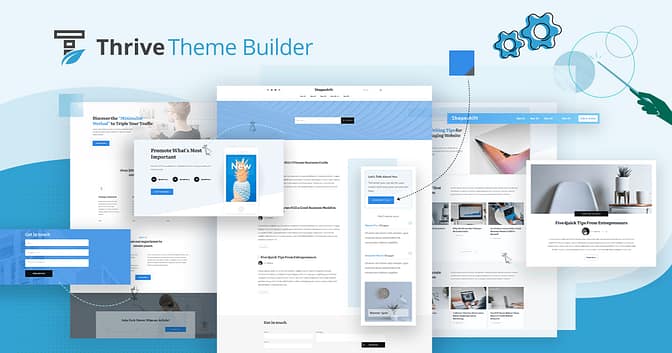
Thrive Theme Builder handles your site's structure: colors, fonts, header, footer, and page layouts, all visual, no code. Thrive Architect is the drag-and-drop builder you'll use for the pages themselves. Both are designed for non-technical users, which means you can get a professional site live entirely by yourself.
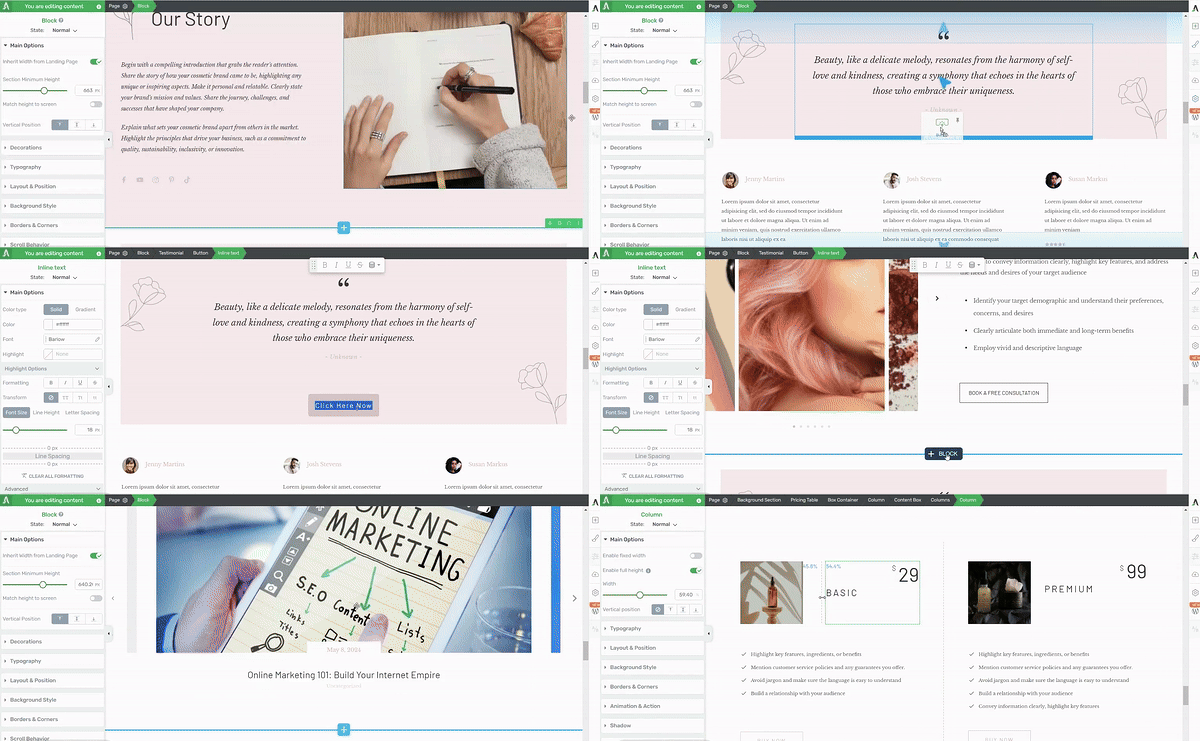
Thrive Architect in action
The best part? These tools are designed with non-technical users in mind. If you're new to WordPress or an experienced user looking for efficiency, you can create a professional-looking website that sets you apart from the crowd, all by yourself.
Take charge of your online presence with Thrive Theme Builder and Thrive Architect. These tools make it simple to build a website that not only looks great but also helps your personal brand grow and attract opportunities.
2. Activate & Launch Thrive Theme Builder
Thrive Theme Builder helps you create your website’s structure in less than 10 minutes.
We have a few themes I often recommend, like Xpert, which is a sharp theme for consultants, coaches, strategists, and other people-oriented entrepreneurs. Ommi is a warm, aesthetic multi-purpose theme that’s great for business owners, job-seekers, or thought leaders in a variety of niches. And Bookwise is the perfect theme for authors and independent writers.

Thrive Theme Builder in Action
The best part about these themes, though, is that you can use any theme to build your website. So, if you want to use a theme like Allure, for example, which was “originally” designed for beauty and cosmetics brands , you can hop in and turn it into an elegant design for your own personal brand.
Like I said , total design control.
Pro tip: You’ll be happy to know that our templates are mobile-friendly and built with search engine optimization (SEO) in mind, giving you a head start in getting your website to rank.
3. Set Up Your Site Structure in a Few Clicks
The Thrive Theme Builder Setup Wizard helps you select all the web page templates, a color palette, and fonts you need for your clean web design , and it only takes a few minutes to do this.
This wizard walks you through setting up the following:
- A sitewide logo for light and dark modes.
- Your entire site’s color scheme by choosing your primary brand color. (This color scheme will automatically appear on all your website templates, fonts, blocks, etc.)
- A conversion-focused header for straightforward site navigation.
- A focused footer to add contact information, your business address, links to social media platforms (Facebook, X, LinkedIn...), etc.
- The perfect homepage template for your site.
- A template for your blog posts.
By the end of the Setup Wizard, you'll have created a clean website layout that you can customize using Thrive Architect. All of our theme templates also come with other default page templates , 404 page, about page, contact page, etc. You can find them in the “Templates” section in Thrive Theme Builder.
See how easy it's to create your site structure? No complex code, no struggling to figure out which step is which… Just a straightforward, user-friendly process to help you get started fast.
4. Create and Customize Your Core Pages with Thrive Architect
Next, you need to create the rest of your site’s pages with Thrive Architect, our landing page builder plugin.
This tool gives you total control over your website’s look and the design flexibility to turn any template into a unique page. You also get a drag-and-drop editor to customize your pages with ease.
Our page templates are there to help you build pages quickly. They all look great and can easily be customized with a few clicks, drags, and drops.
But the real design magic is in our block templates. You can add new blocks to your pages if you feel like something’s missing, or delete the ones you don’t want , in one click.
And in case you need more design options... just take a look at the right sidebar in the Thrive Architect editor. These elements give you further granular control over your site’s appearance. You also get more ways to customize different aspects of your pages to make them more interactive or conversion focused.
5. Finalize Your Homepage
Once you’ve created your custom pages, I recommend finalizing your homepage next.
When you were working through the Thrive Theme Builder Setup Wizard, you got started creating your Homepage template… A homepage is automatically generated for you, so you don’t need to create a new page or configure any other homepage settings.
You’ll find it in the "Pages" section in the WordPress Admin Dashboard. Search for the page titled "Generated Homepage". Click on the link, and you’ll be taken to the WordPress Block Editor (Gutenberg) space from the WordPress Dashboard. In the Editor, click “Launch Thrive Architect”.
As you work on your page design, you may need to add new sections (e.g., a drop-down menu, widgets area, social proof block, or FAQ section) or remove a few. You can go right ahead and use the block templates and design elements to customize your homepage’s look.
Pro tip: Want to learn how to create an engaging, high-quality homepage that'll grab your audience’s attention, build trust, and push them to convert? Check out this handy guide.
6. Connect Your Site to Your Email Marketing Service
Connect your email service through the Thrive API. You will only need to do this once for the first opt-in form you set up. You can find tutorials for all major email providers here.
Go to your homepage or landing page and click on the opt-in form (if you've one on your page). In the sidebar, click on "Connect form with service" and follow the setup wizard. You'll be able to configure the fields you want to show (yes or no first name field), and you'll also select the action after opt-in.
Pro tip: Setting up your email marketing tool is one step. But, do you've a clear idea on how to grow your email list and generate leads? This detailed guide can help.
Personal Website Design Tips: Making Your Site 'Feel Like You'
- Design for mobile first: Most visitors will see your site on a phone. Make sure layouts, buttons, and text are easy to use on smaller screens.
- Improve for speed: Large images and bloated themes slow sites down. Fast pages improve user experience and search visibility.
- Create a clear visual hierarchy: Use headings, spacing, and contrast to guide attention. Visitors should instantly know where to look and what to do next.
- Make accessibility part of the design: Readable fonts, sufficient color contrast, and clear navigation help make sure your site works for everyone.
- Use real photos: Ditch the generic stock images. Your audience wants to see you.
- Write like you talk: Let your personality shine through your copy. Avoid jargon and stiff language.
Bonus: Simple SEO Tips for Your Personal Branding Website
You don’t need to become an SEO wizard to get noticed , but a few smart moves can seriously boost your site’s visibility and help the right people find you.
Here are three low-effort, high-impact tips to get started:
Beyond Clients: The End Game of Your Personal Brand Website
Your personal site does more than build credibility. It's an asset that grows with you, and eventually it can pay for itself. Once it's live and attracting the right people, here's where it can lead:
You don’t need all of this today. But knowing your direction helps you build with intention.
FAQs About Building a Personal Branding Website
I get a lot of questions about personal branding websites, and that's a good thing! It means people are thinking strategically about their online presence. Here are some of the most common ones I hear, along with my take on them.
How do I create a personal branding website?
In five steps: decide what you want the site to do and who it's for; secure a clean domain, professional email, good headshots, and your elevator pitch; pick your platform (I build on WordPress); build your core pages with a visual tool like Thrive Theme Builder and Thrive Architect; then publish and improve it as you go. The full walkthrough for every step is in this guide, and the examples above show you what you're aiming for.
What should a personal branding website include?
At minimum: a homepage that says who you are and what you do, an About page that tells your story, proof of your work (a portfolio, case studies, or media features), and an easy way to contact you. Add a services page if you sell services, and a blog if you want to build authority over time. The Key Elements section above breaks down each of these.
Do I really need one if I'm already active on LinkedIn and social media?
Social profiles are rented space: the algorithm decides who sees you, and the platform owns the audience. Your website is the one place online you fully control, and it's usually among the first results when someone searches your name. So keep posting on LinkedIn, but let it point somewhere you own. Every example in this guide does exactly that.
How much does it cost to build a personal branding website?
Less than most people expect. A domain runs about $15 a year, decent hosting starts around $3 to $5 a month, and WordPress itself is free. A visual builder setup like the one I use starts around $199 to $299 a year [confirm exact pricing at publish]. All in, you can run a professional personal branding website for a few hundred dollars a year, which is less than most people spend on subscriptions they forgot about.
How long does it take to build?
The structure takes minutes, not weeks: Thrive Theme Builder's setup wizard builds your site's skeleton in about ten minutes. Give yourself a weekend for a version one you're proud of, maybe one day for your homepage and About page, another for your work samples and contact page. Then publish it and improve it as you go. Every site in the examples above kept evolving after launch, including mine.
Should the domain be my name?
Ideally, yes: YourName.com is the cleanest signal that this site is you. If it's taken, add what you do (YourNameWrites.com) or try a different ending like .co. Just keep it simple enough to say out loud on a podcast without spelling it twice.
Next Steps: Create a Lead Magnet to Build Your Audience
Now that your personal branding website is live, let's talk about attracting the right people. Creating a lead magnet doesn't have to be overwhelming , think of it as your digital handshake.
Here's what to do:
- Pick one problem you're really good at solving (yes, just one!).
- Create something simple but valuable , maybe a checklist, template, or quick guide.
- Make it look decent (but don't get stuck in perfectionism).
- Add it to your website with a clear sign-up form.
- Tell people about it on your social channels.
Remember, you're not trying to change the world here , just helping one person solve one specific problem. Start small, learn what works, and adjust as you go. Your future audience will thank you for it!
And for more technical details on creating a lead magnet (and funnel) to grow your audience, check out this tutorial.
Ready to Start Building Your Personal Website?
Now you’ve seen how easy it's to go from zero to a clean, engaging personal website using Thrive Architect and Thrive Theme Builder.
As a bonus here are 4 free resources/tutorials to help you drive the right traffic to your website and grow your brand:
As you get more comfortable with our user-friendly tools, you'll start refining every detail to turn your simple design into an impressive website that offers your visitors an amazing user experience , and also gets them to work with, buy from, or hire you.
But most of all, make sure to have fun and I can’t wait to see what you build!


Personal branding lets you control the narrative of your professional image.
With your templates it’s so easy to build a website….been using thrive themes for years and keep on doing this for the next years…
Thanks for this helpful blog post personal branding is so important to reach more potential clients and stand out from the competition.
About how long does it take to build a Perfect Personal Branding Website?
Lately I have created my website using Thrive themes and after years of not being so sastisfied of the work I had done by myself, now I can really say I have a beautiful and functional website! Thanks Thrive!
This is a very helpful article. I have used Thrive Themes in the past and it was very helpful in developing this kind of site.
Wow, I didn’t realise thrive offered so much customisable templates!
Thanks for the useful tips
Very helpful post!
Building a brand is important in standing out in the market! Thanks for the detailed yet simple guide in learning out to do it!
I understand how this could help me move forward in my career.
I truly love how innovative and user-friendly this website builder seems.
Thrive looks like an easy way to build a customized site.
Having a personal blog opens a plethora of options for online earning.
I have been learning and implementing these techniques to earn through online media with the help of having a blog.
Thanks for making this guide to make beautiful website with just drag and drop.
This is a great way to market yourself and promote your projects. A personal brand is key as people trust people.
Awesome oportunity to grow !
Very informative. Please keep the information coming!