

TL;DR: My Top WordPress Theme Picks
I tested all eight WordPress themes on the same website, and here’s the quick version:
- SeedProd is one of the easiest tools to get started with. The setup is straightforward, the templates import properly and you don’t have to jump between multiple editors.
- Hello Elementor is a solid option for beginners who want a familiar visual page-building experience.
- Astra gives you plenty of templates and flexibility, but you’ll probably need Spectra, Elementor or another builder to get the visual editing experience you want.
- Bricks and Divi offer a lot of control, but they make more sense for experienced users, designers or people willing to spend time learning the system.
- GeneratePress is best suited to people who already enjoy block-based building and want a lightweight, modular setup.
- Ollie is the best free option if you want to explore WordPress’s native Site Editor and see how far block-based website building has come.
- And Thrive Theme Builder (yes, it’s ours) ended up as my top overall choice for building a cohesive, professional business website, especially paired with Thrive Architect. I saved it for last here and in the reviews, and if that makes you skeptical, good. Read on and judge whether it earns the spot.
The biggest thing to keep in mind is that choosing a WordPress theme usually also means choosing its page builder, editing system and wider plugin stack.
So don’t only look at the prettiest demo or longest feature list. Choose the setup that matches how you actually want to build and manage your website.
You know why you’re here. I know why you’re here. So let’s jump into it.
You’re here because you either have a theme in mind and this article will be the one to sway you (to push your opinion over the finish line) or you’re trying to figure out whether the theme you’re considering is actually as good as people say it is.
Can I call myself an expert?
Yes, because I’ve been working with WordPress for more than eight years. I’ve worked with multiple tools and themes. I’ve used WordPress.org, and I’ve set up different types of websites for clients across industries like fitness, health, personal coaching, etc.
And that was me as a freelancer.
For the past four years, I’ve also been working with Thrive Themes to help business owners and website owners like you create the best online platform possible to meet their needs, connect with their audience and make sales.
So this article is more than a promotional pitch, because you don’t need another promotional pitch. You’ve probably seen enough of them.
This is my raw, unfiltered experience with every single WordPress theme on this list.
I’ve used every single one of them and set them up on the same site so I could experience them the way you would.
And I’m writing this assuming you’re either a first-time user trying to find the right WordPress theme or website builder, or you’re a busy professional looking for something that will help you build your business site quickly, easily and professionally.
You’ve come to the right place.
The Quick Answer: All 8 Themes at a Glance
Quick word on the order before you scan. In the reviews, I saved our tool for last so it has to earn its place. In this table, it goes first, because a comparison table is for skimmers, and hiding my actual pick in row five would just be fake modesty. Every tool here wins a real category. Find the row that sounds like you.
Theme | Best for | Starts from | My honest verdict |
|---|---|---|---|
Cohesive, conversion-focused business sites | $199/yr | My personal pick, and the tool I use on my own website. It solves the disconnected-workflow problem I kept hitting everywhere else. Reviewed last, so you can see the receipts first. | |
Agencies and template variety | Free (Pro from $99/yr) | Massive template library and real flexibility, but decide on your builder (Spectra or Elementor) before you buy, or the stack grows fast. | |
People already committed to Elementor | Free (Pro from $60/yr) | One of the easiest starts on this list. Gets a little duct-tape at the granular level. | |
Designers and developers with time to learn | $89/yr | Divi 5 is genuinely smoother, but it is still heavy machinery for the average user. | |
Users willing to learn, and developers | $79/yr | Meets you at every level, from design sets to custom code. Navigation takes some getting used to. | |
Block-editor fans who want a lightweight, modular setup | Free (Premium $59/yr) | My starter-site import did not match the preview. Go in comfortable with blocks. | |
Beginners and busy owners who want one dashboard | Free (paid from $39.50/yr) | The most seamless setup I tested. What you see is truly what you get. | |
Free, native WordPress and trying FSE | Free | WordPress catching up. Simple, decent, budget-friendly. |
What I Was Looking for in a WordPress Theme
Before we get into the individual reviews, let me explain what I was actually looking for.
Almost every WordPress theme on this list can technically help you build a website. They all have templates, customization options and enough features to create something decent.
That isn’t really the question.
The question is: how much work will it take you to get there?
For each theme, I looked at:
- How easy it is to get started. Can I install it, open the dashboard and immediately understand what to do next?
- Whether the templates actually work as advertised. Does the site I import resemble the preview, or am I immediately trying to figure out what went wrong?
- How straightforward the editor is. Can I click, drag, drop and customize the page, or do I have to jump between multiple editors and dashboards?
- How many extra tools I need. Does the theme work well on its own, or will I need another page builder, form plugin or paid upgrade?
- How much flexibility it gives me. Can I keep the template simple, or customize it further when I want the website to feel more like mine?
- Who the theme is actually for. Is it better for beginners, busy business owners, agencies, designers or developers?
So, as you can see, I’m not only looking for the theme with the longest feature list. I’m looking at whether a first-time user or busy professional can get a professional-looking website online without turning website design into their new full-time job.
There isn’t one theme here that will be perfect for everybody.
But by the end of this breakdown, you should have a much clearer idea of which one makes sense for you.
A Quick Heads-Up: You’ll Probably Need a Page Builder
Before we get into the reviews, there’s one thing you should know.
Choosing a WordPress theme usually isn’t only about choosing the theme anymore. In most cases, you’re also choosing the page builder or editing system that works with it.
Some themes come with their own builder. Others are designed to work with tools like Elementor, Spectra or the WordPress block editor. And sometimes, while you can use the theme on its own, you’ll get much more out of it once you add a separate page builder.
That isn’t necessarily a bad thing, by the way.
Page builders came into the picture because they filled a real gap in WordPress. They made it easier for regular people to visually design their websites without needing to code or fight their way through the older WordPress editing experience. (If you want to go deeper on that debate, I’ve broken down Gutenberg vs. page builders separately.)
So when you’re comparing the themes below, don’t only ask, “How much does the theme cost?”
Also ask:
- Which builder does it work with?
- Is that builder included?
- Is the free version enough for what I need?
- Will I eventually need to pay for both the theme and the builder?
- How easy is it to manage the two together?
There are exceptions. Some block themes work well with WordPress’s native Site Editor, and some theme builders already include most of the visual editing experience.
But in many cases, your actual setup will be the theme plus the builder.
Just keep that in mind before you make your decision.
FSE vs. Traditional Themes (A Quick Guide)
WordPress has shifted a lot in the past few years. Traditional themes still work beautifully, but Full Site Editing (FSE) is clearly the platform’s long-term direction. The good news: you don’t have to pick a “right” side. You just need the one that matches how you like to build.
In simple terms:
FSE vs. Traditional Themes: Quick Comparison
Feature | Traditional Themes | FSE (Block Themes) |
|---|---|---|
Ease of Use | Very beginner-friendly | Moderate learning curve |
Design Flexibility | Guided templates | Full-site customization |
Performance | Good, varies by theme | Often excellent (lighter structure) |
Tools Needed | May require a page builder | Works natively in WordPress |
Best For | Users who want simplicity | Users who want control and modern design |
Future-Proofing | Still supported, widely used | Growing fast; WordPress’s long-term path |
So, what should you choose?
If you want the quickest path to a beautiful, functional website, I’d say a traditional theme or a visual theme builder will feel more natural. You’ll get up and running with less fuss. (But be warned, there are some things they don’t tell you about no-code website building that you should definitely know.)
If you enjoy modern layouts, minimal plugins and the idea of shaping every part of your site visually, an FSE theme like Ollie or Twenty Twenty-Five will feel exciting and future-ready. You’ll see exactly how that went for me in the Ollie review below.
If you’re somewhere between the two, don’t overthink it. Pick the theme that lets you build without friction. The goal is momentum, not complexity.
Here's My In-Depth Breakdown of the Best WordPress Themes in 2026
Before you dive in: this is not a ranked list. The reviews below run in the order I tested each theme, not from best to worst. Every theme was set up on the same website, with the same expectations, so the comparisons stay fair. (And yes, our own tool comes last. You know why by now.)
Each review walks through what it was actually like to use the theme: getting started, the templates, the editor, and who I'd honestly recommend it to. Read them all if you're serious about this decision, or jump straight to the ones that sound like your situation.
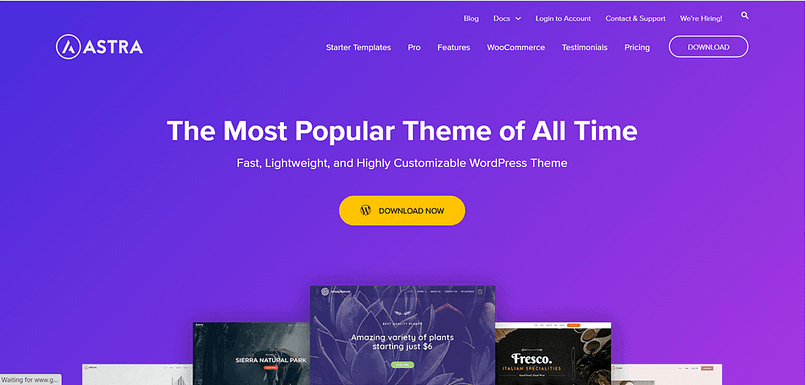
Fun fact: I’m pretty sure when I started getting into WordPress.org about seven or eight-odd years ago, Astra was actually the first WordPress theme I installed.
It was in the Themes section in the WordPress backend. It looked good, and when I went through the preview, it showed me all these templates. I installed it and started messing around with it until it told me I needed to use a page builder called Elementor.
Another fun fact: Elementor was actually the very first page builder I used on WordPress. It led me down the road of page builders, which completely transformed my experience. (More on that later)
So, returning to Astra for a guide like this, I was curious to see how it fared. It was still boasting templates, AI features, etc., and it looked impressive.
Installing it and hooking it up to a license was pretty quick. I was using Astra Pro, and this is important. I wanted to see what I would get from the paid experience rather than only testing the free theme.
Getting Started Wasn’t Immediately Obvious
Once I installed it, I noticed a bit of friction with getting started. I had to move around and figure out, okay, where am I actually supposed to go?
The dashboard showed me a wide array of options. When I clicked “Customize,” it took me to the WordPress Customizer, which, full disclosure, I’m not the biggest fan of.
That is because I’m someone who likes something quick, convenient, and instant. The WordPress Customizer and block editor work well, but they require a level of time and granular focus that I don’t feel busy professionals necessarily have the patience for.
Eventually, I found the site builder option, which is where Astra helps you build the website.
You start by picking a template. Astra has a wide variety of templates (like, wide), which is great for agencies and freelancers. But if you’re someone walking into this looking for a simple template to get your website started, you might experience some intense overwhelm.
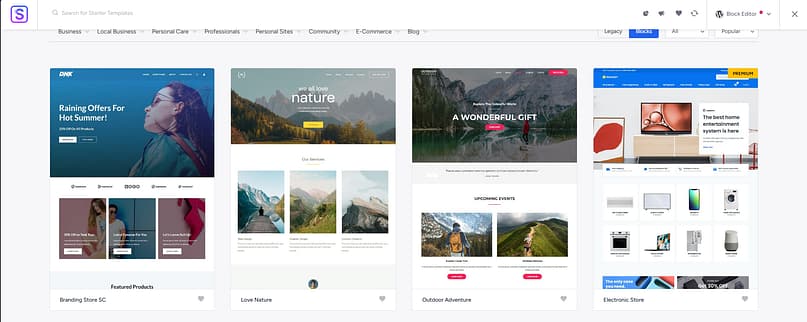
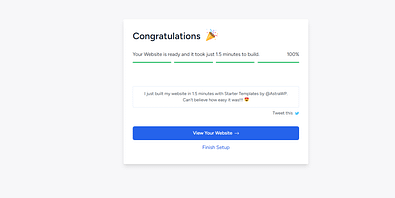
I kept it simple and picked a coaching template. After I went through the setup wizard, Astra told me I had built my site in 1.5 minutes, which was great, until I visited the site and saw that it was still the template.
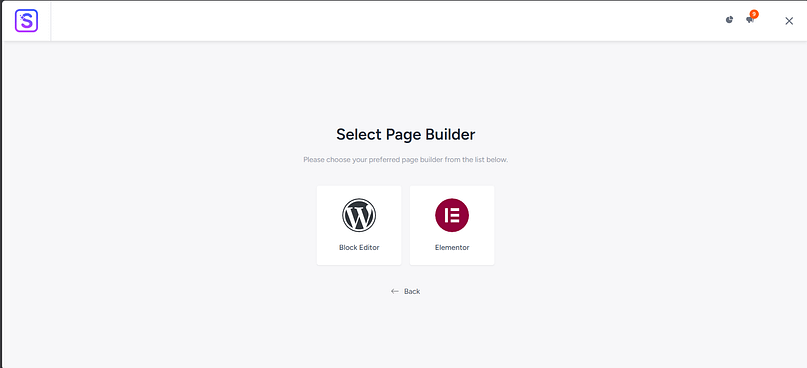
I still needed to customize it. I could use the WordPress block editor with Spectra, Astra’s block-based page builder, or choose Elementor instead.

Now, the free version of Spectra is pretty good. It gives you more blocks and design options than the native WordPress editor alone, so you may be able to build the website you want without paying for another tool.
But it still means installing and learning another plugin. And if you eventually want some of Spectra’s more advanced features, those sit inside Spectra Pro.
The Tool Stack Starts Growing Quickly
Listen, if Astra was a free theme and I needed to add Spectra or another page builder to enhance it, no problem. But I was already paying for an Astra plan, and now I potentially needed another tool to get the visual design experience I wanted.
That tool could be Spectra, Elementor or something else. The free version may be enough for you, but depending on the features you need, you could eventually run into another paid upgrade.
So this constraint of needing to get A to do B was already a little frustrating to me.
When you use Astra’s site builder, you’re also given the option to add other features. You can add forms, bookings, a page builder, etc. Some of these require you to install additional plugins, which is understandable.
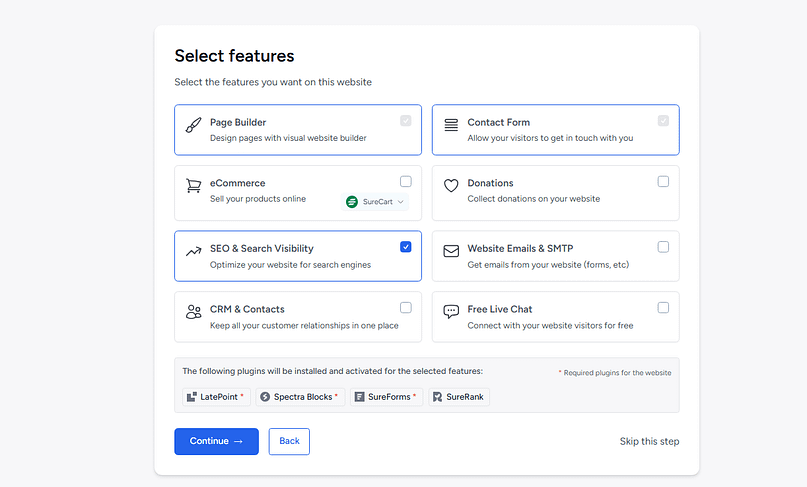
I just tend to (and this may be a personal preference, but it’s something I say to people I work with) avoid building a wide stack of tools from the beginning. You don’t necessarily know what that stack is going to look like in the long run.
A lot of these tools also come with their own upgrade requirements. Yes, they have basic features, but if you want to get the most out of them, especially as a business owner, you may eventually have to pay more.
So imagine I’ve already paid for Astra Pro. I don’t want to use the block editor, so I decide to use Elementor. Now I may need an Elementor plan, which currently costs around $60 a year for one basic website.
That price is fair. But do you see how many things are going into simply setting up the website?
Before I’ve even really started customizing it, I have to consider the theme, the page builder, the form plugin, the booking plugin and which of those tools might eventually require paid upgrades. That can be a little frustrating, I’m not going to lie.
Who Is Astra For?
I would say Astra is for someone who wants flexibility and doesn’t mind choosing how the different parts of their website-building setup will work together.
If you already know that you like Elementor, Spectra or another page builder, Astra gives you a solid foundation and a wide selection of templates to start from.
It could also work well for agencies and freelancers because the template library is wide (like, wide) and gives you plenty of options for different types of websites.
But if you’re a beginner who expects Astra Pro to be one completely self-contained visual website builder, you may experience a little friction.
You need to understand which editor you’re going to use, which extra plugins the website needs and whether any of those tools may require their own paid upgrades later.
So I would say Astra is best for someone who values flexibility over having everything contained inside one tool.
My Overall Experience With Astra
Overall, Astra is a good theme. I can see why it is one of the most popular WordPress themes and why so many people recommend it.
The templates look good. There is a lot of variety. You have the freedom to use Spectra, Elementor or another builder, depending on how you prefer to work.
But I think that flexibility can also be where some of the confusion comes in.
When I got started, I had already paid for Astra Pro, gone through the Site Builder and been told that my website was ready. But I was still sitting there thinking, okay, what do I use now?
Do I stick with the native block editor? Do I install Spectra? Do I use Elementor? Which features are free, and which ones might require another upgrade later?
That is the main thing I would want someone to understand before choosing Astra.
It gives you a strong foundation, but depending on the experience you want, Astra may only be one part of the website-building stack.
If you are comfortable using the block editor with Spectra, you may be able to create a solid website without paying for another builder. The free version of Spectra is good, even if some of its more advanced features are limited to Spectra Pro.
If you prefer something like Elementor, that is also an option. Just keep in mind that you may eventually end up managing and possibly paying for more than one tool.
And again, there is nothing inherently wrong with that. People have built excellent websites with Astra.
But if you are a beginner or a busy business owner who wants one completely streamlined website-building experience, you may find the number of decisions a little frustrating.
So would I recommend Astra?
Yes, particularly if you want flexibility, a wide selection of templates and the freedom to choose your own page-building setup.
But I would recommend going into it with a clear idea of how you want to build your pages and which additional tools you may need.
The templates are great. The theme is flexible. The setup just may not be as all-in-one as it first appears.
Starting Price: The Astra theme itself is free. Astra Pro starts from $99 for your first year and renews at $149 per year, with bigger bundles above that.

As I said earlier, Elementor was actually my introduction to WordPress page builders.
Before that, I was very much a Wix, Squarespace, heck, even ClickFunnels kind of person when setting up websites and funnels for clients during my freelance days.
At some point, one of my clients was like, “Look, this pricing for ClickFunnels is a bit much. Do we not have another alternative?”
And I was just like, “Well, I mean, you could use WordPress.”
I had limited knowledge of WordPress at the time, but I set up hosting, installed WordPress and ended up at Elementor. It was one of the page builders that was recommended.
I was able to replicate a ClickFunnels funnel right there in WordPress. Did it take me a lot of time? Yes. I was a beginner. But it goes to show you the power that is in the Elementor page builder.
Hello Elementor Is More of a Blank Canvas
For a while, I knew Elementor mainly as the go-to supporting page builder for themes like Astra, Kadence, etc. But Elementor now has its own theme called Hello Elementor.
And it really is a minimalistic theme. It serves more as, I would say, a canvas. You’re not going to get a lot of bells and whistles out of the theme alone, because it’s designed to work with the Elementor page builder. That is also how Elementor describes it: a lightweight, minimal foundation that gives you a blank canvas for building the rest of the site.
This means that if you choose Elementor, you don’t necessarily have to go and look for a separate premium theme.
Remember the problem I mentioned before? If you pay for a premium theme that works with Elementor, you could end up paying for two plans: one for Elementor Pro and another for the Pro version of the theme, its templates and whatever else it includes.
Hello Elementor removes part of that problem because the theme itself is free and is specifically designed to work with Elementor.
You’ll Get More From It With the Elementor Builder
You can technically use Hello Elementor with the WordPress Block Editor and its limited theme settings, if you have the patience to do so.
Again, the WordPress Block Editor and Customizer have made leaps and bounds, but I still find them quite limited compared to using a dedicated page builder. And that’s especially the case here, because Hello Elementor is intentionally very minimal.
You’ll get way more out of it by using the Elementor builder and, depending on what you need from the website, probably an Elementor Pro plan.
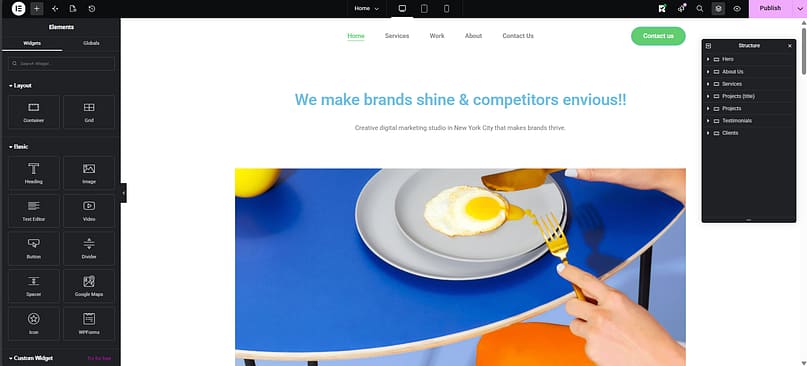
The free version is good. You get the visual drag-and-drop builder and enough features to create basic pages, add images and get a simple website going. But when you want more advanced features, such as building parts of the theme, adding forms or accessing more professional tools, you may need to upgrade.
Elementor also has a good selection of templates. I wouldn’t say it’s an overwhelming amount. I feel like it gives you enough variety without making you feel too overwhelmed.

And because of the strength of the Elementor page builder, you can basically take any template and customize it.
Where Elementor Started to Feel... A Little Janky
My only gripe with Elementor, and one of the reasons I eventually started looking for alternatives, was that while I could build my websites, it sometimes felt like the website was being held together by duct tape.
My first personal website was actually an Elementor website. The features would work, but they sometimes required a workaround, or the builder wouldn’t really let me express my fullest creativity.
If you’re just looking for a plain website (“I just want a website, a basic page builder to set it up and get it going”), you can absolutely get that out of Elementor.
But if you want more customization, you may need to spend more time with it. The more granular you get, the more it can start to feel a little janky, especially if you’re not experienced with WordPress.
Not every business owner has the time to learn how to build everything. Sometimes, you kind of just want a tool that lets you get it done, you know?
Who Is Hello Elementor For?
Hello Elementor is for someone who already knows they want to use Elementor.
That sounds obvious, but I think it matters.
The theme itself is very minimal. It gives you the canvas, and Elementor is where most of the actual website-building experience happens.
If you’re a beginner looking for a straightforward visual builder, Elementor is still one of the easier tools to understand. You know where to go, you know where to get started and there’s minimal friction.
You can use the free version to build a decent, simple website. If you want more advanced features, you may eventually need Elementor Pro, but you don’t necessarily need to start there.
I can also see it working well for freelancers and small business owners who want plenty of templates and customization options without having to learn the native WordPress editing experience.
But if you want to get extremely granular with your design, you may eventually find yourself using workarounds or feeling like things are being held together by duct tape.
So I would recommend Hello Elementor to someone who wants an accessible visual builder and enough flexibility to grow, but maybe not someone who already knows they want the most advanced or seamless design system possible.
My Overall Experience With Hello Elementor
Compared to some other tools, where you have to go through the Customizer or spend time figuring out where everything lives, Hello Elementor and the Elementor page builder provide a pretty straightforward, in-depth offering of templates, customization and ease of use.
I would say it’s up there in terms of ease of use. It’s pretty straightforward. You know where to go, you know where to get started and there’s minimal friction.
So I would actually put Hello Elementor as one of my more up-there themes.
Starting Price: Hello Elementor is completely free. Elementor Pro starts from $60 per year for one website.
I’m going to keep it 100 with you: Divi is not one of my favorite WordPress themes or tools to use.
I know it’s one of the bigger names in WordPress. It comes with templates, layouts, design elements, forms, pop-ups and a wide variety of functionality. It’s popular for a reason.
But in my opinion (and this is an opinion you’ll probably find consistently in some of my other reviews on this website), I’ve always felt like Divi was doing too much for the average personal user.
Not too long ago, though, someone said to me, “Hey, Divi has upgraded. There’s Divi 5 now, and it’s so much better.”
So I went into this review with a slightly fresher perspective. I wanted to see whether Divi 5 could change my mind.
How Easy Is It to Get Started?
Listen, I’m really strict about how easy it is to get started.
In my head, I should be able to click on the dashboard and immediately know where to go. But I’ve noticed that quite a few WordPress themes and plugins don’t work like that. They may give you a dashboard, but you still have to look around and figure out where everything lives.
And if I’m going through that with more than eight years of WordPress experience, someone with less experience, or someone who simply doesn’t have time to search, is probably not going to enjoy it.
Divi was a bit better in that regard. I was able to use Quick Sites to get a starter website set up relatively quickly.
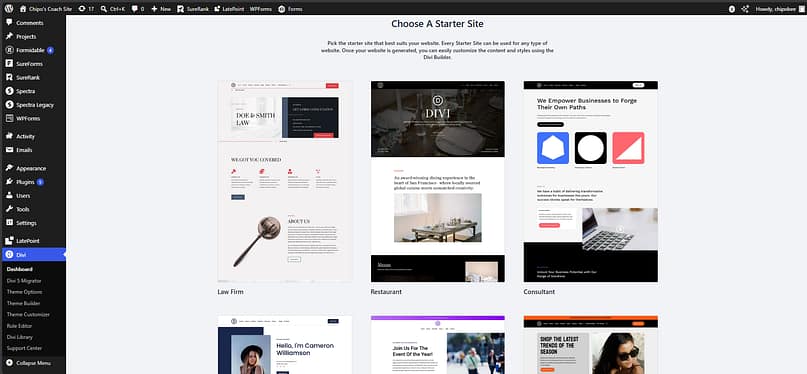
Quick Sites and Layout Packs Can Feel Disconnected
Where I experienced some confusion was in the relationship between Quick Sites and Divi’s layout packs.
Quick Sites helps you generate the structure of a complete website. Then, when you open or create an individual page, you can access Divi’s broader library of layouts and layout packs.
The layout packs include coordinated designs for different pages and website types. The selection is wide, which gives you plenty of options to work with.
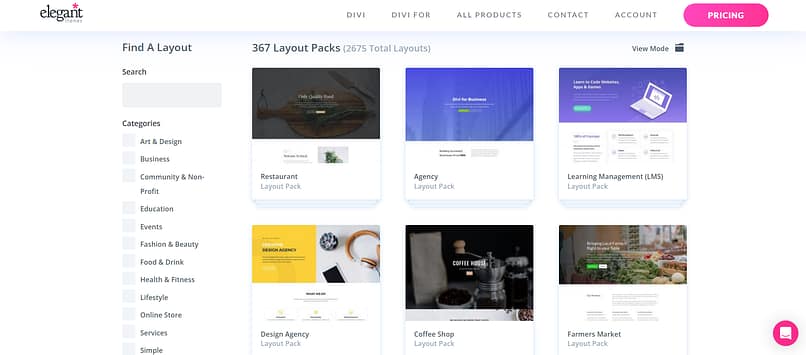
That wide selection can be a blessing or a curse, depending on which side of the WordPress-user spectrum you belong to.
If you’re an agency or freelancer building websites for multiple clients, this is great. You have a huge variety of designs, and they’re fully customizable.
But if you’re a business owner who only wants to build one website, the number of choices can feel overwhelming. I also wish the transition between setting up a Quick Site, editing its pages and bringing in additional layouts felt a little more cohesive.
I prefer tools where the path from setting up the website to customizing it is completely straightforward. I don’t want to go up, down and all around the corners trying to understand which part of the tool I should be using.
The Divi Editor Is Heavy Machinery
In terms of customization and features, the Divi editor is heavy machinery, in my opinion.
It has a point-and-click system. If you want to edit a particular item, such as a heading or image, you select it and then use the panel on the right to find the content and design settings you need.
It’s intricate.
Compared to when I used Divi in late 2024 or early 2025, it felt smoother this time around. I didn’t experience as much frustration while trying to set everything up in 2026.
But it’s still a lot to deal with.
Having to select and customize every individual element works well if you’re a web designer who does this for a living. It gives you granular control over what you’re creating.
But if you’re a busy professional or a beginner who’s just trying to get something solid set up, you might find it frustrating.
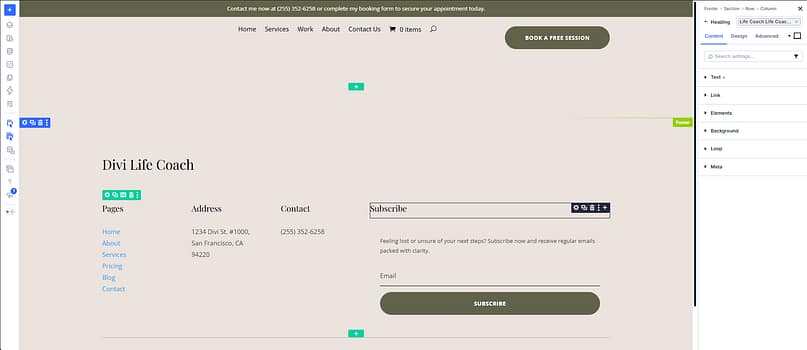
I don’t think the editor is bad. I just think it’s different.
Compared to Elementor, for example, the drag-and-drop process and its settings feel easier to work with. The same applies to Thrive Theme Builder and Thrive Architect, where you drag, drop and customize elements in a way that feels pretty straightforward.
Divi is more intricate and, I would say, slightly more complex.
Who Is Divi Best For?
If you’re a WordPress designer, developer or someone with experience using different builders, you’ll probably find Divi fine.
You have a large library of layouts, extensive customization settings and enough functionality to create very different websites for multiple clients.
But if you’re a busy entrepreneur, a professional who wants to get a website online quickly or a complete beginner, I would not recommend letting Divi be your first rodeo.
It could get complicated.
Divi gives you a lot, but you need time to understand how everything works. That makes it more suitable for someone who wants extensive control and is willing to learn the system than someone who simply wants the most streamlined experience possible.
My Overall Experience With Divi
When I compare Divi 5 to my previous experiences with Divi, I can see the difference.
The interface feels smoother and more user-friendly to an extent. I didn’t feel as much frustration while setting things up, and there is clearly a lot you can build with it.
I still wish there were more cohesiveness between Quick Sites, layout packs and the process of customizing the individual pages. I also still feel like Divi may be doing too much for the average personal user.
But overall, it’s decent. You get value for money, and the theme gives you a wide array of features for building a custom website.
You’ll just need the time and patience to really learn how it works.
Starting Price: Divi starts from $89 per year for unlimited websites. The bigger Divi Pro bundle, which adds Divi AI and other services, is $277 per year.
I think it’s still fair to describe Bricks as one of the newer kids on the WordPress block, even though it has actually been around for a few years now.
I started hearing about Bricks when I joined Reddit at the beginning of 2025. I was spending more time in WordPress communities, trying to keep up with what was going on and what people were saying, and I kept seeing people recommend it.
Yes, give or take, we know that sometimes people promote tools for their own reasons. Maybe they work for the company or have some other incentive. Oops, can I say that?
Anyway, I had heard that Bricks was pretty impressive, so I thought, you know what? It belongs on this list.
It has developed a fairly enthusiastic following, and after using it, I can see why.
Getting Started Took a Little Familiarization
Familiarizing myself with Bricks was a little touch and go in the beginning.
But for the first time in a while, I actually read the getting started guide, and honestly, shout-out to them for that. It was easy to find, included screenshots and was simple to go through. I could quickly understand the gist of what I was supposed to do.
Bricks works a little differently from a traditional WordPress theme. Bricks itself is both the theme and the visual site builder. There is also an optional child theme available if you need to make more advanced modifications.

It’s still very canvas-like, kind of like Hello Elementor. The theme gives you the foundation, but the magic happens when you start adding templates and building out the website.
And, I suppose, it’s in the name: you build your website brick by brick. You get it?
For a regular page, you create the page in WordPress, click “Edit with Bricks,” choose a template or start from scratch, and build from there.
There is a bit of back and forth involved when creating multiple individual pages, which can feel slightly janky in 2026. But I’ll kind of let it slide because the process itself really isn’t that difficult.
Bricks also lets you create reusable templates for things like headers, footers, blog posts and other parts of the site, so you don’t necessarily have to rebuild every repeated section manually.
Wireframes and Design Sets Make It Easier
Once you get into the editor, things are pretty straightforward.
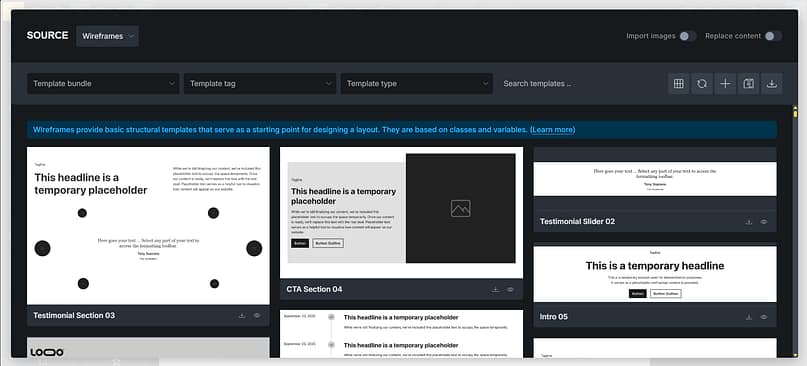
You can start from scratch or open the template library from the toolbar. From there, you’ll see options including wireframes and design sets.
Wireframes are more like individual blocks or layouts that you can add to a page. They focus on the structure rather than giving you a completely finished design. You’ll find sections for things like headlines, testimonials, cards, grids and other areas of a page.
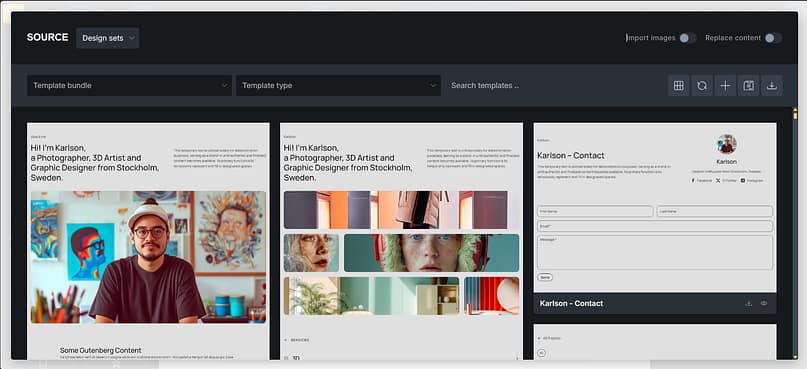
Then there are the design sets, which are more complete, fully designed templates. They come with coordinated pages, colors and design elements that make it easier to get started without building everything from nothing.
The only gripe I had was that I spent quite a bit of time scrolling through the options to see what was available.
It would be cool if the collections felt slightly easier to browse, where you could click into one design set and immediately see everything included inside it instead of moving through so many different templates and wireframes.
But overall, they look good. They’re high quality, easy to add to a page and the process is pretty straightforward compared with some of the other tools I’ve used.
So I can definitely see the appeal.
The Editor Is Clear, but the Menus Take Time
The editor itself is pretty clear.
I like big writing, good spacing and an interface that’s easy to click through and drag and drop.
The menus do get a little complicated, especially once you start clicking on individual elements. I appreciated having the Structure panel, where you can click through the different parts of the page rather than trying to select everything directly on the canvas.
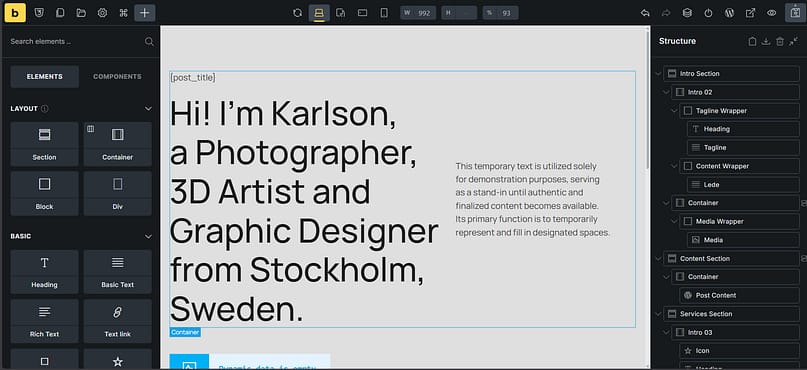
But I struggled to get back to the original Elements panel on the left with the different items you can add.
I feel like, with a bit more time, it would become easier to navigate. That felt more like a learning-curve issue than something fundamentally wrong with the editor.
Overall, I think the editor works. I can see that it’s trying to cater to different types of users.
If you like the template, you can simply change the writing and images, and voilà.
If you want more customization, you can drag and drop additional elements. And if you want to get more advanced, you can add custom CSS, code and more detailed design systems.
You can really turn it into what you want it to be.
Who Is Bricks Best For?
My basic experience with Bricks suggests that it’s doing a good job. I see why it’s popular.
It appears to meet you at different levels.
If you’re a beginner or simply not interested in expanding the customization, you can start with a design set and work with what’s already there.
If you want more control, you can add elements, create your own layouts and manage the broader styling of the website.
And if you’re more advanced, you can work with custom code, reusable components, global classes and other developer-friendly features.
There are just small levels of cohesiveness that I feel are missing: things I appreciate in the tools I already use and would personally prefer.
I also think someone who only wants to build a simple website may find the page-and-template workflow less immediate than a tool that generates and guides you through one complete website in a single process.
But besides that, it’s a pretty good tool. I can’t knock it.
I’d definitely put it down as one I would consider if I were newer to the game, wanted strong customization options and was willing to spend a little time learning how everything works.
Starting Price: Bricks has no free version. Pricing starts from $79 per year for one website, with higher tiers for more sites.
GeneratePress is another well-known theme that I’ve known about for a while. I’ve played around with it and taken a look at it before, but while doing my research for this breakdown, I saw its name come up a lot. So I felt it was necessary to include it in these theme reviews.
To keep things fair, since I’ve used the Pro or premium version for most of these reviews, I decided to use GeneratePress Premium.
I wasn’t 100% sure who GeneratePress was for when I hopped in. And, if I’m being honest, I’m still not 100% sure who I would say this is for.
But anyway, let’s get into it.
Getting Started Was Relatively Simple
Getting started was relatively simple. I got the theme and plugin set up, and GeneratePress appeared in the left sidebar.
What I did notice was that the dashboard gives you a variety of features or modules that you can choose to activate.
Knowing most beginners (or honestly, knowing most people), you’ll probably choose to activate everything, because they seem like the standard things you would need to build a website.
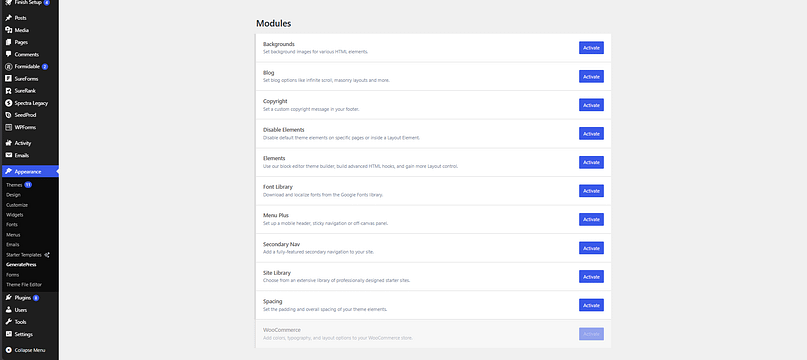
I’m a bit curious as to why GeneratePress thought leaving that decision to the user would be a good idea.
I would have assumed that, like most themes, plugins and builders, it would just activate everything you need for you. Leaving that decision there might be a little confusing, especially if you don’t really know what each option does yet.
It also took me a second to realize that this was where the setup was.
That could be because I tend to be more of an “I’ll ask for directions later” kind of person, so I’m not going to put all of that on GeneratePress.
The Starter Sites Look Great
GeneratePress has a decent selection of starter sites. There’s enough variety without it feeling like you have to scroll through 700 different options just to pick one website.
They look great.
You click on one, you can preview the style and see how it’s supposed to look on a live website, and then you’re given the option to import it.
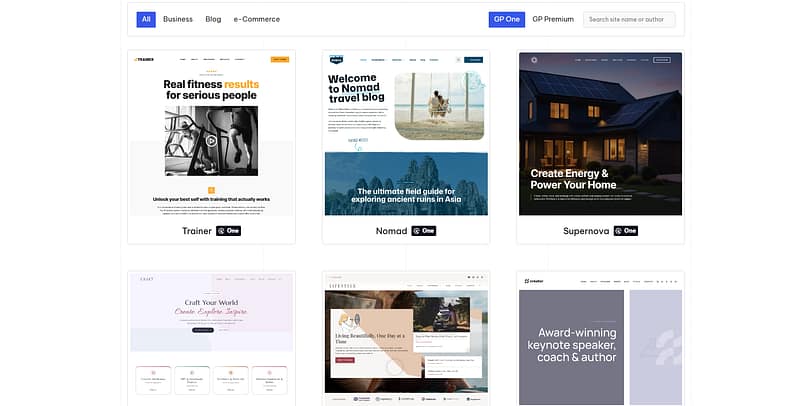
Depending on the starter site you choose, you may also need to install a few other plugins or tools.
I went ahead and imported one. Then GeneratePress told me my site was ready, so I went to the website and, voilà.
Except what I saw was not what I was promised.
What I Saw Wasn’t What I Got
You’ll see it in the screenshots.
Here, you see the starter site preview, and it looks great.
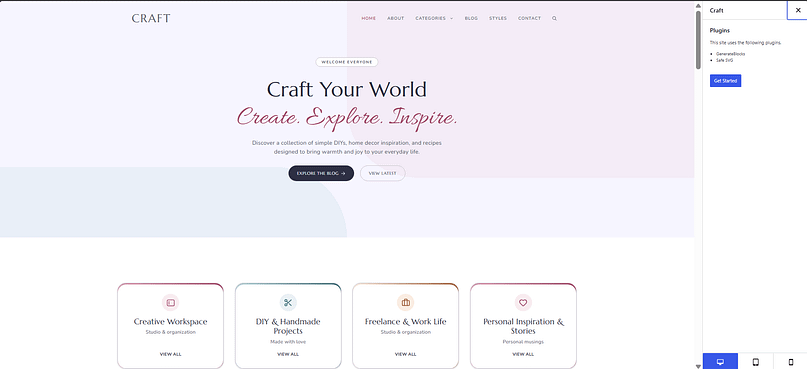
Then you see it on the actual website, and now it does not look the way it’s supposed to look.
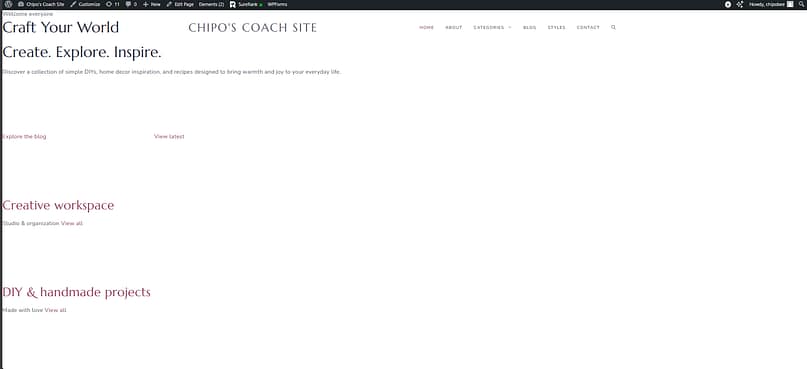
Some of the blocks also didn’t appear properly and showed errors when I opened the page in the WordPress block editor.
Now, there could be a ton of reasons why that happened.
Maybe something went wrong during the import. Maybe one of the required plugins didn’t install properly. Maybe something was going on in my backend. Maybe I needed to contact support.
I’m not saying that everybody who uses GeneratePress is going to experience the same thing.
But I can only review what happened during my test. And ideally, in my head, when I hear “starter site,” I want to see the starter site.
I don’t want to see errors. I don’t want to see disconnects. I don’t want to immediately start investigating what went wrong before I’ve even started building the website.
I have seven or eight years of experience with WordPress (you know that by now), so it wasn’t something I couldn’t work around. I know I can replace a missing block, check the plugins or install something else from GeneratePress’s block selection.
But if you have less experience, you might not know what went wrong or what you’re supposed to do next.
And that can be a little off-putting.
Starter Sites Aren’t Always Finished Sites
This is actually a common issue I’ve found with WordPress themes.
It’s one of the reasons I tend to tell people that, unless you’re experienced with website design, do not go buying a theme from ThemeForest expecting your website to immediately look exactly like the preview.
There are usually things you still have to populate or set up: background images, sliders, plugins, carousels, different sections, etc.
And if you’re not prepared for that switch-up between what was advertised and what appears on your website, you’re going to be shocked. You’re probably going to be a little frustrated too.
But I do think there’s a difference between having to replace demo content and importing a starter site that doesn’t initially resemble the preview.
If you tell me the site is ready, I expect it to at least look like the thing I just imported.
You’re Still Working in the Block Editor
Once the starter site was imported, I was taken to the WordPress block editor to customize the pages.
And again, that is not my favorite place to edit, especially when it comes to full website pages.
I prefer something a bit more powerful because I want flexibility and results that look a bit more professional without having to spend ages working through individual blocks.
I’m more of a drag-and-drop, point-and-click kind of person.
That doesn’t mean you can’t create a professional-looking website using GeneratePress and the block editor. Clearly, people do.
But it doesn’t really suit how I prefer to build websites.
If you already like working with WordPress blocks, you may have a completely different experience. You might hop in and think, “What is she complaining about? This is perfect.”
Fair enough.
But for me, compared with a dedicated visual builder, it felt more limited and less immediate.
Who Is GeneratePress For?
I would say GeneratePress is for someone who already likes the WordPress Block Editor, or is at least willing to learn it.
It makes more sense for someone who wants a lightweight theme, values performance and doesn’t necessarily want a heavy visual page builder running the entire website.
I can see it working well for experienced WordPress users, developers and designers who want a flexible foundation and prefer deciding which modules and tools they activate.
It may also work for someone who enjoys building with GenerateBlocks and wants more control over their setup without being locked into one all-in-one builder.
But if you’re a beginner expecting to import a starter site, click a few buttons and immediately have a complete visual website-building experience, I’m not sure this would be my first recommendation.
The separate modules, the block editor and the wider GeneratePress ecosystem may take a little time to understand.
So GeneratePress probably makes the most sense for someone who values a lightweight, modular setup and doesn’t mind piecing together the exact website-building experience they want.
My Overall Experience With GeneratePress
Look, it’s a good tool, and I can see why it’s recommended. It boasts a lot of features, has good-looking starter sites and gives you plenty of room to build a custom website.
But my experience with the starter-site import was not very straightforward, and the block editor is not my preferred way to design full pages.
I also finished the review still not being 100% sure who I would recommend it to first.
Maybe it’s for someone who already enjoys the block editor and wants a lightweight theme to build on. Maybe it’s for a more experienced WordPress user who doesn’t mind piecing things together.
But compared with some of the other options on this list, would it be my first go-to?
I wouldn't say so.
Starting Price: The GeneratePress theme is free. GeneratePress Premium is $59 per year, and GeneratePress One, which bundles more of the wider ecosystem, is $149 per year.
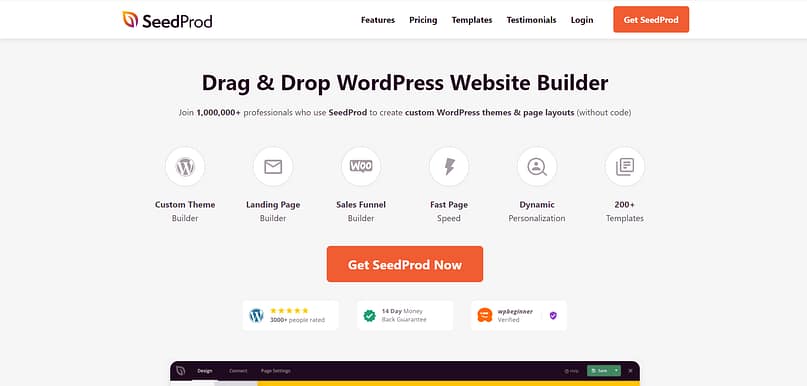
I started learning more about SeedProd when Thrive Themes joined Awesome Motive.
I had known of SeedProd before then as a theme and page builder, but I had never really used it. And when I finally got to know the tool for myself, I was just like, okay, this is a really good tool.
Over the years, I’ve watched it go from being a tool that was good for beginners to one that can help you set up a pretty decent website for a blog, a business, etc.
And one of the things I really like about SeedProd is how easy it is to get started.
Everything Starts From One Dashboard
You get the plugin, set it up, and it appears right there in the left sidebar.
You click on it, and you’re given the option to configure everything from there.
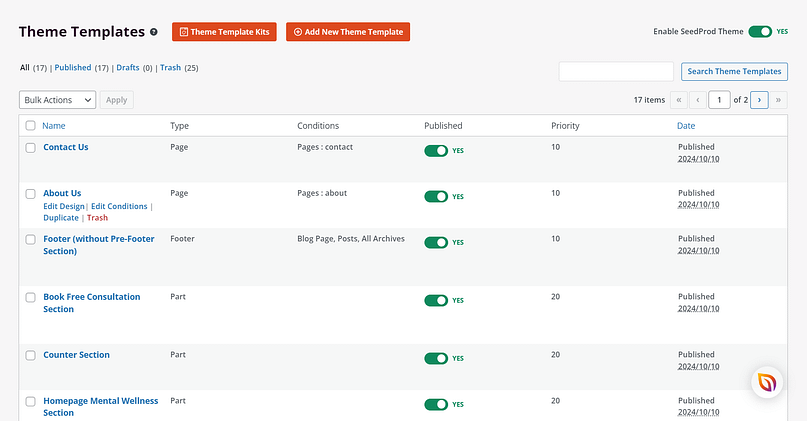
SeedProd's straightforward setup hub
You’ll notice that with some of the other themes, or even the theme-and-plugin combinations, you have to go to one place, then go to another place, then figure out which editor you’re supposed to be using now.
SeedProd seems to have navigated that by giving you one central dashboard to work from.
Once you choose to build your site with SeedProd, most of what you need is right there. You can work on the different parts of the theme, choose your template kit and open the editor without jumping between the WordPress Customizer, the block editor and three other places.
That is what ease of use means to me.
There Are Plenty of Template Kits
From the dashboard, you can go through the template kits and pick one for your website.
SeedProd has a wide variety of designs, which makes it a pretty good option for agencies that want to create solid websites (maybe not overly complex ones) and for someone who simply wants a lot of options.
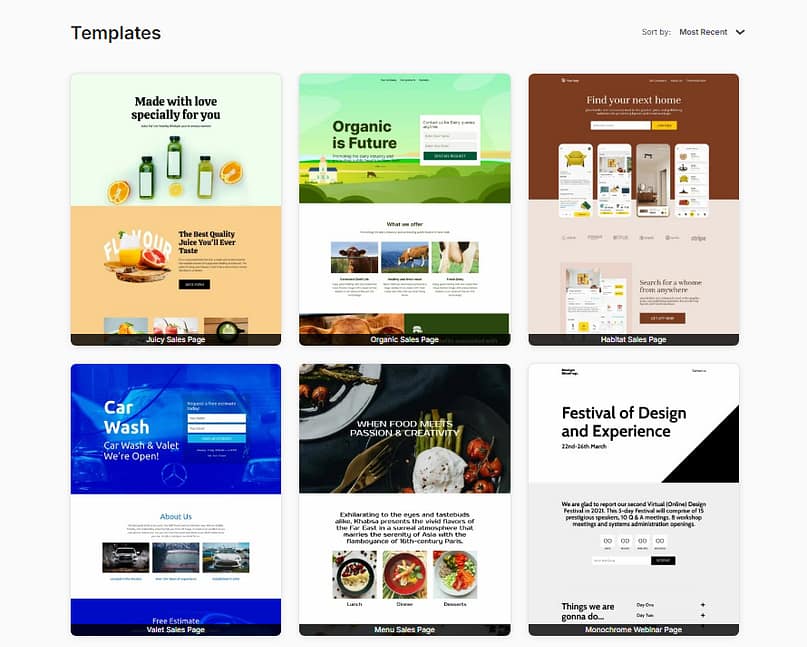
Can you get overwhelmed?
Probably. It’s a lot of templates.
But I appreciate how each template kit is centered around a particular business, industry or focus. You really can find something that fits your niche.
That’s something Divi, Elementor and maybe Astra have also been able to do well, so I appreciate that SeedProd has kept that up and made the options relatively easy to navigate.
What You See Is Actually What You Get
When you hop into the editor, the experience is pretty seamless.
This is what I mean when I say I like an editor where I don’t have to jump between the WordPress Customizer, the block editor, etc.
I can easily drag, drop and edit everything from the template.
And when you select a template, what you see is truly what you get.
I selected a template. It’s here now. It’s on me to change the images, change the writing, change the colors or even elevate the template from where it is into something better.
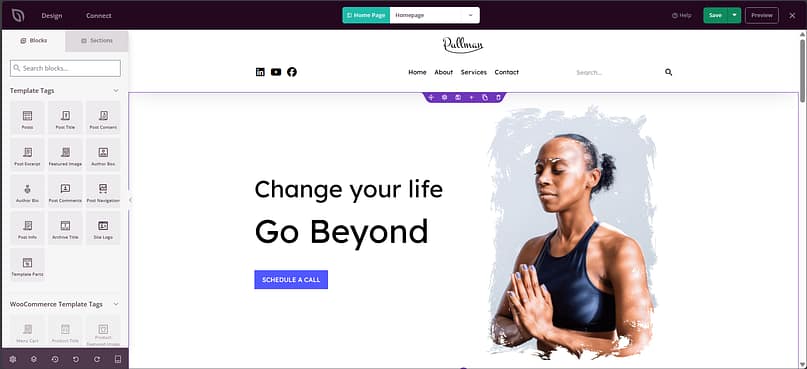
You get options.
You can keep it as it is and simply switch things out, or you can really customize everything and make it look completely different.
There’s less of that horror of, “Oh my goodness, the template I selected is not what I’m seeing on my page. What am I supposed to do?”
Considering the experience I had with some of the other starter sites on this list, I appreciated that.
My One Small Nitpick With the Editor
One slight nitpick is that I wish the editor was a bit more point-and-click.
When you click on some text, for example, you edit it through the sidebar.
I’m just used to diving in, clicking on something and editing it directly on the page.
It’s a small nitpick. It’s not the end of the world.
But when you’re in the midst of editing, sometimes you just want to work on something right there instead of moving your attention back to the sidebar.
Besides that, the editor itself is pretty straightforward.
SeedProd Gives You a Lot of Blocks
SeedProd also offers a lot of blocks.
Like, a lot of blocks.
Keep in mind that I was using the highest-tier account I had access to for this test. So I had access to a wider selection of blocks, templates and features than someone using the free version or one of the lower-paid plans might have.
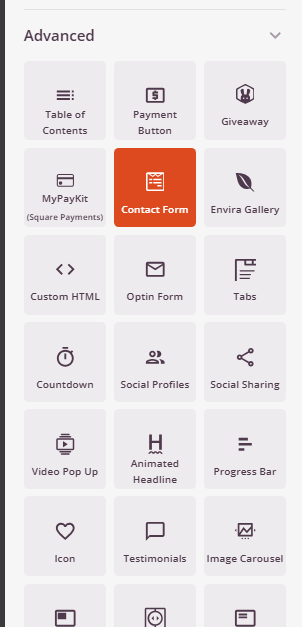
If you’re on a lower-tier premium plan, you might not have access to absolutely everything.
But depending on the plan, you should still have enough to customize your website without immediately feeling pressured to upgrade again.
If you’re on the free plan (because SeedProd does have a free version), you will run into more limitations.
You can probably get something decent set up, particularly if you want a basic landing page, coming-soon page or maintenance page.
But if you’re trying to create a complete business website, build more advanced lead-generation flows or design an online store, you’re probably going to need one of the premium plans and, depending on what you’re building, an ecommerce or payment plugin as well.
Who Is SeedProd For?
I think SeedProd holds up well against the other tools on this list.
I would probably reach for it before a couple of the others simply because of the seamlessness.
It makes things easy.
And I believe that if you’re running a business, or your website is serving as a channel for whatever you’re trying to do, you don’t want to get bogged down in all the nitty-gritty.
How do I set this up?
Where do I customize this?
Why do I have to go over there now?
Where do I do that?
You want to be able to get in, get started and launch from there.
And I think SeedProd does that very well.
It’s probably a good fit for a beginner who wants a visual builder that doesn’t take too long to understand. I can also see it working for business owners and agencies that want to create good-looking websites without every project becoming overly complicated.
My Overall Experience With SeedProd
SeedProd, in my opinion, is a great drag and drop builder. You get everything you need to set up a website, without the overwhelm or design fatigue.
Though I would say SeedProd is a little more simplistic than something as powerful and intricate as themes/builders like Divi or Bricks.
But whether that’s a negative really depends on what kind of WordPress user you are.
Sometimes you don’t need the tool with the most settings, the most panels and the most complicated system.
Sometimes you just need the tool that helps you get the website built.
And I think SeedProd does that very well.
So yeah, that was my experience with SeedProd.
Worth checking out.
Starting Price: SeedProd has a free version. Paid plans start from $39.50 for your first year, with higher tiers for the full theme builder and ecommerce features.
It wouldn’t be an up-to-date “best WordPress themes” kind of review if I didn’t bring WordPress FSE into the conversation.
WordPress has had an overhaul (not that recently) to make its block-based editing and site customization much more effective.
Because, if we keep it real, that’s why a lot of page builders exist.
They filled the design gap for people who wanted to own their websites and didn’t want to use a third-party platform like Squarespace or Wix, but also wanted to fully design their sites without having to become developers.
But WordPress is starting to catch up.
FSE and block-based website building look a lot different now. And when I was looking for a good theme to represent that experience, one of the names that kept coming up was Ollie.
WordPress Has Come a Long Way
I will say that I probably still wouldn’t choose the WordPress Site Editor over a dedicated page builder.
But that’s because I’m very set in my ways. I like page builders. That’s my thing.
Still, I think WordPress definitely has something to be proud of here.
Any WordPress veteran will know how hard it used to be to customize a theme using only the Customizer, and maybe the block editor, if you even got there.
It was not very straightforward. There was a lot of friction.
With what WordPress has now, it is much easier to customize quite a few key elements of your website from one place.
I already knew mentally, okay, I’m using a block theme. I don’t need to go and find another plugin somewhere on the left side of the dashboard. I know I’m going straight into the Site Editor.
And I was happy to see that the experience was pretty straightforward.
Ollie Gives You a Simple Starting Point
Ollie is another theme that kind of provides a canvas, but it doesn’t leave you with absolutely nothing.
You get a selection of full-page designs and patterns that you can use to put the website together.
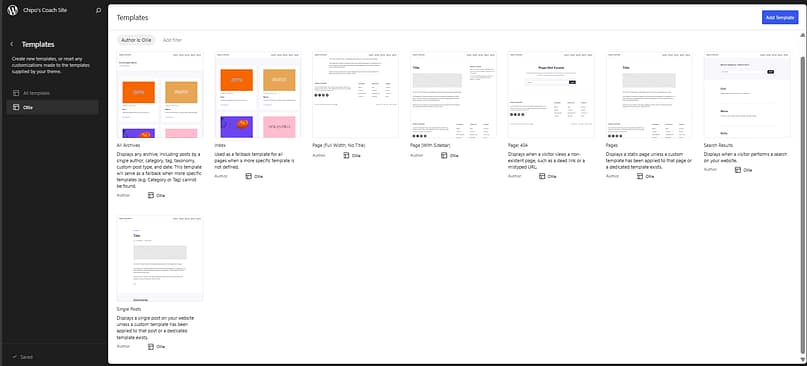
It isn’t an overwhelming selection, but I think that works in its favor. There’s enough there to help you build your pages without making you scroll through hundreds and hundreds of options before you can even decide what you want.
The patterns are the different parts of the website: calls to action, pricing sections, testimonials, headers and other sections you can insert into a page.
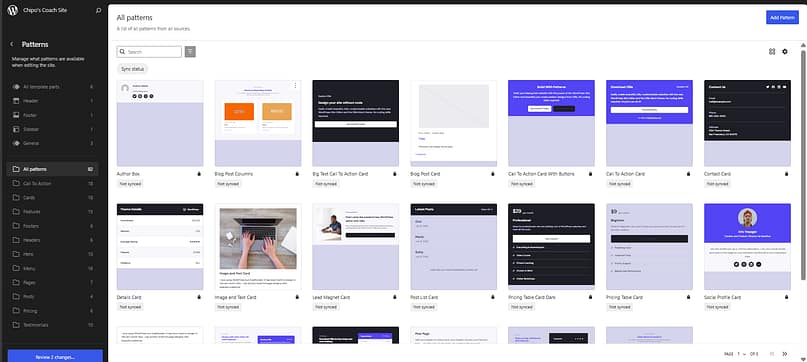
And I think the templates, patterns and Site Editor work together pretty cohesively.
The Global Editing Is Pretty Cool
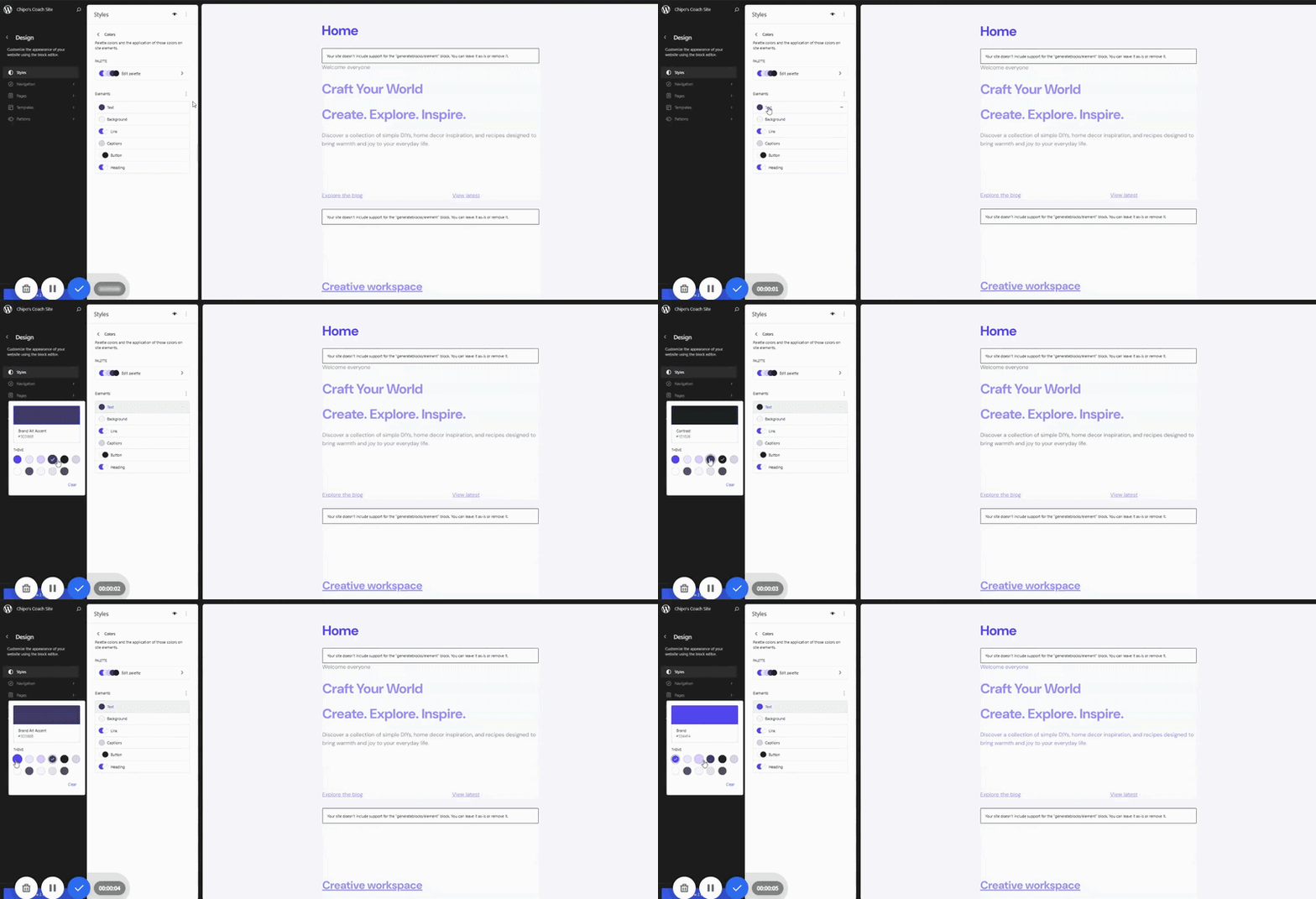
One of the cool things about the Site Editor is that you can edit groups of design choices across the website in one go.
You can change your color scheme, typography, styles and broader layout settings without opening every individual page and changing them one by one.
You can also switch between the different style variations and see how the website changes.
It’s not very complex.
Compared with some of the top visual page builders and website-design tools, it does still have a way to go. You don’t necessarily get the same level of immediate drag-and-drop flexibility or granular control.
But I would say it’s heading in the right direction.
And depending on what you actually need from your website, the native WordPress tools may already be enough.
Who Is Ollie For?
Ollie makes sense for someone who wants to play around with WordPress’s native features and understand how block-based website building works.
Maybe you only want something really, really simple.
Maybe you’re working with a tight budget and can’t spend $80 or more on a page builder or premium theme setup.
You can always start with Ollie. You can always start with WordPress.
And you can get a pretty good website out there.
There are also plenty of tutorials available to help you understand the Site Editor, patterns and blocks if you get stuck.
For me, this is giving: we’ll give you the basics so you can create the magic.
It doesn’t lock you into an endless selection of templates, features and settings, although I wouldn’t be surprised if more options continue to appear over time.
It’s free, which makes it budget-friendly and potentially beginner-friendly, especially if you’re someone who wants to understand how WordPress itself works a little more deeply.
My Experience With the WordPress Site Editor
I’ve also had some experience with the Site Editor through WordPress.com, where I have a little personal blog.
I have my WordPress.org site, where I use my tools of choice. Then I have my WordPress.com blog for when I just want to quickly write something and edit it without doing too much.
I’ve used the Site Editor there as well, and it’s pretty good.
Obviously, the exact experience will depend on the theme, site and WordPress.com plan you’re using, but I’m getting beside the point.
The point is that this isn’t my first time seeing WordPress’s block-based site-building experience, and I do think it is improving.
My Overall Experience With Ollie
Ollie is a decent starter theme for someone who wants to use WordPress’s native Site Editor.
It gives you enough templates and patterns to start building, but it doesn’t overwhelm you with too many options. It also works well as a way to see what modern block-based WordPress can actually do.
Would I personally replace my preferred page builder with it?
Probably not. Again, I am set in my ways.
But would I recommend checking it out if you want something free, simple and native to WordPress?
Yeah, definitely. It’s worth trying.
I’d say it’s decent. Not top, top tier, but I don’t think it was intended to compete in that way.
To me, this feels like WordPress saying, “We’re starting to catch up now, so keep an eye on us.”
Starting Price: Ollie is completely free.
You’re probably surprised that Thrive Theme Builder is number eight on a Thrive Themes list.
Like, what? Do I not rate our tool?
No, actually, I rate it very much. That’s why I put it here as the last one.
Chances are, this isn’t the first post you’ve read about the best WordPress themes. You were probably expecting Thrive Theme Builder to be number one because almost every other company is going to put its own product first, which is fine.
But I wanted to use this article as a buildup.
One, if you’re still here by the end of the article, you’re very serious about what you’re looking for.
And two, the previous reviews will make more sense now.
Full disclosure: I was comparing every single tool on this list to Thrive Theme Builder.
Why?
Not just because I work for Thrive Themes. No, I actually use the tool.
Fun Fact: Thrive Architect Was My First Page Builder
I told you that Elementor was the first page builder I used for my own website, but it wasn’t actually the first page builder I ever came across.
In 2019, I was working as a blog writer for an entrepreneur who had a bunch of websites. He told me he used WordPress and another tool, and that was the first time I ever worked with a page builder.
I was like, “What is this easy thing to use? What is this?”
I never remembered the name, though.
Years later, when I was using Elementor, I actually tried to find the page builder I had used before. But I couldn’t remember what it was called, and Elementor was what worked for me at the time.
It was only when I started working for Thrive Themes that I realized, wait…
I went back to Slack because the conversation between me and that former client was still there. And the tool I had been using was Thrive Architect.
Talk about full circle, right?
Anyway, I say all that to say that I’m not new to this. I’m pretty true to this.
It also doesn’t serve me, or you, for me to lie to you right now. What good would that do?
I’m here to help you make the best choice for your website. You need to know what you’re getting into with every theme so that, when you decide to make that payment, you aren’t surprised.
Anyway, let’s dive into Thrive Theme Builder.
The Site Wizard Makes Getting Started Easy
Thrive Theme Builder is one of the tools in the wider Thrive Themes ecosystem. And the purpose is right there in the name: it helps you build a cohesive, professional-looking WordPress website.
When I started using Thrive Theme Builder, that was actually when I stopped using Elementor for my personal website.
It gave me a level of cohesiveness and seamlessness that I wasn’t achieving with my previous tool.
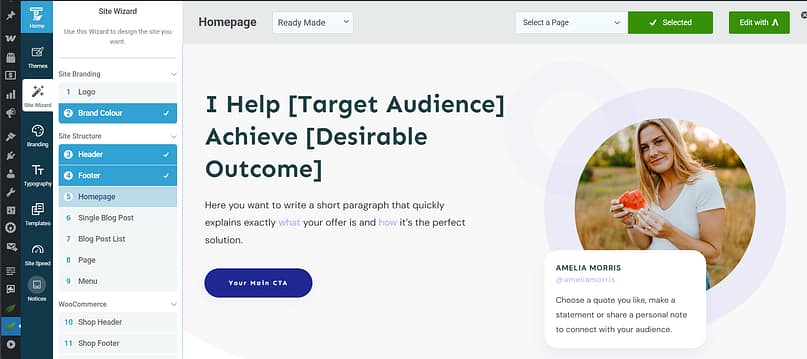
When you first enter the Site Wizard, you’re taken through the key parts of setting up your website: your logo, main brand color, header, footer, homepage, blog post template, blog list, standard page template and menu.

You click through the steps, choose the designs you want and start putting the broader website together.
And that is what I mean when I talk about ease of use.
I don’t want to set up one part of the site, go somewhere else for another part and then start wondering where the footer lives now.
The Site Wizard gives you a clear path.
I would say you can get the bones of a cohesive, professional-looking website set up in less than 30 minutes. Obviously, replacing all the content, images and other details will take longer. Let’s keep it real.
But the starting point is there.
Fewer Themes, but More Quality Over Quantity
There aren’t that many companion themes compared with some of the other tools on this list. I will say that.
You get a selection, as you can see in the screenshot, but you are not going to open the library and find hundreds and hundreds of completely different theme kits.
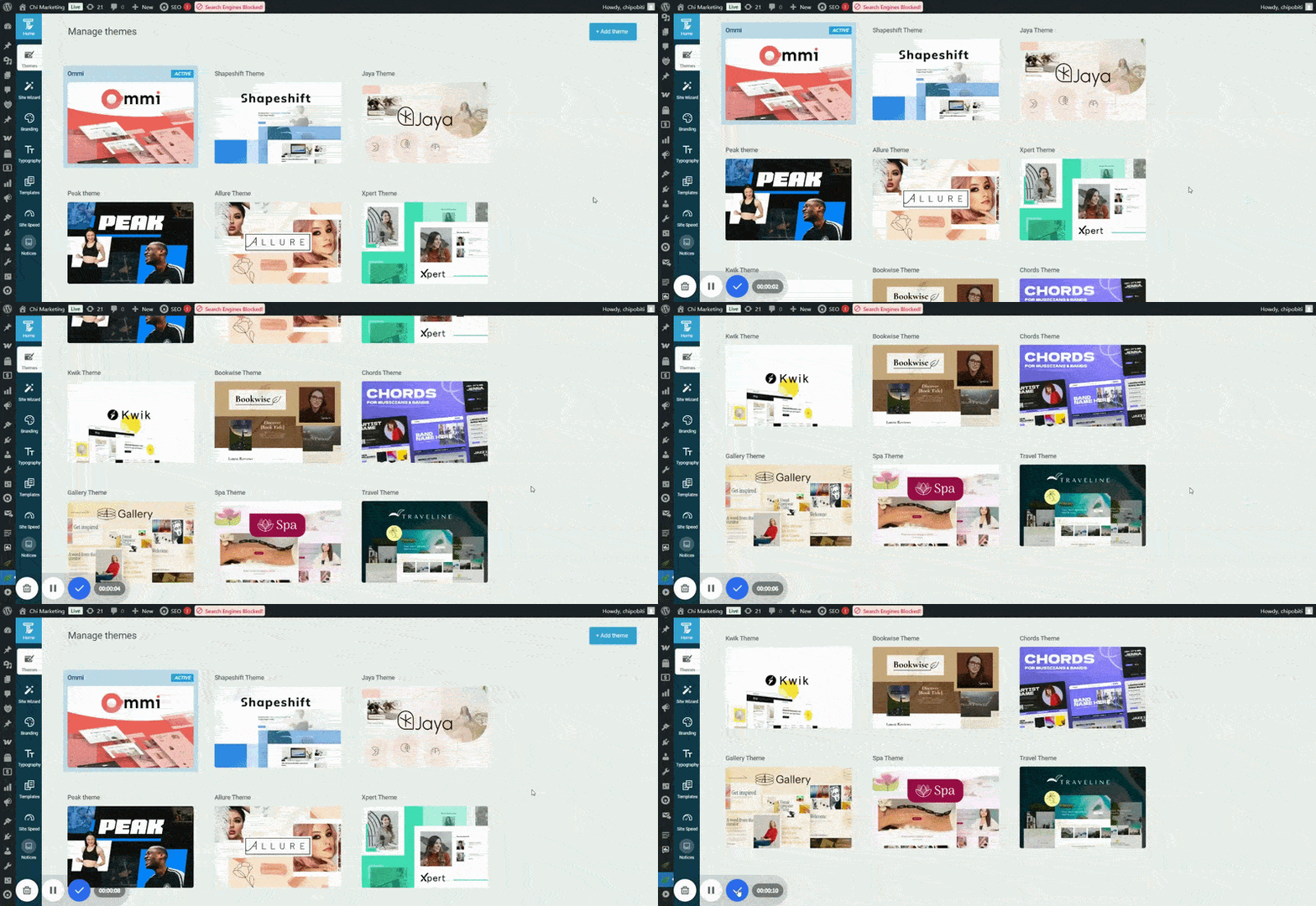
What I appreciate, though, is that it feels more like quality over quantity.
It doesn’t necessarily matter what the theme is called or which niche it appears to represent.
You can use a template that says “Travel” to create a full-on personal blog. I’ve done it before.
You could take something that looks like a yoga theme and turn it into a wellness website, coaching website or something completely different.
The themes give you more than a blank canvas, but they also don’t lock you into the industry shown in the preview.
They give you a starting point, and then you decide where you want to take it.
Your Website Templates Work Together
This is one of the areas where Thrive Theme Builder works especially well for me.
You aren’t only designing one pretty homepage and then being left to figure out what the rest of the website is supposed to look like.
You have templates for your header, footer, standard pages, blog posts, blog list, archives and other parts of the site.
You can customize the templates you’ve assigned, create additional ones and decide where different designs should appear.
You can also make global changes to things like your typography and site color scheme instead of opening every page and changing the same thing again and again.
The point is cohesiveness.
Your blog posts still look like they belong to the same website as your homepage. Your header and footer work across the site. When you change the broader branding, you’re not hunting down every individual page.
That was one of the main things I felt I was missing with some of the other tools I had used before.
Thrive Theme Builder Is the Start; Thrive Architect Gets You Further
Now, I have said throughout this article that some tools require another tool if you want to get their fullest experience.
So I’m not going to suddenly change the rules because I’ve reached the Thrive Themes section.
You can use Thrive Theme Builder by itself. A standalone license includes Thrive Architect Lite, which gives you the visual editing needed to customize the theme and key pages.
But if you want the fullest Thrive website-building experience, you’re probably going to want the complete version of Thrive Architect too.
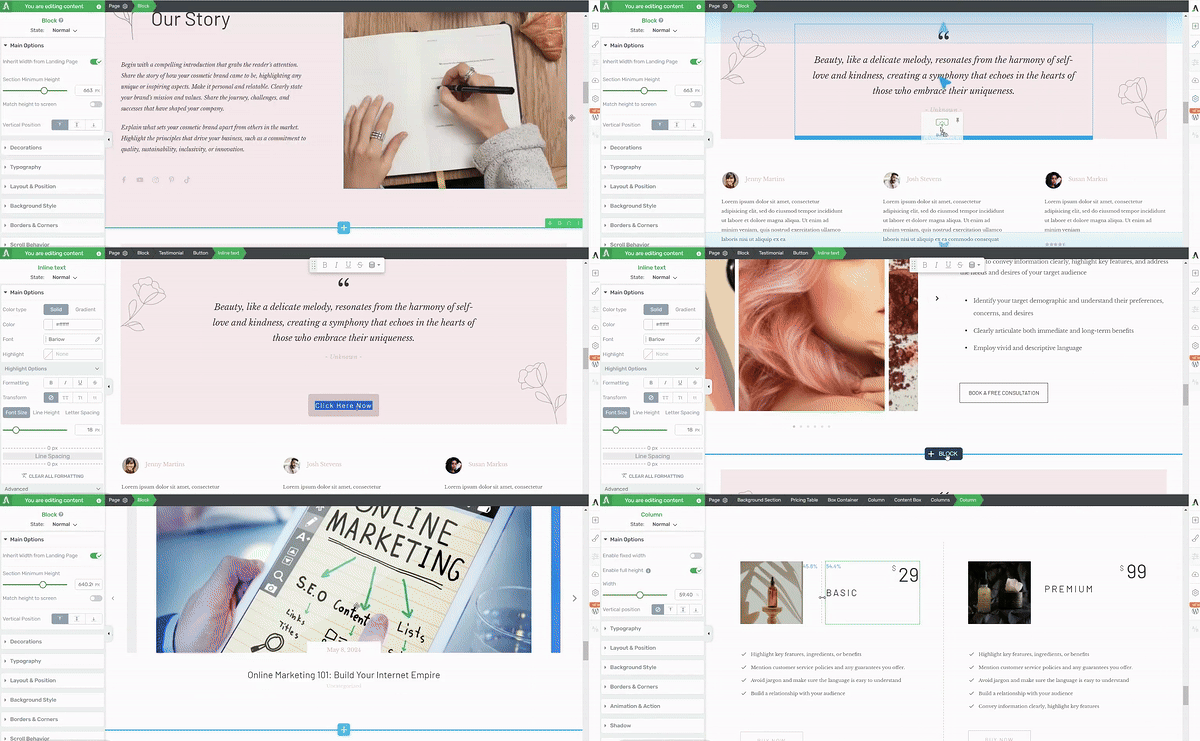
Thrive Theme Builder controls your broader website design: your templates, headers, footers, blog layouts and other site-wide elements.
Thrive Architect is what you use to customize the content inside your individual pages and posts, as well as build landing pages and more advanced layouts.
So I would say Thrive Theme Builder gives you the perfect starting block.
Thrive Architect is what gets you across the finish line, and probably in first place too.
That’s where you get the fuller selection of page-building elements, landing-page templates and the flexibility to turn the starting theme into a website that truly feels like yours.
And yes, that means you may end up buying two tools or choosing the bundle that includes both.
For some people, that might not be their first choice. You might not want more than one tool involved in building your website.
Fair enough.
But, I mean, if you look at almost every other theme on this list, you’re probably already doing something similar.
At least here, the two tools were specifically designed to work together.
Who Is Thrive Theme Builder For?
I would say this is for people who want to get set up quickly but don’t want to cut corners.
You want a beautiful, professional-looking website right there and then, but you also want the different parts of the site to look like they belong together.
You don’t want a good homepage and then a random-looking blog.
You don’t want to spend all your time working out where each setting lives.
You want a strong starting point, and then you want the freedom to customize it.
If you’re only running a good old blog, Thrive Theme Builder and Thrive Architect may be enough for you. You don’t necessarily need to do too much. You can leave the rest for later.
But if you’re running a business and have a full-on funnel system in mind, that’s where the entire Thrive Suite starts to make more sense.
Thrive Suite adds tools for lead generation, testimonials, quizzes, online courses, A/B testing, scarcity campaigns, comments and other parts of running an online business.
If you don’t need all of that yet, you don’t have to start there.
I Actually Use It on My Own Website
I use Thrive Theme Builder and Thrive Architect for my own personal website, and I have done so for the last few years.
It is my go-to place for showing people who I am and what I do.
And I designed the whole thing on my own.
That matters to me because I’m not recommending something I opened once for this review, clicked around for ten minutes and then closed.
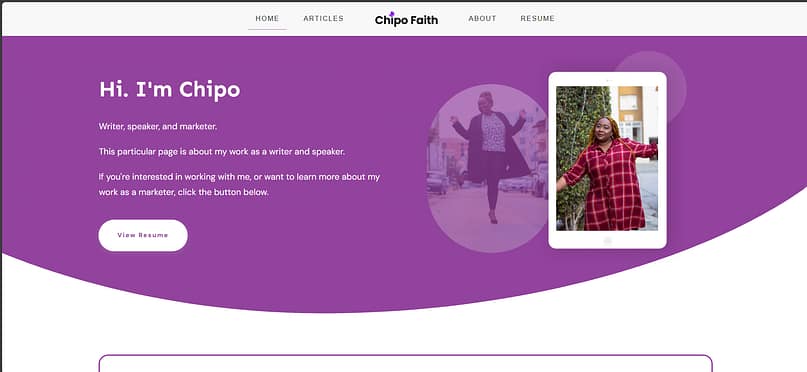
I’ve built with it. I’ve maintained my website with it. I’ve used it to represent me online.
Again: I’m not new to this. I’m pretty true to this.
Yes, I work for Thrive Themes. You already know that.
But I also know what the tool feels like to use when the website is yours and you’re the person who has to keep working on it after launch.
My Overall Experience With Thrive Theme Builder
Thrive Theme Builder belongs on this list because it gives you a strong starting point without forcing you to stay at the starting point.
It helps you put together a cohesive website quickly. It is customizable, it works hand in hand with Thrive Architect, and it meets you at the level you’re at.
You can use the supplied designs and simply replace the content.
You can customize them further and make the site your own.
Or you can go deeper with Thrive Architect and the rest of the Thrive Suite if you’re building a full online business.
Would I put it at the top of my personal list?
Yes.
And now that you’ve read the other reviews, you can hopefully see why.
Not simply because I work for the company, but because it solves many of the specific issues I kept running into with the other tools: disconnected workflows, confusing setup processes, templates that don’t feel cohesive and needing to work out where everything lives.
For me, a good website builder shouldn’t only give you a lot of features.
It should give you a good start, help you understand what to do next and then give you enough flexibility to grow from there.
That is what Thrive Theme Builder does.
Starting Price: A standalone Thrive Theme Builder + Thrive Architect license starts from $199/year.
My Quick WordPress Theme Recommendations
So, after testing all eight themes, which ones would I actually recommend?
It depends on what kind of WordPress user you are and how much time, patience and control you want.
Here’s my quick roundup:
Would I personally reach for all of them?
No.
For my own website, I still prefer Thrive Theme Builder and Thrive Architect because they give me the cohesiveness and straightforward setup I kept looking for throughout this review.
SeedProd would also be high on my list if I wanted something easy to launch without too much friction.
But that doesn’t automatically make Divi, Bricks, Astra or the others bad tools. It just means they suit different people.
That is the main thing I want you to take away from this breakdown.
Don’t choose the theme with the longest feature list or the prettiest demo.
Choose the one that matches how you actually want to build and manage your website.
Other Themes You’ll Keep Seeing (My Quick Takes)
I kept the full reviews to the eight themes I actually installed and tested. But if you have been researching for a while, there are a few other names you will keep running into, so here is my quick take on each. The caveat: these did not go through the same hands-on test.
None of these are bad choices. They just were not the eight I would test first, and I would rather give you a real hands-on review than a rewritten feature list.
Frequently Asked Questions About WordPress Themes
Before you go, here are quick, honest answers to the questions people ask most about choosing a WordPress theme, based on everything I just tested.
Which WordPress theme is best?
There is no single best WordPress theme for everyone, and I would be careful with any list that pretends there is. Based on my testing, Thrive Theme Builder is the best pick for a cohesive, conversion-focused business website, SeedProd is the easiest to get started with, and tools like Astra, Divi and Bricks make more sense for agencies, designers and developers. Start with what you are building and how you like to work, then pick the theme that matches.
What is the best WordPress theme for a business website?
If you're building a business website, my pick is Thrive Theme Builder paired with Thrive Architect. A business site needs more than a good-looking homepage. Your blog, your service pages and your landing pages all have to look like they belong to the same brand, and that cohesiveness is what I kept missing with the other tools I tested. If you'd rather have the simplest possible start and plenty of template kits to choose from, SeedProd would be high on my list too. And if your business runs on funnels or online courses, that's when the full Thrive Suite starts to make sense, because those tools are built to work together with your theme.
What is the difference between a WordPress theme and a page builder?
A theme controls your website’s overall design: the headers, footers, layouts and styling that apply across the whole site. A page builder is the tool you use to visually create and edit the content on individual pages. In practice, the line has blurred. Some themes, like Thrive Theme Builder and Bricks, include their own visual building experience. Others, like Hello Elementor and Astra, are designed to be paired with a separate builder. That pairing is exactly why I say choosing a theme today usually means choosing a builder too.
Are free WordPress themes good enough?
Free themes are good enough to start with, but in my experience you usually hit a wall sooner than you expect. The free versions of themes like Astra and GeneratePress give you a real taste of the tool, but much of the design flexibility sits in the Pro upgrades or in a paid page builder. The exception is if you are happy building with the WordPress Site Editor, where a free block theme like Ollie can carry you surprisingly far. My advice: budget for a theme plus a builder from the start instead of expecting a free theme to do everything.
What are some good WordPress themes to buy?
From the themes I tested, the paid options I'd look at depend on what you're building. For a cohesive business website, Thrive Theme Builder with Thrive Architect starts from $199 a year. Designers and developers who want deep control will probably look at Divi, which is $89 a year for unlimited sites, or Bricks, which starts at $79 a year. Astra Pro starts from $99 for your first year, and it's the one I'd pick for template variety. And if you're on a tighter budget, SeedProd's paid plans start from $39.50 for your first year and GeneratePress Premium is $59 a year. Just keep in mind that Astra, GeneratePress and Hello Elementor are free themes. With those, what you're really paying for is the Pro upgrade or the page builder, like Elementor Pro, which starts from $60 a year.
How do I pick the right WordPress theme?
Ignore the pretty demo for a second and ask five questions. How easy is it to get started? Does the imported template actually match the preview? Which editor will you really be using day to day? What extra tools or paid upgrades will the theme need? And is it built for someone like you, whether that is a beginner, a busy business owner, an agency or a developer? If you can, test the free version before you pay, and pay attention to how the setup feels. If the first hour is frustrating, the first month usually is too.
What is the fastest WordPress theme?
I didn't run speed tests for this article (my focus was on what each theme is like to build with), so I'm not going to crown one. That said, a few of the themes on this list are designed to be lightweight. GeneratePress is built around speed and stability, Hello Elementor is a deliberately minimal canvas for the Elementor builder, and block themes like Ollie stay light because they lean on WordPress's own Site Editor instead of a separate builder. But the theme is rarely the only thing that decides how fast your site loads. Your page builder, plugins, images and hosting all add up, so a lightweight theme with a heavy setup on top can still load slowly. If speed is your priority, I've shared the site speed tools I've tried and tested separately.
Is WordPress outdated in 2026?
No. WordPress still powers over 40% of the internet, and the building experience has matured a lot. The Site Editor keeps improving, as themes like Ollie show, and modern visual builders have removed most of the old friction that made WordPress feel technical. AI is becoming part of the workflow too, and I’ve covered using AI on WordPress the smart way separately. What has changed is the shape of the setup: today it is usually a theme plus a builder rather than a theme alone. If owning your website, your content and your growth matters to you, WordPress is still the platform I would build on.
Choose the Theme That Makes Building Easier for You
Look, there is no single WordPress theme that will be perfect for everybody.
Some people want hundreds of templates and control over every tiny detail. Other people just want to open the dashboard, know exactly where to go and get a professional-looking website online without fighting with the tool first.
Neither person is wrong.
The important thing is understanding what you’re actually signing up for: not just the theme, but the builder, the plugins, the potential upgrades and the amount of time you’ll need to learn how everything works.
Because the prettiest demo in the world means very little if you can’t comfortably turn it into your website.
Hopefully, this breakdown has helped you look beyond the feature lists and see what using each theme may actually feel like.
I’ve given you my experience, including the good parts, the frustrating parts and the moments where I was sitting there thinking, okay, where am I supposed to go now?
Now it comes down to what matters most to you.
Pick the tool that matches the way you want to build, gives you enough room to grow and, most importantly, doesn’t make creating your website harder than it needs to be.


Great, useful and thoughtful exploration as always. Been a Thrive Theme customer for many years now and always highly rated the themes and plugins provided and how they all work together. Thank you for your good work.
Thank you for your kind words, Una! We’re really glad to have you as a part of the Thrive Themes family
I Absolutely love Thrive Themes!
The suite includes everything necessary to create high-converting content, from blog posts to sales pages and even membership portals.
Its ability to simplify the design process of a conversion-focused website, a feature that stands out even among numerous WordPress page builders!
One of the most significant advantages of Thrive Themes is their focus on conversion-oriented design. Their themes and plugins are crafted to help websites turn visitors into customers, subscribers, or members, depending on the site’s goals.
The suite it includes a robust WordPress visual editor that’s considered the best for creating aesthetically pleasing content. The drag-and-drop editor is user-friendly and comes packed with elements that can enhance pages, like testimonial boxes and exit-intent pop-ups, which are all aimed at improving conversion rates!
Another aspect where Thrive Themes seems to excel is customer service. The support team receives commendations for their dedication and effectiveness, going beyond the call of duty to resolve issues.
The combination of powerful, conversion-focused tools and strong customer support makes Thrive Themes the BEST suite for individuals and agencies looking to optimize their WordPress sites for better user engagement and conversion. 100% recommended!
Marco, thank you so much for this amazing testimonial. We’re so glad to hear that our products have helped you.
Thrive Themes is the best as always.
Been with Thrive Themes for a few years… Their themes are awesome (and so easily interchangeable!!) and their customer support is out of this world!! The Thrive Themes platform and suite makes my life soooo easy! From a course platform, to quizzes, to beautiful and simple to use Themes… there are no cons to subscribing!!
Thanks for this pro-level rundown, Chipo. I have used several of these but by far, my recommendation goes to Thrive Themes. Why?
First, I know that pretty websites alone are not enough. They don’t convert visitors to leads and into customers – unless they’re optimised for conversion. I know from long experience, plus the continual series of educational videos and blog posts over the past nine years (that I’ve been a happy customer) that Thrive Themes templates are optimised.
Also, other themes I’ve used in the past have proved difficult to work with. Options have been confusing, making any meaningful changes has been frustratingly difficult and over time, they have not always been maintained, leaving them open to security breaches. Thrive Themes has always been the opposite in every way.
And in fairness, I gave the others an honest go. I even tried to like them. But they just didn’t come close, no matter what the glossy images made them look like they could produce.
Thank you so much for these amazing words, Matthew! We love hearing about how our products have helped our customers, because we really want to see you guys win.
I didn’t know that Thrive was offering themes for WordPress. They look great!
Since I chose to use ThriveThemes (some years ago now!), and the themes offered in the suit, never needed anything else. They’re easy to set up, very flexible for any desired changes, and in my opinion they can meet most needs. I really like being able to adapt them as I wish. I don’t even look anywhere else.
I use Thrive Suite for 5+ years and all my business is built around it. I can say that it was a life changer for me that this suite is actually meant to help the creators get leads, build funnels and grow a business on one of world known platform. Since then, updates changed the way I promote and get more leads and sales and this makes me give +1 on any one asking for a platform to build an online business.
When I began looking for a website for my author page, I researched many options. Coming across Thrive Themes I was able to create the look I wanted. Thrive Themes is great value for money as it continues to incorporate additional items that work to bring you more results. It also has templates for courses and quizzes. So no need to purchase another tool for those. For instance, I want to update my website with courses and some quizzes. While I had someone help me with the initial set-up I can easily change and plug in items as needed. I love that I don’t need to be a techie, have coding experience, or have to pay someone to add or change items on my website. I also like that they have instructional videos for when I need help. Whenever another author (or anyone) asks about website platforms, I tell them about Thrive. Check it out!
I’ve been using Thrive Themes for 3 years now and just installed it on a second (new) website. I’ve used WordPress before so I’m not a newbie, but I prefer not to customize a site all that much because it create maintenance nightmares later. Here’s what I learned from using TT twice. The first time, I didn’t understand all the different features and I’m still not using even a fraction of what the system can do. But I still made mistakes in not recognizing when I was working in the blog area versus the main site. I also didn’t fully understand how to keep everything consistent with global features. But I correct all of this when I built the second site. And now it’s super easy to maintain and make needed changes without customization.
But as a former programmer and now a content creator who has worked on several different platforms and WordPress sites…where Thrive Themes excels is in their customer service. Without fail, when I get stuck and can’t figure something out – I open a support ticket and give support access to my site. Within a day or two (often less), I get a thoughtful response that shows evidence the technician took the time to truly look at my site, detect the problem, and often fix it for me. Seriously – Unparalleled in this industry.
Thank you for sharing this, Shelley. I love what you shared about your growth with finding your way around our tools, and being able to use them on a second site. Thank you for being a part of the Thrive Themes family 🙂
I changed over to the Bookwise theme. Love it! Great for author websites.
So glad to hear this, Kelly!
An interesting overview. Thank you.
I’ve been using shapeshift since it came out and have loved it. I can’t say enough about Thrive Themes. It has been a Wow experience since I first got it. So much continued improvements/upgrades. I use the quizzes and online courses (Apprentice) and all their features/plug-ins. I can’t recommend it enough.
So happy to hear this, Duke. Thank you for sharing!
Breakthru Pro works well with Woo which works with Thrive so it’s not a bad option.
Great article – I like the differentiated view.
Thank you, Jörg 🙂
This article was very helpful I will definitely use all the info to create my website!
Glad to hear that, Stella!
Feel free to share a link to your site once you’ve built it!
Glad to see there’s a coach template in Thrive Themes.
I build all my sites (and my client sites) using Thrive Themes. There is no better system, full stop.
Thanks, Aaron 🙂 Glad to have you as part of the Thrive Themes fam!
By far the most visually attractive but beyond that functional and easy to navigate. I enjoy building with Thrive Themes.
Thank you, Kenny!
Love the DIVI theme. It’s one of my favorites.
Great article. I am constantly looking at new WordPress Themes and trying them out for new clients. However, I always come back to Thrive because my business needs the advanced features that I get with the Thrive Suite.
So glad to hear that, Andrew! Thank you for sharing!
I’m currently involved in working behind the scenes on the complete redesign and rebuild of a site. During the research and planning we experimented with no fewer than five others of your “13 Most Popular WordPress Themes” listed above, in addition to Thrive Themes. We settled on Thrive Themes. The interconnectedness of the various plugins and opportunity to minimise external plugins outside the Thrive Themes ecosystem was a key factor in the decision.
So glad to hear this, David. Thank you for sharing!
Thrive themes are the best.
Excellent content as always! Thank you very much for sharing your knowledge and expertise.
This is a vry nice overview, I’ll stick with Thrive Themes any day. I have build my website in the early days from notepad, afterwards in WordPress, and always felt, there is something missing.
That missing link is Thrive Themes, I save time setting up my website and have more time to do my business. It’s as simple as that.
Thank you for this, Peter. We’re glad to have you as a part of the Thrive Themes family!
I chose Thrive Themes because it’s an all-in platform and allows me to host my online videos as well
thrive themes are amazing
This is a very comprehensive post about which theme you should consider using for your next website. I prefer the Thrive themes because they are truly wysiwyg and as a visual person I find this so much easier to implement. Some clever people have done all the hard work for you behind the scenes, and all you need to do is to make them your own using preferred colours and a few extra tweaks.
Thank you for your kind words, Alice!
I have heard and used most of the aforementioned themes but never used thrived theme. I’ll give it a try on my next website. I hope it’s good as advertised here.
We look forward to seeing what you build with our tools, Enoma. Thanks for commenting!
Those themes are really nice and look very professional! Very useful post with nice tips for people looking for neat themes!
Thank you for the info! Very helpful
Great info!
Very informative and educational article. I learned a lot. Article was well put together and is a great learning tool.
Una forma rápida, económica y profesional de mejorar tu presencia web
Hi Chipo, great blog post! As a website designer for 10+ years who started on dreamweaver and have used Divi themes and all other website builder software (squarespace, wix, godaddy, etc), Thrive Theme is by far the best theme builder in terms of easy-to-use, extensiveness of customisation (that doesn’t damage SEO/site performance) AND longevity. As someone who has been in the industry for a while, and even if you want a FAST theme (yes you have a thrive theme template customised in under an hour) – you need the company who owns the theme to be reliable, constantly updating, and innovating with the times. This is where Thrive is the real winner. Everything from customer support, youtube channel, the weekly emails – they don’t cut corners and they are here to stay! That’s really important for a business owner – switching themes and software is an expensive business mistake that most business owners can’t afford to make! I love thrive themes – I’m currently designing a site with Xpert Theme and I’m loving it. Before that, Shapeshifter has been my go-to for years! Thanks Thrive Themes for keeping website building simple, extensively customisable and reliable!!
Very informative read. Thanks.
I’ve used a few of these themes! Thrive is a good choice. It’s quick and provides good design flexibility. You can set your website colours and unique look while also utilising the prebuilt templates.
I never realized how a webpage layout would have so much impact based on the business style of a company, this gives me a lot to consider in the future even for personal web design.
DIVI theme – very interesting! I like!
So much info! But very helpful. I’m needing WordPress more and more so I found this very helpful. I had to save it for reference.
It’s awesome to refer to the 13 popular themes you shared
thanks a lot
u do a great job
go go go continue
This testimonial reflects my experience. I began creating my website using Notepad, before migrating to WordPress. However, I felt a constant lack in the process.
Discovering Thrive Themes filled that gap. Using it has saved me precious time in setting up my site, leaving me more available for my professional activities. It’s become an essential tool that really simplifies the management of my site, and it’s incredibly efficient.
Translated with http://www.DeepL.com/Translator (free version)
Astra & OceanWP are by far my go to when I’m building a website for someone. They have so many flexibilities.
Great content
Informative and thought provoking for my business. Thank you for the education
I really like kadence but their blocks can be confusing when using for the first time.
This is a solid overview! I’ve used several of these themes myself, and I can definitely relate – choosing the wrong theme upfront can make everything more challenging. A great theme should look good and also keep your site running smoothly. It’s all about finding the right balance between design and performance, and this list really does a great job of pointing out themes that get that mix just right.
I like Astra and its simplicity!
Divi is by far the best
Great review thanks.
The begginner ones might come in handy 😀
Great tips and tools for businesses starting and growing. Excellent resource for people looking to improve.
Nice, I’ve always loved “setup wizards” because they usually save hours if not entire days of work!
I love the simplicity of the themes.
I once read a comment from a very successful female entrepreneur: No system is 100% perfect, so if you find one that works for you, stick with it! I agree! That is what Thrive themes have been for me for years! And the best part? The support! And that is rare these days:)