

TL;DR: What a Quiz Funnel Is, and What the Good Ones Do
A quiz funnel is a short quiz that sorts visitors by what they actually need, then sends each group to the offer, content, or next step that fits them. Here are the pieces, in the order someone moves through them:
- The thing that sends people to the quiz: a button on your homepage, a call to action inside a post, a popup, or an ad.
- The quiz itself: usually 5 to 12 questions, answered in under five minutes.
- The opt-in decision: whether you ask for an email before showing results. The four funnels below split right down the middle on this one.
- The results page: what the person actually came for, and it has to be worth the time they just spent.
- The follow-up: where a quiz stops being a fun distraction and starts earning you something.
Four real quiz funnels are pulled apart below, all of them running right now.
You can have a busy website and still know almost nothing about the people on it. They arrive, they read a bit, they leave, and all you're left with is a number in your analytics that goes up and down for reasons you can't explain.
A quiz solves that better than almost anything else, because people will happily tell you about themselves as long as you give them something back. Ask someone to fill in a form and they stall. Ask them what their brand personality is, or whether the damp patch in their bathroom is likely to be mold, and they'll answer twelve questions without thinking twice.
The catch is that most articles about quiz funnels show you examples that stopped running years ago. Beardbrand's beard style quiz is the one everybody points to, and Typeform, whose tool it was built on, says it brought in 150,000 leads. I went to look at it while I was writing this. The page is a 404 now and there's no quiz anywhere on their site.
So every funnel below is one I opened and clicked through myself. Three of the four belong to Thrive customers, which means I can tell you how they were built and not just how they look from the outside.
Four Quiz Funnels I Walked Through Myself
I picked these four because each one answers the same question differently: what do you ask for, and when? One of them asks for nothing at all. One asks on the second screen. The gap between those two choices is the most interesting thing in this whole article, so I've put them next to each other.
For each one I started the quiz as a visitor would and kept going until I hit something I shouldn't push past. Two of these are live intake forms for real businesses, so I stopped before submitting rather than drop a fake inquiry into somebody's pipeline. Where a number appears below, it came off the page I was looking at.
Kaye Putnam's Quiz Asks for Nothing. A Quarter of a Million People Took It Anyway.
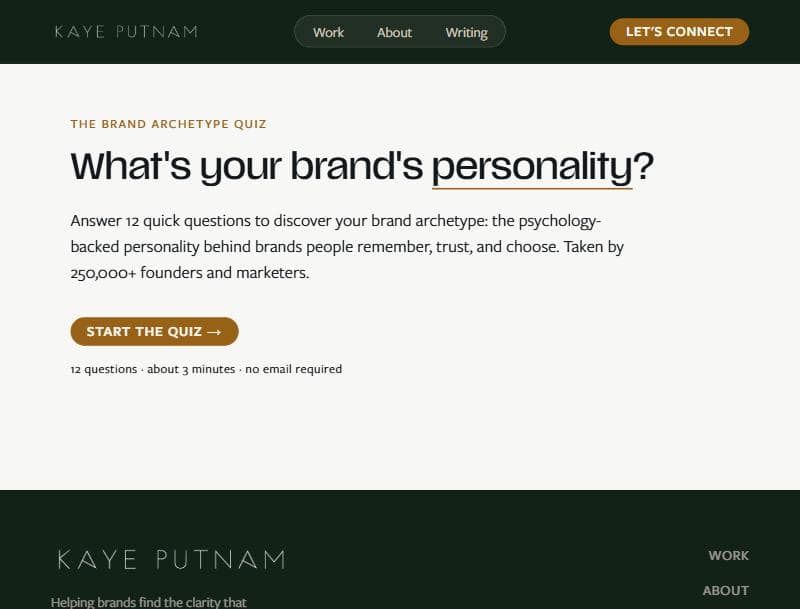
Kaye Putnam is a brand strategist, and her brand archetype quiz is probably the best known quiz funnel in the small business world. Her homepage puts the number at 250,000+ quiz takers, and the quiz page repeats it under the start button.
The line I'd look at twice is the small print underneath: 12 questions, about 3 minutes, no email required.
So I took it, expecting a gate somewhere near the end. There isn't one. Twelve questions about your brand's strengths, values, and which fictional character it most resembles, and then the result appears: a primary archetype, a sentence on what drives it, and a secondary archetype underneath, because she makes the point that strong brands pair two. No form. No popup. The only link out is to a longer write-up of your archetype, and you can read all twelve of those without taking the quiz at all.
We wrote about this exact funnel back in 2020, and it worked differently then. It ran sixteen questions, and after the last one it showed a soft opt-in gate, which asked for an email in exchange for an archetype-specific PDF rather than for the results themselves. That quiz fed a $297 course called Brandfluency.
Six years later the questions are down to twelve, the gate is gone, and so is the course. The quiz now ends in content and nothing else.
I don't know her reasoning and I'm not going to invent it. But the trade is visible in the numbers: she gave up every email that quiz could have collected, and in exchange the thing spread far enough to put a quarter of a million people through it and to become the asset she's known for. That's a real strategy, just not the one most quiz advice will hand you.
If you take one thing from Kaye's funnel: a quiz result that people genuinely want to know is worth more than the email you could have charged them for it. Decide which one you're actually in this for before you build anything.
Jorge Asks for Your Email Second. I Think He Gets Away With It for One Reason.
Jorge de los Reyes Martinez runs En Busca del Fuego, a Spanish-language consultancy working on legal structure, AI governance, and business strategy. We profiled him in 2024, back when he was using Thrive Quiz Builder to sort his audience into four profiles and show each one different courses. The business has moved toward consulting since then, and the quiz moved with it.
What's there now is a nine-step diagnostic called Empieza aqui, which means "start here." The headline is blunt in a way I like: stop improvising important decisions for your business. It promises that in three to five minutes it will work out what's slowing your growth, and point you at a sensible next step.
Then it asks for your email on the second screen, at 22% complete, before it knows a single thing about your business.
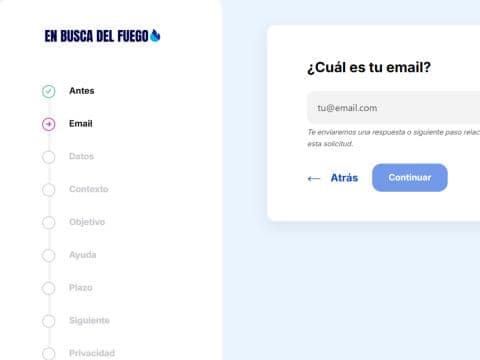
On paper that's the worst possible place to put the ask. You've invested nothing, you've received nothing, and he wants your address. Kaye's quiz runs twelve questions and never asks at all.
But look at what the field actually says underneath: we'll send you a response or next step related to this request. That reframes the whole thing. He isn't charging you an email to unlock a result. He's asking where to send the answer, which is a completely different transaction, and it's one most people will accept because it's obviously reasonable.
The other thing propping it up is what he promises at the end. The diagnostic routes you to useful content, a consultation, a service, mentorship, or a clear no if you don't fit. I've read a lot of funnels and I can't remember the last time one advertised rejection as a possible outcome. It costs him some leads. What he gets back is a form that feels like an honest conversation rather than a trap, which is probably why he can ask so early and still have people finish it.
He also tells you upfront that it takes three to five minutes and to have a description of your business ready. That quietly filters out anyone who was only browsing, before they start.
If you take one thing from Jorge's funnel: you can ask early, but only if the email is clearly a delivery address rather than a toll gate. Say what you'll send and when, and the ask stops feeling like a price.
Jenna Kutcher's Quiz Looks Like a Game. Read the Questions Again and It's a Sales Call.
Jenna Kutcher is the one business in this list we have no relationship with, which is partly why I wanted her in it. Her Level Up quiz sits on her homepage as a free, five-question, thirty-second sort of thing, and it's built on Interact rather than anything of ours. The pattern works regardless of what you build it with.
Five questions is short. Here's what she does with them:
Stage, need, objection, timeline, preferred format. That's not a personality quiz. That's the discovery call a good salesperson runs before they recommend anything, and every one of those answers maps onto something she sells.
The second question gives it away most clearly, because the options aren't abstract goals. They're her product lines.
Then at the end, after you've answered all five, the gate appears and asks for your first name and email before it will show you anything.
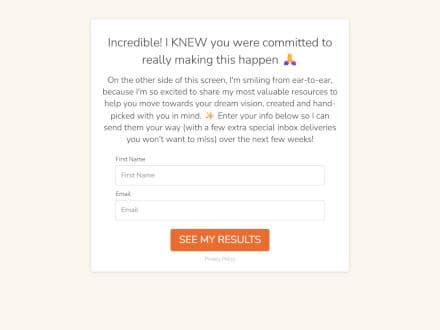
What I like about that screen is that it doesn't pretend. It tells you, in the gate copy, that she'll be sending resources "over the next few weeks." You know you're joining an email sequence before you hand anything over, which is a small piece of honesty that costs her almost nothing and buys a lot of goodwill.
If you take one thing from Jenna's funnel: write your questions backwards from what you sell. If an answer doesn't change what you'd recommend, it's decoration, and five useful questions will beat fifteen interesting ones.
HomeCleanse Asks for Your Home Address. By the Time It Does, You'll Hand It Over.
Michael Rubino is the founder of HomeCleanse, a mold remediation company, and a Thrive customer we interviewed in 2024. His funnel is the most commercially serious of the four, and it earns the biggest ask of the lot.
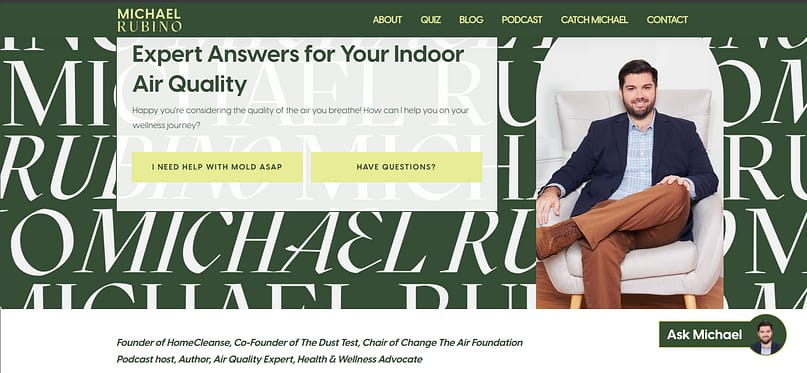
It starts before the questions do. His homepage offers two buttons side by side: I need help with mold ASAP, and have questions? That's a sort before anyone has answered anything. Someone in a panic about their bathroom and someone idly curious about air quality want completely different things, and he splits them at the door rather than funneling both into the same flow.
Take the urgent path and a qualifying quiz opens: Book Your Free Consultation With Michael Rubino's Mold Remediation Team, with a progress bar across the top. The questions are plain and every one of them is doing work. Are you a homeowner or a renter. Have you had your home inspected for mold.
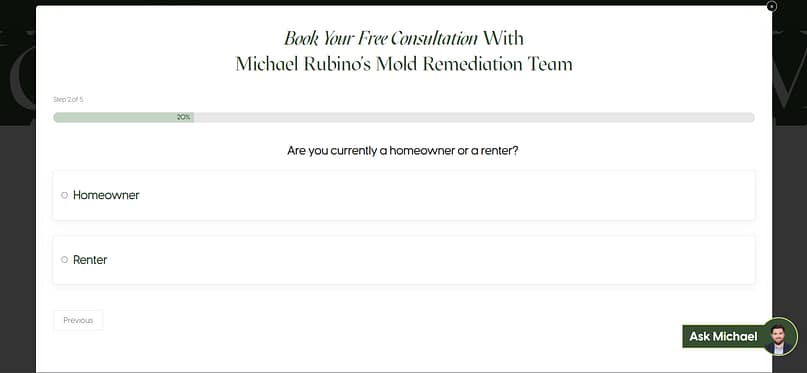
Two details in there are worth stealing outright.
The first is that the flow changes length depending on your answers. One screenshot shows step 2 of 5, another shows step 3 of 8. Answer differently and you get a different number of questions, which means nobody is sitting through screens that don't apply to them.
The second is the small print under the inspection question: a proper mold inspection will include lab results as well as a scope of work from the company performing the inspection. If you do not have this, choose no. He's teaching you how to answer his own question accurately, because plenty of people think they've had an inspection when they've had someone glance at a wall. It costs him a line of text and it keeps his answers clean.
Then the last screen asks for first name, last name, phone, email, street address, city, state, and zip code.
That is far more than anyone else on this list asks for, and I think it's completely reasonable, because of what sits on the other side of it. Kaye is handing you a word about your brand's personality. Michael Rubino is offering to send a remediation team to your house. You cannot do that without an address, and by step eight you've already told him you own the place and that nobody has properly inspected it, so you know why he's asking.
If you take one thing from HomeCleanse's funnel: the size of your ask has to match the size of what you're giving back. Work out what you're really offering before you decide what's fair to request, and put the request last.
Strip Away the Branding and All Four Are Doing the Same Five Things
A brand strategist, a legal consultant, a creator with a podcast, and a mold remediation company have almost nothing in common as businesses. Their quizzes look nothing alike either. But when I lined up what each one actually does, in order, the same five decisions turned up every time.
They All Put the Quiz on the Homepage, Not Three Clicks Down
Every one of these is reachable from the front door. Kaye's sits in her main navigation with the quiz-taker count displayed next to it as proof. Jenna's is promoted on her homepage as a free quiz. Michael Rubino's is one of two buttons in his hero section. If you build a quiz and then hide it in a blog post, you've built something nobody will take.
They're Short, and They Tell You How Short Before You Start
Twelve questions and about three minutes from Kaye. Five from Jenna. Three to five minutes from Jorge, who also tells you what to have ready. Nobody is asking for twenty-five questions and nobody is making you guess how long you're committing to. That one sentence of expectation setting is doing more work than it looks like it is.
The Questions Sort People, They Don't Test Them
There's no right answer anywhere in these four. Jenna asks which of six goals you'd pick for the next ninety days, and each one points at something she sells. Michael Rubino asks whether you own your home or rent it, because the answer changes whether he can help you at all. Kaye asks which fictional character your brand resembles, which sounds like a bit of fun and is really a personality variable. You're not being graded, you're being filed.
The Ask Is Placed on Purpose, and Priced Against What's on Offer
This is where they split hardest, and it's the decision I'd spend the most time on if I were building one:
Line those up and the rule writes itself. The bigger the thing you're offering, the more you can ask for, and the later you should ask for it.
The Result Routes Somewhere. It Is Never the Finish Line.
None of these four stop at a label. Kaye's result links to a full write-up of your archetype. Jorge's sends you toward content, a consultation, mentorship, or a polite no. Jenna's unlocks resources picked for your answers. Michael Rubino's puts a real person in touch with you. A quiz that ends with "you're a Hero!" and nothing after it has entertained somebody and done nothing for your business.
How to Build One Yourself With Thrive Quiz Builder
I'm not going to click-by-click this, because the four funnels above have already made the decisions that matter and the mechanics are the easy part. What's worth showing is where the tool asks you the same questions the examples just answered. And if you do want every click, our guide on how to make a quiz in WordPress walks through the whole build step by step.
Start by Telling It What the Quiz Is For
When you create a quiz in Thrive Quiz Builder, the very first screen asks what the quiz is for. Not what it's called, not how many questions, what it's for. You pick between building from scratch, list building, social shares, or gaining customer insights.
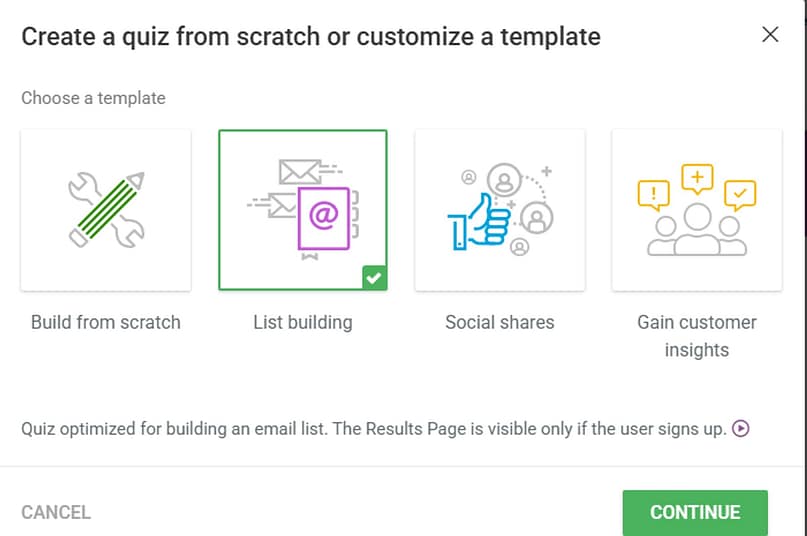
Look at that list next to the four funnels and they sort themselves. Kaye's quiz is a social shares quiz: she gave up the opt-in and got reach. Jenna's and Jorge's are list building. Michael Rubino's is closer to customer insights, since every answer tells his team whether they can help you before anyone picks up the phone. Pick the wrong one here and you'll spend the rest of the build fighting your own settings.
Select list building and it spells the trade out for you in one line: quiz optimized for building an email list. The Results Page is visible only if the user signs up. That is the Jenna route, stated plainly, before you have written a single question. Choose social shares instead and you are choosing Kaye's.
Name It for You, Not for Your Visitors
After that it asks you to name the quiz, and tells you plainly that the name is internal and your visitors will never see it. Small thing, but it's the difference between naming it something useful for you and writing a headline in the wrong box.
Then Three Decisions You Have Already Seen Made Four Ways
From there the build is three decisions you've already seen made four different ways:
Start Smaller Than You Think You Should
This is the most common reason a quiz never gets finished: you do not need twelve archetypes and a zodiac wheel to start. Jenna's whole quiz is five questions. Build the five-question version, put it on your homepage where people will actually find it, and let what people answer tell you what the next version should be.
Three Mistakes That Will Flatten an Otherwise Good Quiz
None of the four funnels above make these, which is probably why they're all still running. I've put them last because they're easier to spot once you've seen what good looks like.
It Reads Like Market Research, and People Can Tell
Nobody wants to fill in a survey for you. They want to find something out about themselves, and the moment a question sounds like it's for your benefit rather than theirs, people close the tab. This is why Kaye asks which fictional character your brand resembles instead of asking you to rate your brand clarity on a scale of one to five. Same information, completely different experience.
Every Result Lands on the Same Page, Which Throws Away the Payoff
If you've gone to the trouble of sorting people and then send them all somewhere identical, you've done the work and thrown away the payoff. Kaye has twelve separate archetype write-ups. Jorge has five different routes out, including the one where he tells you no. At minimum, change the angle and the proof for each result, even when the offer behind it is the same.
Nobody Ever Reads the Answers
This one is my own hobby horse. A quiz quietly produces the best audience research you will ever get, in the words your customers chose themselves, and most people set it up, celebrate the opt-ins, and never go back and look at what anyone said. Michael Rubino's team added a line explaining what counts as a real mold inspection, which is not something you write unless you've been reading the responses and noticed people getting it wrong.
Frequently Asked Questions About Quiz Funnels
A few things people ask me whenever quiz funnels come up, answered as briefly as I can manage.
What is a quiz funnel?
A quiz funnel is a short quiz that sorts visitors by what they need, then sends each answer group to the content, offer, or next step that suits them. It usually runs from a link on your homepage, through five to twelve questions, to a results page, with a decision somewhere along the way about whether you ask for an email address.
How many questions should a quiz funnel have?
Between five and twelve, based on the four running funnels in this article. Jenna Kutcher uses five, Kaye Putnam uses twelve, and both tell you the length before you start. The number matters less than whether each question changes what you'd recommend afterward. If an answer doesn't change your response, cut the question.
Do you have to ask for an email to see quiz results?
No, and it's genuinely a strategic choice rather than a rule. Kaye Putnam asks for nothing and has had more than 250,000 people take her quiz. Jenna Kutcher gates the results behind a name and email. Michael Rubino asks for a full address, but only after seven qualifying questions and only because he's offering to send a team to your house. Decide whether you're optimizing for reach or for a list, then build to match.
What is the best tool to create quizzes?
That depends on what you're building on. If your site runs on WordPress, Thrive Quiz Builder handles the whole funnel inside your own site, including the opt-in gate and the results pages. If you want a wider comparison, I've reviewed the options in our guide to quiz funnel software.
How do I actually get people to take it?
Put it where people already are. Every funnel in this article is reachable from the homepage: Kaye's is in her main navigation, Jenna's is promoted in her hero, and Michael Rubino's is one of two buttons above the fold. A quiz buried in a blog post from 2023 will not find an audience on its own.
Pick Your Gate First. Everything Else Follows From It.
If you remember one thing from the four funnels above, make it this: the question of whether you ask for an email, and when, is not a detail you settle at the end. It decides what your quiz is for. Kaye Putnam traded her list for reach and got a quarter of a million people. Michael Rubino asks for a home address and gets to send a crew. Both are right, because both knew which one they were building.
So decide that first, then write five questions that would actually change your advice, then give people a result worth the three minutes they just spent. That's the whole thing.
Ready to Build Yours in WordPress?
Thrive Quiz Builder lets you build the quiz, the opt-in gate, and a separate results page for every outcome, all on your own site. It comes as part of Thrive Suite, alongside Thrive Leads for the forms that catch everyone the quiz sends your way.
Start with five questions. You can always add more once you've read what people say.


